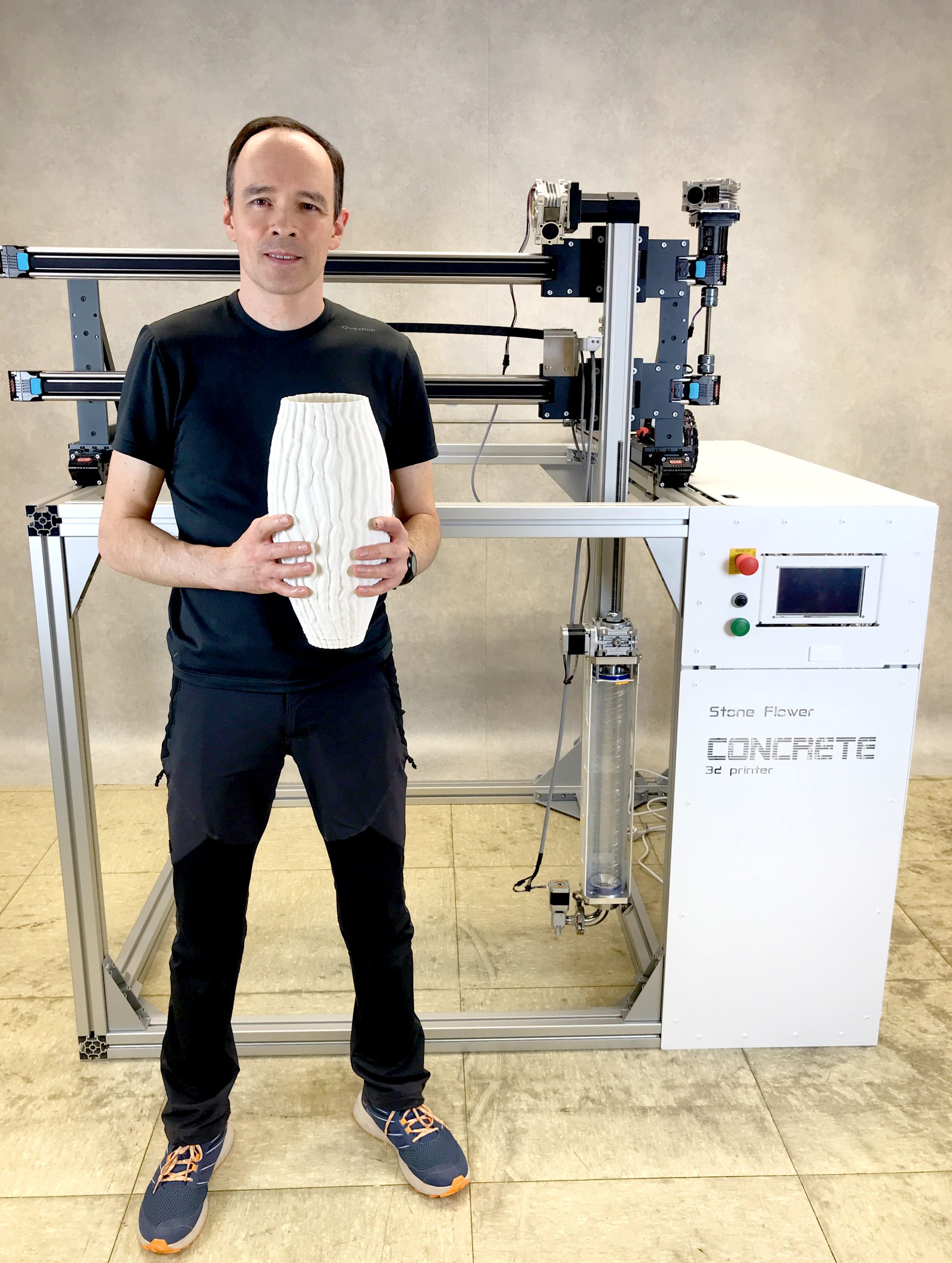
German ceramic 3D printing company Munich-basedStoneFlower3Dhas launched a laboratory-scale 3D printer aimed at researchers working with concrete, mortars, clays and other mineral-based materials.
The system handles both single-component and two-component formulations, with build volumes configured to order. Printable dimensions range from 50 cm to 300 cm across different axes, depending on the setup.
Materials that can be processed include concrete mixtures, mortars with aggregates up to 6 mm, fiber-reinforced concrete or clays containing fibers up to 30 mm in length, as well as foamed concrete, porcelain, earth and biomaterials. The system works with digitally controlled continuous mortar or plaster pumps alongside smaller piston extruders.
The mixing print head can process one or two rapidly curing components, such as cement combined with an accelerator. Material flow can reach 3 liters per minute, with printing speeds up to 150 mm per second.
Industrial reliability in the lab
The mechanical framework includes hardened stainless steel linear guides, CCM belt drives and Duet 6HC electronics. Operators can control the system through a 7-inch color touchscreen or remotely via web interface. It runs on standard Marlin or Repetier-type G-code and integrates with common slicing software including Cura, Simplify3D, Repetier, Slic3R, SuperSlicer and PrusaSlicer. Each installation ships with Cura and a configuration file.
For material delivery, users can opt for an automated concrete pump that handles flow rates up to 10 liters per minute and pressures reaching 40 bar while accommodating aggregates up to 6 mm. A 5-liter ram extruder is also available for integration. For applications requiring steady material transport, there’s a continuous mortar pump using a progressive cavity unit.
The system is intended for research, prototyping and small-series production rather than structural certification or full-scale construction deployment.
Most laboratory-scale concrete printing systems face material and pressure constraints that limit how well experiments translate to construction conditions. Research platforms often use reduced aggregate sizes or low-pressure extrusion methods that differ significantly from on-site pumping environments. These differences can affect how formulations perform once they’re scaled beyond the lab.
This platform takes a different approach. By accommodating aggregates up to 6 mm and working with pumping systems rated to 40 bar, it allows researchers to test cementitious and mineral formulations under conditions closer to actual field workflows, while staying within a controlled laboratory setting.
Source: 3D Printing Industry
