People routinely search for little bits of personal history in yearbooks, but Roslyn High School graduate Michael Seinhauer in late January found a piece of national history hidden in one of his.
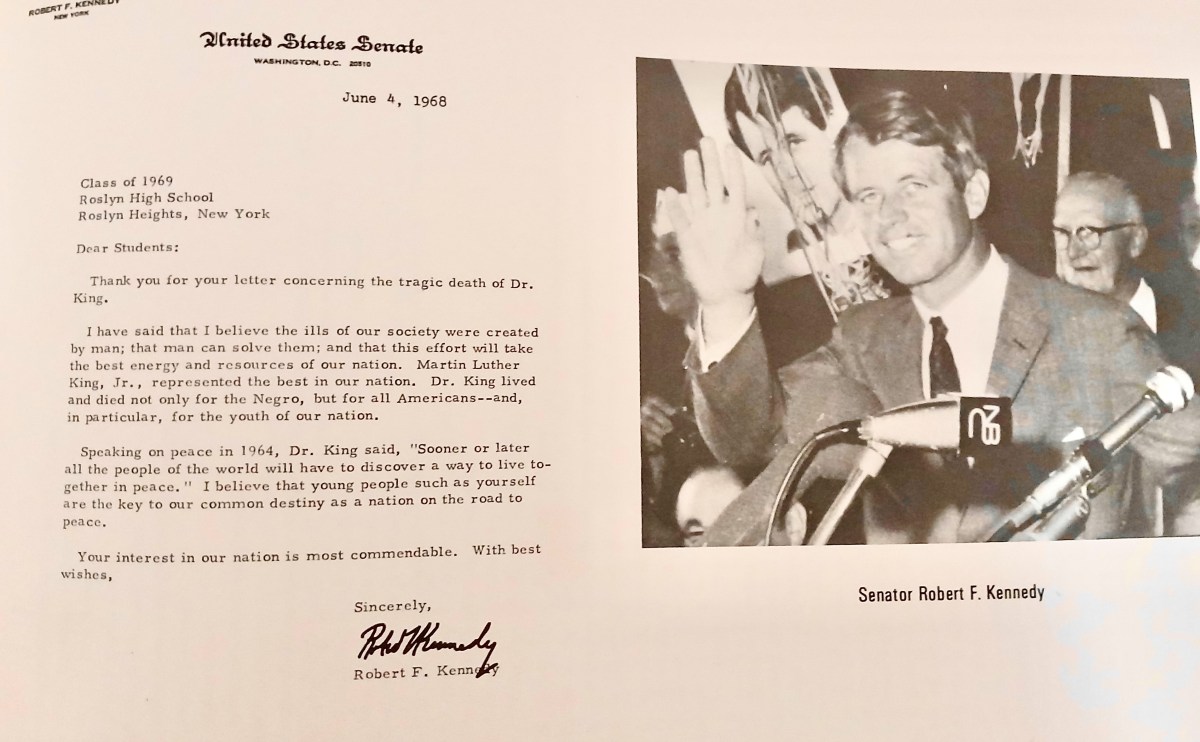
He found black-and-white pictures of Robert F. Kennedy Sr. and Martin Luther King in his 1969 freshman high school yearbook, known as the Harbor Hill Light, honoring two historic figures who had lost their lives the prior year.
“I could understand why they were in the book of 1969,” Steinhauer said of the recent find. “I knew they were both assassinated within two months of each other in 1968, Martin Luther King in April and RFK in June.”
He read a letter RFK wrote to the students, reproduced in the yearbook, thanking them for writing him after MLK’s assassination. Then Steinhauer noticed the letter’s date, June 4, 1968.
RFK wrote it one day before being shot and two days before he died, making it one of the last things he wrote and signed on U.S. Senate stationery, including his thoughts.
“Forty-eight hours later Robert F. Kennedy died,” Steinhauer said of his death following the June 5 shooting. “It’s addressed to the class of 1969, Roslyn High School.”
The letter conveys pervasive optimism and a belief in the promise of youth, as well as reflections on MLK. In addition to becoming a comment on MLK’s assassination,it now indirectly is a comment from beyond the grave on his own.
“The purpose of a yearbook is to record events of our high school years that have influenced our lives,” the editors wrote in the yearbook. “The editors feel they could not accomplish this purpose without trying to give honor to two men who in life and death have had a profound effect upon us.”
RFK thanked the students for writing a letter “surrounding the tragic death of Dr. King,” noting “I believe the ills of our society were created by man,” and that “man can solve them and that this effort will take the best energy and resources of our nation.”
“Martin Luther King Jr. represented the best of our nation,” RFK wrote. “Dr. King lived and died not only for the Negro, but for all Americans and in particular for the youth of our nation.”
Source: LI Press