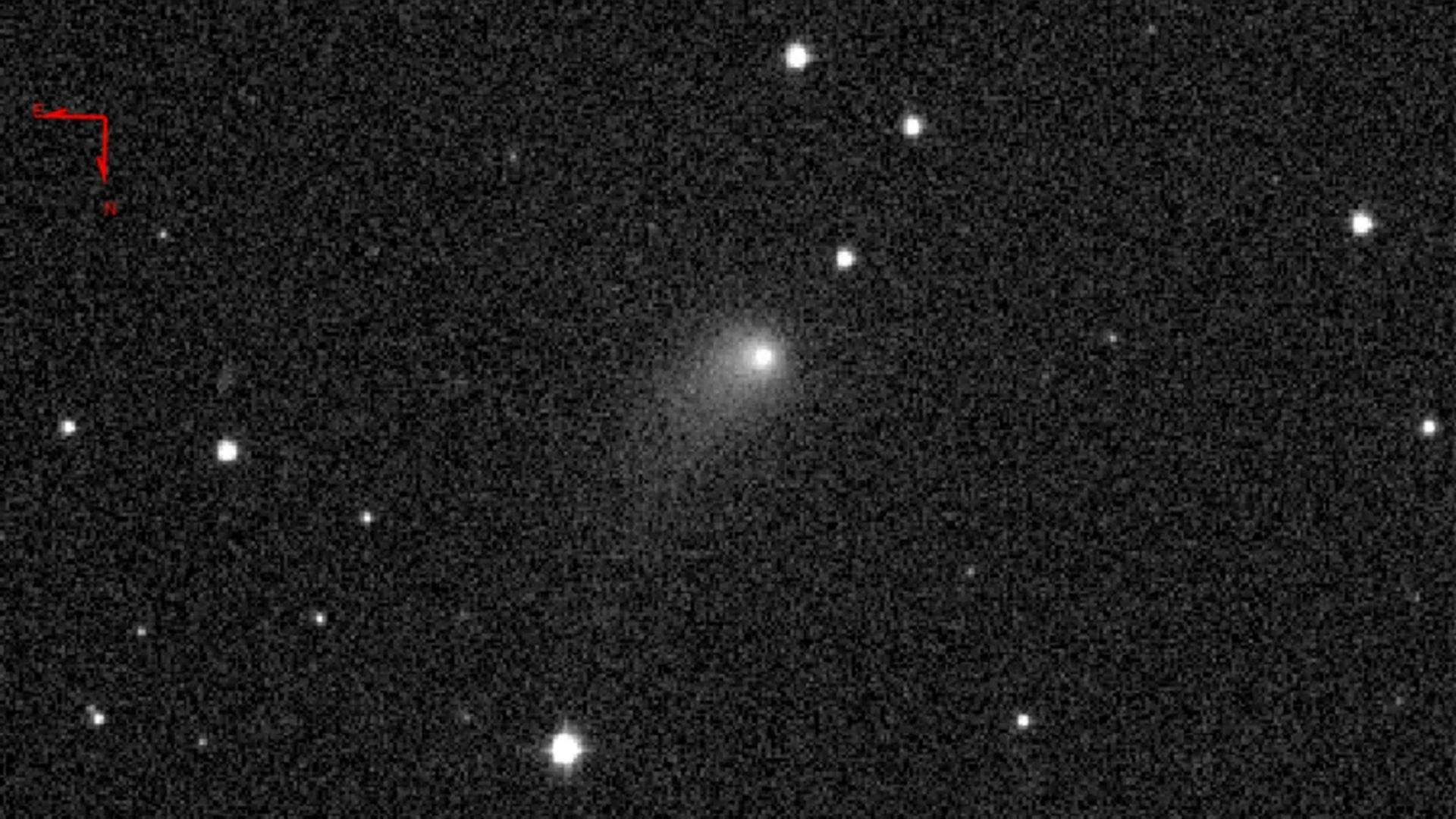
If you walk outside tonight, look up and expect to see a green streak across the sky, you're going to see nothing. The comet is around magnitude +7, which means it is roughly five times too faint for the human eye under even the darkest skies in Britain. You need binoculars at minimum; a small telescope is better. And if you're in the northern hemisphere you'll be squinting at something low above the south-western horizon, in the constellation Sculptor, which half the population couldn't find with a star chart and a compass. From the southern hemisphere it's higher and easier, but still not naked-eye.
Here is what the comet actually is, and why it's worth caring about despite the fact that most people reading this will never see it: a lump of four-and-a-half-billion-year-old ice, somewhere between two and 10 kilometres across, that has been falling toward the Sun for up to three million years. Tonight C/2024 E1 passes Earth at roughly 151 million kilometres — about the same distance as the Sun — and then it leaves. Not on another orbit. It leaves the solar system entirely, over the coming decades or centuries, and drifts off into interstellar space. It is not coming back.
TheLive Sciencearticle by Harry Baker mentioned the comet was discovered in March 2024 and has a green glow. Fine. What it did not mention, at all, is that the James Webb Space Telescope (JWST) observed this comet in June 2024 andthatthe results were published in a peer-reviewed paper in Monthly Notices of the Royal Astronomical Society Letters.
Kacper Wierzchoś — a Polish astronomer working with a 1.5-metre Cassegrain telescope at Mount Lemmon in Arizona — first spotted the comet (C/2024 E1) on 3 March 2024 in four 30-second exposure images. At the time it was magnitude 20.4. Absurdly faint. Over a billion kilometres from the Sun. JWST caught it at 7 AU out, roughly Jupiter's distance.
The spectrometer found the comet was venting carbon dioxide. Not carbon monoxide. That distinction matters more than it might sound: CO is more volatile than CO₂, so if anything should have been detected first, it was CO. The researchers think the comet lost its near-surface carbon monoxide early in its life, before something — probably a gravitational interaction with one of the giant planets — flung it out to the Oort Cloud. It has been sitting there, frozen, for billions of years. The missing CO is a clue about what happened to it before it went into cold storage; it may have spent time closer to the Sun than expected, in the chaotic early period when the planets were still jostling for position.
That's the science. That's why professional astronomers care about a magnitude-7 smudge most people will never see through a telescope they do not own.
The initial JWST estimate was 13.7 kilometres. A follow-up study, not yet peer-reviewed, revised that down to between two and 10 kilometres based on how much CO₂ it was producing. So it might be the size of a city, or it might be the size of a large village, or it might be somewhere in between.
Green is one of the most common colours comets display when they get close enough to the Sun for diatomic carbon — C₂ molecules — to fluoresce under ultraviolet radiation. 3I/ATLAS went green. Comet Lemmon went green. Comet Lovejoy went green. It is not rare; it is chemistry. The activity driving this comet's coma is CO₂ sublimation, confirmed by JWST. The green glow comes from a different mechanism entirely. Lumping them together as 'carbon' is technically not wrong in the same way that describing both a diamond and a pencil as 'carbon' is technically not wrong. It just isn't very helpful.
Now 3I/ATLAS comparison. C/2024 E1 as 3I/ATLAS's replacement. Both green. Both leaving. Both once-in-a-lifetime. Emotionally, the comparison works. Scientifically it does not. 3I/ATLAS was born around another star, possibly billions of years before our Sun existed. It was a genuine interstellar object.
C/2024 E1, also named Wierzchoś, which is ours. It formed in the same disc of gas and dust that made everything else in the solar system, got scattered to the Oort Cloud, sat there for aeons, and is now passing through on its way out. After the gravitational kick from this solar flyby, it'll eventually drift into interstellar space and become, technically, an interstellar object. But it won't be a visitor from another system.
Source: International Business Times UK
