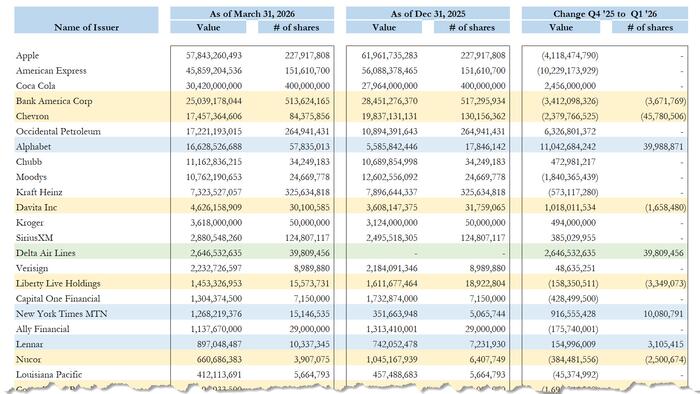
Friday was the 15th of the month 45 days after quarter end, which means we got a flood of 13F reports indicating what asset managers were long as of March 31. We will do a summary recap below of all the biggest names, but as usualwe start with Berkshiredue to its traditional lack of turnover and corresponding price impact of the stock of new positions or liquidations. And we should underline "traditional" because in Berkshire's first full quarter under Warren Buffett replacement Greg Abel, who took the reins at Berkshire this year after Buffett stepped down following six decades at the helm,the new CEO took a machete to no less than 14 existing position which he dumped unceremoniously.
But first, let's look at the additions of which there were two:one big oneand amuch smaller one.
Starting with the former,Berkshire unveiled a new $2.6 billion stake in Delta Airlines, reigniting the conglomerate’s complicated relationship with the airline industry. The Omaha-based hedge fund-cum-conglomerate said it had purchased 39.8 million shares in the airline as of the end of March, according to its latest 13F. The move - which amounted to a 6.1% stake - sent shares of the carrier up more than 3% in late trading.
It's not the first time Berkshire has been involved with the name: Under the recently departed former CEO Warren Buffett, Berkshire had a tense relationship with the airline industry over the decades. After a troublesome investment in USAir, Buffett once joked in 2001 that he would call an 800 number to declare he was an “air-o-holic” if he ever got the urge to invest in airlines again. Then in 2016, Berkshire dove into the industry again, amassing stakes in the four largest U.S. airlines. But Buffett reversed course again in 2020, when he exited his airline holdings in Delta, Southwest, American Airlines and United as the sector was grappling with the fallout from the Covid-19 pandemic. Fast forward 6 years and the company is once again building up a stake in airlines, only at much higher prices.
Berkshire also revealed it has amassed asmall stake in retailer Macy’s.A stronger-than-expected sales outlook had boosted Macy’s stock earlier this year. Shares of the department store operator jumped more than 6% in late trading on Friday in response to the Berkshire filing.
During the quarter, Berkshire also boosted its holding in star AI performer Alphabet, adding 36.4 million shares in Google’s parent company. Berkshire also added modestly to its stake in Lennar.
But while Abel added to Google,it dumped all its holdings of Amazon.com, some 2.276 million shares as of Dec 31, 2025.
There was much more: Berkshire also exited its sizable positions in credit card companies Visa and Mastercard (combined over $5 billion as of Dec 31), and liquidated holdings in UnitedHealth Group, which proved to be a brief flirt for the conglomerate; UnitedHealth had been trying to rebuild confidence with investors after struggling to adapt to changing US government payment policies. The stock dropped roughly 2.5% in post-market trading on Friday. Berkshire also sold out all its holdings in Diageo plc, Pool Corp, Charter Communications, Domino’s Pizza, Heico, Lamar Advertising, Allegion, AON, and Liberty Latin America.
Why the mass dump? According to the WSJ, Abel offloaded all the equity holdings that were previously managed by Todd Combs, Berkshire’s former stock-picker. Combs left Berkshire and joined JPMorgan in December for a broad investing advisory role.
Finally, Berkshire reduced its holdings in Bank of America, Chevron, Davita, Liberty Live Holdings, Nucor and Constellation Brands. The full breakdown of Berkshire's 13F is in the table below.
Source: ZeroHedge News
