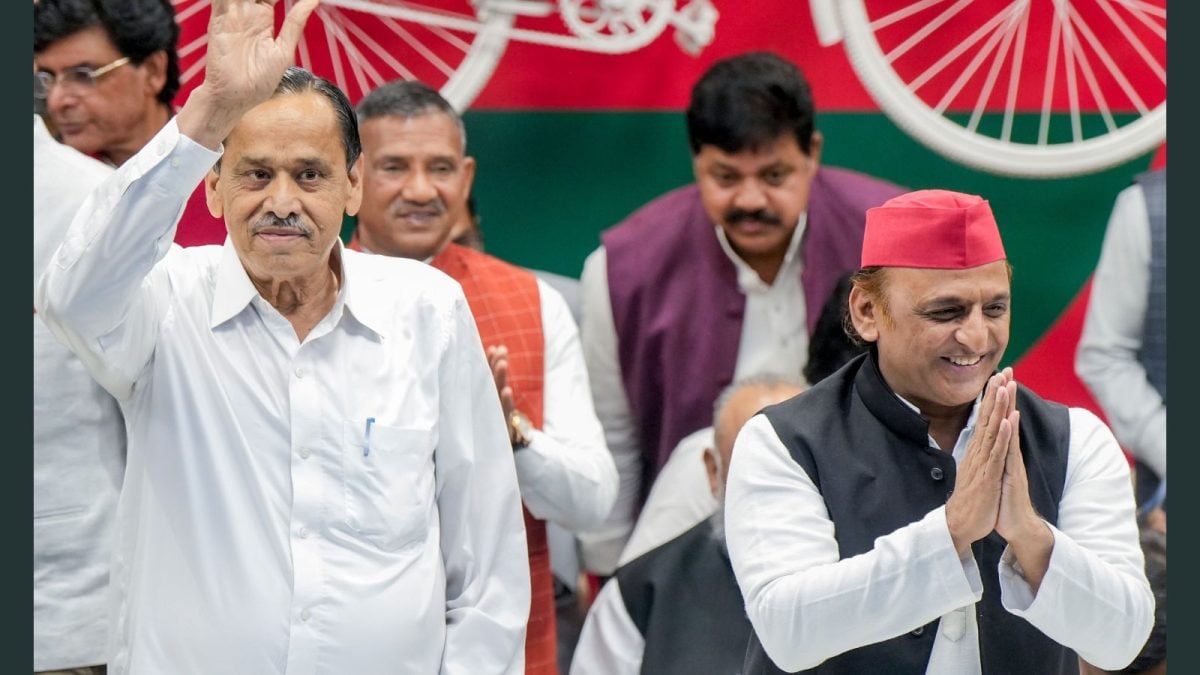
Will the entry of a seasoned Muslim face like Nasimuddin Siddiqui into the Samajwadi Party reshape the political arithmetic of Uttar Pradesh ahead of the 2027 Assembly elections?
“We have to aim at the bird’s eye. The goal is clear — change the government in 2027 and makeAkhilesh Yadavthe Chief Minister," said Naseemuddin Siddiqui, shortly after joining the Samajwadi Party in Lucknow — a move widely seen as a significant development in Uttar Pradesh politics ahead of the 2027 Assembly elections.
Inducted into the party in the presence of SP chief Akhilesh Yadav, Siddiqui was accompanied by over 15,000 supporters, many believed to be former workers of the Bahujan Samaj Party (BSP). Political observers say his entry could help the SP consolidate Muslim voters while denting the BSP’s traditional cadre base across western Uttar Pradesh and Bundelkhand.
In an interaction with News18, Siddiqui said his immediate focus would be strengthening the organisation at the grassroots. “The coming months are crucial. I will travel extensively and ensure that the message of inclusive politics reaches every booth," he said.
Nasimuddin Siddiqui’s journey in Uttar Pradesh politics has been long and eventful. Born on June 4, 1959, he did not come from a political family. In his early years, he briefly served in the Army but had to leave due to his mother’s illness. Thereafter, he became active as a railway contractor — a profession that marked the beginning of his public life.
Around 1990, Siddiqui came into contact with BSP founder Kanshi Ram, a meeting that would alter the course of his career. He had formally joined the BSP in 1984 and began his political journey through municipal elections. In 1991, he was elected as an MLA from the Banda Assembly seat, becoming one of the BSP’s earliest and most prominent Muslim legislators.
Over time, he emerged as a key organisational figure within the BSP.
pic.twitter.com/pCFnGOjYJf— Akhilesh Yadav (@yadavakhilesh)February 15, 2026
Political analysts believe Siddiqui’s return to a regional power centre could have ripple effects. A Lucknow-based political expert Shashikant Pandey, head, department of political science, Dr Bhimrao Ambedkar University, said, “Naseemuddin Siddiqui is not just a symbolic Muslim face. He brings decades of booth-level organisational experience, especially in Bundelkhand and parts of western Uttar Pradesh. His influence among former BSP workers could help the Samajwadi Party penetrate pockets where it has historically struggled. While he may not single-handedly shift vote banks, in a closely contested election, even a 2–3% swing in specific constituencies can alter outcomes."
Pandey said that Siddiqui’s entry also sends a psychological message to the cadre. “It signals that the Samajwadi Party is serious about expanding its social coalition beyond its traditional Yadav-Muslim base. Bringing in a leader who once managed the BSP’s electoral machinery adds both experience and perception of strength."
Source: Politics News in news18.com, Politics Latest News, Politics News
