Days after the U.S. bombing campaign against Iran began, we pointed out on March 3 that the conflict was likely to accelerate a major Gulf infrastructure push tobypass the Strait of Hormuz. Saudi Arabia'sEast-West pipelineto the Red Sea stood out as the clearest signal thatregional producers needed a credible Plan Bfor moving crude and crude products when the Hormuz chokepoint becomes disrupted. That logic is now coming into sharper focus for the UAE.
Surprising Fujairah is not a bigger oil terminal: it bypasses the straits completely.Expect major infrastructure push here after the war.https://t.co/Do1gK7KBDQ
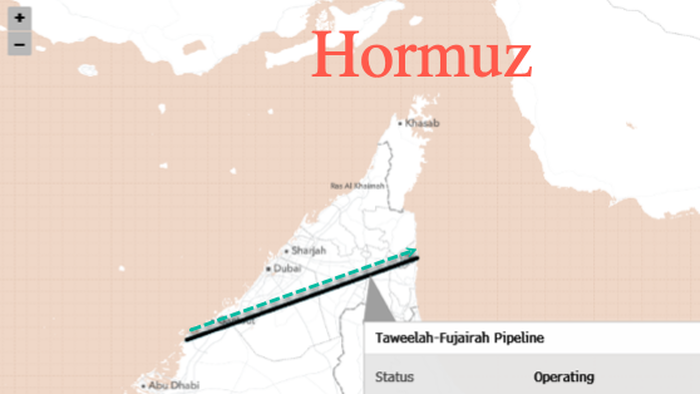
Abu Dhabi National Oil Co.(ADNOC) is the UAE's state-owned energy giant and isset to double its crude-export capacitythat bypasses the Hormuz chokepoint next year with the construction of anew pipeline to Fujairah on the Gulf of Oman, according to a newBloomberg report.
The pipeline project wouldexpand an existing 1.5 million-barrel-a-day pipeline, which has become critical for ADNOC amid the ongoing Hormuz disruption. This allows the UAE to keep about half of its oil exports flowing to the world.
BREAKING: UAE discloses it’s building an additional second pipeline bypassing the Strait of Hormuz.The new pipeline will be finished in 2027 and will double the country’s export capacity in Fujairah (the current pipeline has a capacity of 1.5-1.8m b/d)pic.twitter.com/adsRgnDbjX
The current bottleneck for the UAE is that ADNOC's pipeline can handle only about half of its normal export volumes, limiting revenues and proving particularly troubling for the Gulf producer, whose oil-related activity accounted for 22.7% of GDP in Q1 2025.
The urgency to divert flows, or in fact rewire energy flows, will be a top priority for other Gulf producers because oil still matters heavily for public finances and their billionaires.
Perhaps Gulf producers received another memo after President Trump's comments on Air Force One earlier today, following his China trip, when he said the U.S. does not need to reopen the Hormuz chokepoint. The U.S. still has a naval blockade in place to pressure Iran's energy complex into collapse, with hopes that Tehran will sign a peace deal.
Source: ZeroHedge News
