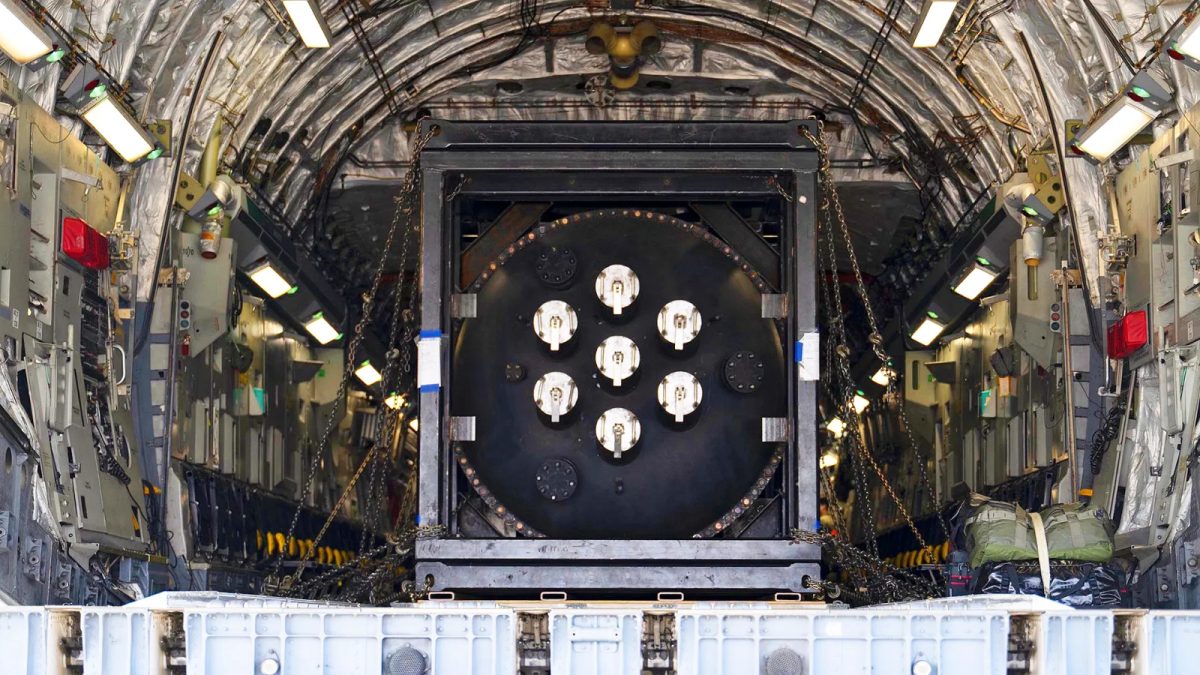
In a groundbreaking demonstration of mobile nuclear technology, the U.S. military executed Operation Windlord, transporting eight modules of the Ward 250 microreactor via three C-17 Globemaster planes from March Air Reserve Base in California to Hill Air Force Base in Utah. The reactor, constructed by California-based Valar Atomics, was shipped without nuclear fuel, underscoring that nuclear power plants are no longer fixed installations but can be relocated like cargo.
The Ward 250 microreactor is remarkably compact, comparable in size to a large van, yet designed to produce up to 5 megawatts of electricity at full capacity—sufficient to power approximately 5,000 homes. It will commence operations later this year at 100 kilowatts, scale to 250 kilowatts, and eventually reach its maximum output. Unlike traditional reactors, it employs TRISO fuel, where uranium kernels are encased in multiple layers of ceramic material, and uses helium for cooling rather than water, enhancing safety, resistance to damage, and the ability to operate at higher temperatures.
Valar Atomics aims to begin commercial power sales by 2027, marking a significant step toward market-ready microreactors. Meanwhile, the U.S. Department of Energy has set an ambitious target for at least three microreactors to achieve operational criticality by July 4th of this year.
The strategic value for the military lies in its grid independence. A microreactor can be deployed to remote locations such as desert bases, mountain ranges, or arctic outposts, generating electricity for years without refueling convoys or reliance on civilian power infrastructure, addressing a longstanding logistical vulnerability for the Pentagon.
This capability holds particular relevance for nations with vast, challenging terrains like India. From the frozen heights of Siachen and Ladakh to the dense jungles of the northeast, the island chains of Andaman and Nicobar, and the tribal highlands of Chhattisgarh, India's military and civilian operations span some of the world's most difficult environments.
Powering these areas remains a persistent challenge. Extending grid infrastructure has proven difficult, with around 25,000 villages still experiencing unreliable electricity supply, and many remote corners entirely beyond the reach of the grid.
The successful airlift of the Ward 250 signals a paradigm shift in nuclear energy deployment, offering a model for energy security in isolated regions that countries like India, grappling with similar geographic hurdles, would do well to consider.