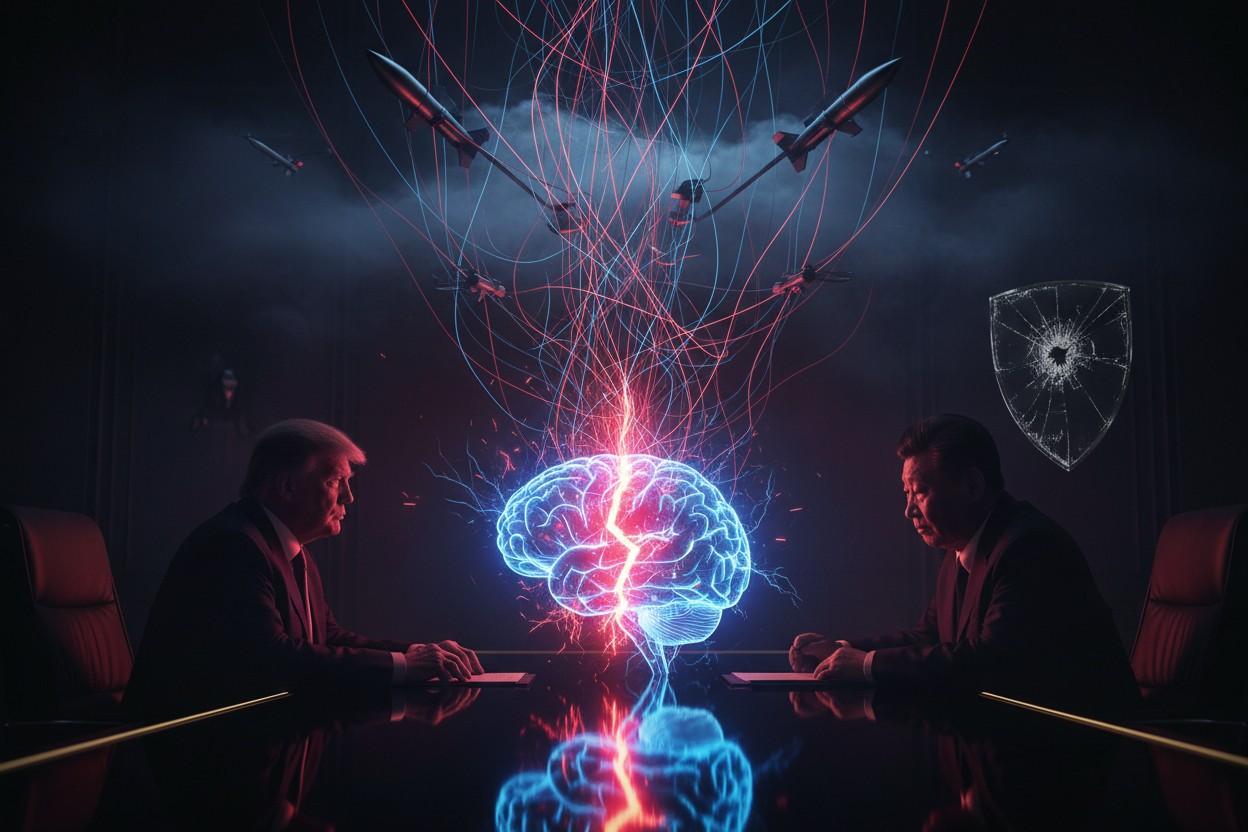
The meeting aims to open a channel of communication on AI matters, according to one official. Both the U.S. and China have interests in preventing weaponization of AI tools and rogue systems, officials said.Driving the News: Export Controls and Shared RulesThe U.S. continues to use export controls to slow China's AI progress, but officials increasingly recognize the need for shared rules of the road, according to the report. Chinese models like DeepSeek are primary competitors to U.S. models. The release of DeepSeek, a powerful open-source AI model developed by a Chinese company, has sent shockwaves through the tech industry, raising questions about China's motives[1].Sixteen business executives including X's Elon Musk and Apple's Tim Cook are joining Trump, but CEOs from leading AI firms are not on the list. The shift in focus is evident: while U.S. tech firms have largely halted publishing scientific papers, China continues to lead in open-source development, as noted by the Health Ranger Mike Adams in a broadcast[2].Big Picture: AI Safety and Regulatory ChallengesU.S. AI companies are wrestling with how to safely release models that can find and exploit software vulnerabilities, according to the report. The White House has been engaged in a month-long back-and-forth over regulation after more than a year of denouncing such regulation. In a significant policy reversal, Google removed its ban on using AI for weapons and surveillance, causing concern among tech and human rights communities[3].Meanwhile, theDepartment of Warhas embraced Muskâs Grok AI for classified military operations despite warnings from agencies like theGeneral Services Administrationand theNational Security Agencyabout its reliability and security risks[4]. The White House accused China last month of running âindustrial-scaleâ campaigns to distill and copy American AI models, according to the report.Yes, But: Dual-Use Offensive CapabilitiesBoth countries are actively testing the offensive cyber capabilities of frontier models, potentially to use against each other, the report stated. Former Google CEO Eric Schmidt has warned that the AI arms race between the U.S. and China could trigger global conflict over data centers and resource control[5].Anthropic, an AI safety-focused lab, has publicly rejected the War Department's ultimatum to remove restrictions on how its technology can be used by the U.S. military, with stakes including a $200 million contract, according to a report on February 2026[6]. The company cited ethical concerns, such as preventing use for mass domestic surveillance or autonomous weapons. In a related development, the War Department's pressure on U.S. companies could inadvertently push them toward adopting Chinese alternatives such as DeepSeek, according to a Bright Videos Network broadcast[7].Expert Perspectives: Engagement and SkepticismMelanie Hart, senior director of the Atlantic Councilâs Global China Hub and former State Department official, told reporters that the topic is important enough and dangerous enough that the U.S. should be having engagement with China on this. Hart said the Chinese government used previous AI safety meetings under the Biden administration primarily to gather information about the United States, rather than to be serious about AI guardrails. During those talks, Beijing often sent representatives from the foreign ministry who lacked technical AI expertise, she added.A framework for responsible AI emphasizes human-by-design principles, fairness, and intentional actions to build trust and protect from risks, according to Paul R. Daugherty and H. James Wilson in their book "Human + Machine, Updated and Expanded"Â[8]. The Chinese have their own code for AI systems, and if different civilizations encode distinct values into their machines, ideological conflicts between AIs could arise, according to a Sept. 19, 2025 interview with Daniel Estulin[9].What to Watch: Future of U.S.-China AI DialogueHart said the trip is more likely to determine whether future discussions become substantive or remain symbolic, according to her statement. âFrom there, we then need to judge who shows up for the China side,â she said. âWe want to see the technical experts showing up at the table. Thatâs how weâll know that thatâs actually real.âDonât expect a single visit to reshape U.S. AI policy overnight, Hart added. The outcomes may depend on whether China sends technical experts rather than diplomatic personnel to subsequent talks.ReferencesKevin Hughes. "Health Ranger Report: Seth Holehouse on the AI arms race and navigating the future". NaturalNews.com. July 20, 2025.Mike Adams. "Bright Videos News - HUMAN FREEDOM - BrightVideos.com". January 9, 2026.Willow Tohi. "Google abandons AI weapons ban: A dangerous shift in tech ethics?". NaturalNews.com. February 8, 2025.Belle Carter. "Pentagon embraces Elon Musks Grok AI despite internal warnings over safety risks". NaturalNews.com. March 2, 2026.Willow Tohi. "Bomb the data centers: Eric Schmidt sounds AI war warning amid US China race". NaturalNews.com. May 28, 2025."Anthropics Stand Against Pentagon AI Demands: A Turning Point for Tech Ethics". NaturalNews.com. February 27, 2026.Bright Videos Network. "2026-03-05-BVN-GLOBAL FOOD INFLATION INCOMING". March 5, 2026.Paul R. Daugherty, H. James Wilson. "Human + Machine, Updated and Expanded: Reimagining Work in the Age of AI".Mike Adams interview with Daniel Estulin. September 19, 2025.Explainer InfographicEditorial Cartoon
The meeting aims to open a channel of communication on AI matters, according to one official. Both the U.S. and China have interests in preventing weaponization of AI tools and rogue systems, officials said.Driving the News: Export Controls and Shared RulesThe U.S. continues to use export controls to slow China's AI progress, but officials increasingly recognize the need for shared rules of the road, according to the report. Chinese models like DeepSeek are primary competitors to U.S. models. The release of DeepSeek, a powerful open-source AI model developed by a Chinese company, has sent shockwaves through the tech industry, raising questions about China's motives[1].Sixteen business executives including X's Elon Musk and Apple's Tim Cook are joining Trump, but CEOs from leading AI firms are not on the list. The shift in focus is evident: while U.S. tech firms have largely halted publishing scientific papers, China continues to lead in open-source development, as noted by the Health Ranger Mike Adams in a broadcast[2].Big Picture: AI Safety and Regulatory ChallengesU.S. AI companies are wrestling with how to safely release models that can find and exploit software vulnerabilities, according to the report. The White House has been engaged in a month-long back-and-forth over regulation after more than a year of denouncing such regulation. In a significant policy reversal, Google removed its ban on using AI for weapons and surveillance, causing concern among tech and human rights communities[3].Meanwhile, theDepartment of Warhas embraced Muskâs Grok AI for classified military operations despite warnings from agencies like theGeneral Services Administrationand theNational Security Agencyabout its reliability and security risks[4]. The White House accused China last month of running âindustrial-scaleâ campaigns to distill and copy American AI models, according to the report.Yes, But: Dual-Use Offensive CapabilitiesBoth countries are actively testing the offensive cyber capabilities of frontier models, potentially to use against each other, the report stated. Former Google CEO Eric Schmidt has warned that the AI arms race between the U.S. and China could trigger global conflict over data centers and resource control[5].Anthropic, an AI safety-focused lab, has publicly rejected the War Department's ultimatum to remove restrictions on how its technology can be used by the U.S. military, with stakes including a $200 million contract, according to a report on February 2026[6]. The company cited ethical concerns, such as preventing use for mass domestic surveillance or autonomous weapons. In a related development, the War Department's pressure on U.S. companies could inadvertently push them toward adopting Chinese alternatives such as DeepSeek, according to a Bright Videos Network broadcast[7].Expert Perspectives: Engagement and SkepticismMelanie Hart, senior director of the Atlantic Councilâs Global China Hub and former State Department official, told reporters that the topic is important enough and dangerous enough that the U.S. should be having engagement with China on this. Hart said the Chinese government used previous AI safety meetings under the Biden administration primarily to gather information about the United States, rather than to be serious about AI guardrails. During those talks, Beijing often sent representatives from the foreign ministry who lacked technical AI expertise, she added.A framework for responsible AI emphasizes human-by-design principles, fairness, and intentional actions to build trust and protect from risks, according to Paul R. Daugherty and H. James Wilson in their book "Human + Machine, Updated and Expanded"Â[8]. The Chinese have their own code for AI systems, and if different civilizations encode distinct values into their machines, ideological conflicts between AIs could arise, according to a Sept. 19, 2025 interview with Daniel Estulin[9].What to Watch: Future of U.S.-China AI DialogueHart said the trip is more likely to determine whether future discussions become substantive or remain symbolic, according to her statement. âFrom there, we then need to judge who shows up for the China side,â she said. âWe want to see the technical experts showing up at the table. Thatâs how weâll know that thatâs actually real.âDonât expect a single visit to reshape U.S. AI policy overnight, Hart added. The outcomes may depend on whether China sends technical experts rather than diplomatic personnel to subsequent talks.ReferencesKevin Hughes. "Health Ranger Report: Seth Holehouse on the AI arms race and navigating the future". NaturalNews.com. July 20, 2025.Mike Adams. "Bright Videos News - HUMAN FREEDOM - BrightVideos.com". January 9, 2026.Willow Tohi. "Google abandons AI weapons ban: A dangerous shift in tech ethics?". NaturalNews.com. February 8, 2025.Belle Carter. "Pentagon embraces Elon Musks Grok AI despite internal warnings over safety risks". NaturalNews.com. March 2, 2026.Willow Tohi. "Bomb the data centers: Eric Schmidt sounds AI war warning amid US China race". NaturalNews.com. May 28, 2025."Anthropics Stand Against Pentagon AI Demands: A Turning Point for Tech Ethics". NaturalNews.com. February 27, 2026.Bright Videos Network. "2026-03-05-BVN-GLOBAL FOOD INFLATION INCOMING". March 5, 2026.Paul R. Daugherty, H. James Wilson. "Human + Machine, Updated and Expanded: Reimagining Work in the Age of AI".Mike Adams interview with Daniel Estulin. September 19, 2025.Explainer InfographicEditorial Cartoon
Driving the News: Export Controls and Shared RulesThe U.S. continues to use export controls to slow China's AI progress, but officials increasingly recognize the need for shared rules of the road, according to the report. Chinese models like DeepSeek are primary competitors to U.S. models. The release of DeepSeek, a powerful open-source AI model developed by a Chinese company, has sent shockwaves through the tech industry, raising questions about China's motives[1].Sixteen business executives including X's Elon Musk and Apple's Tim Cook are joining Trump, but CEOs from leading AI firms are not on the list. The shift in focus is evident: while U.S. tech firms have largely halted publishing scientific papers, China continues to lead in open-source development, as noted by the Health Ranger Mike Adams in a broadcast[2].Big Picture: AI Safety and Regulatory ChallengesU.S. AI companies are wrestling with how to safely release models that can find and exploit software vulnerabilities, according to the report. The White House has been engaged in a month-long back-and-forth over regulation after more than a year of denouncing such regulation. In a significant policy reversal, Google removed its ban on using AI for weapons and surveillance, causing concern among tech and human rights communities[3].Meanwhile, theDepartment of Warhas embraced Muskâs Grok AI for classified military operations despite warnings from agencies like theGeneral Services Administrationand theNational Security Agencyabout its reliability and security risks[4]. The White House accused China last month of running âindustrial-scaleâ campaigns to distill and copy American AI models, according to the report.Yes, But: Dual-Use Offensive CapabilitiesBoth countries are actively testing the offensive cyber capabilities of frontier models, potentially to use against each other, the report stated. Former Google CEO Eric Schmidt has warned that the AI arms race between the U.S. and China could trigger global conflict over data centers and resource control[5].Anthropic, an AI safety-focused lab, has publicly rejected the War Department's ultimatum to remove restrictions on how its technology can be used by the U.S. military, with stakes including a $200 million contract, according to a report on February 2026[6]. The company cited ethical concerns, such as preventing use for mass domestic surveillance or autonomous weapons. In a related development, the War Department's pressure on U.S. companies could inadvertently push them toward adopting Chinese alternatives such as DeepSeek, according to a Bright Videos Network broadcast[7].Expert Perspectives: Engagement and SkepticismMelanie Hart, senior director of the Atlantic Councilâs Global China Hub and former State Department official, told reporters that the topic is important enough and dangerous enough that the U.S. should be having engagement with China on this. Hart said the Chinese government used previous AI safety meetings under the Biden administration primarily to gather information about the United States, rather than to be serious about AI guardrails. During those talks, Beijing often sent representatives from the foreign ministry who lacked technical AI expertise, she added.A framework for responsible AI emphasizes human-by-design principles, fairness, and intentional actions to build trust and protect from risks, according to Paul R. Daugherty and H. James Wilson in their book "Human + Machine, Updated and Expanded"Â[8]. The Chinese have their own code for AI systems, and if different civilizations encode distinct values into their machines, ideological conflicts between AIs could arise, according to a Sept. 19, 2025 interview with Daniel Estulin[9].What to Watch: Future of U.S.-China AI DialogueHart said the trip is more likely to determine whether future discussions become substantive or remain symbolic, according to her statement. âFrom there, we then need to judge who shows up for the China side,â she said. âWe want to see the technical experts showing up at the table. Thatâs how weâll know that thatâs actually real.âDonât expect a single visit to reshape U.S. AI policy overnight, Hart added. The outcomes may depend on whether China sends technical experts rather than diplomatic personnel to subsequent talks.ReferencesKevin Hughes. "Health Ranger Report: Seth Holehouse on the AI arms race and navigating the future". NaturalNews.com. July 20, 2025.Mike Adams. "Bright Videos News - HUMAN FREEDOM - BrightVideos.com". January 9, 2026.Willow Tohi. "Google abandons AI weapons ban: A dangerous shift in tech ethics?". NaturalNews.com. February 8, 2025.Belle Carter. "Pentagon embraces Elon Musks Grok AI despite internal warnings over safety risks". NaturalNews.com. March 2, 2026.Willow Tohi. "Bomb the data centers: Eric Schmidt sounds AI war warning amid US China race". NaturalNews.com. May 28, 2025."Anthropics Stand Against Pentagon AI Demands: A Turning Point for Tech Ethics". NaturalNews.com. February 27, 2026.Bright Videos Network. "2026-03-05-BVN-GLOBAL FOOD INFLATION INCOMING". March 5, 2026.Paul R. Daugherty, H. James Wilson. "Human + Machine, Updated and Expanded: Reimagining Work in the Age of AI".Mike Adams interview with Daniel Estulin. September 19, 2025.Explainer InfographicEditorial Cartoon
The U.S. continues to use export controls to slow China's AI progress, but officials increasingly recognize the need for shared rules of the road, according to the report. Chinese models like DeepSeek are primary competitors to U.S. models. The release of DeepSeek, a powerful open-source AI model developed by a Chinese company, has sent shockwaves through the tech industry, raising questions about China's motives[1].Sixteen business executives including X's Elon Musk and Apple's Tim Cook are joining Trump, but CEOs from leading AI firms are not on the list. The shift in focus is evident: while U.S. tech firms have largely halted publishing scientific papers, China continues to lead in open-source development, as noted by the Health Ranger Mike Adams in a broadcast[2].Big Picture: AI Safety and Regulatory ChallengesU.S. AI companies are wrestling with how to safely release models that can find and exploit software vulnerabilities, according to the report. The White House has been engaged in a month-long back-and-forth over regulation after more than a year of denouncing such regulation. In a significant policy reversal, Google removed its ban on using AI for weapons and surveillance, causing concern among tech and human rights communities[3].Meanwhile, theDepartment of Warhas embraced Muskâs Grok AI for classified military operations despite warnings from agencies like theGeneral Services Administrationand theNational Security Agencyabout its reliability and security risks[4]. The White House accused China last month of running âindustrial-scaleâ campaigns to distill and copy American AI models, according to the report.Yes, But: Dual-Use Offensive CapabilitiesBoth countries are actively testing the offensive cyber capabilities of frontier models, potentially to use against each other, the report stated. Former Google CEO Eric Schmidt has warned that the AI arms race between the U.S. and China could trigger global conflict over data centers and resource control[5].Anthropic, an AI safety-focused lab, has publicly rejected the War Department's ultimatum to remove restrictions on how its technology can be used by the U.S. military, with stakes including a $200 million contract, according to a report on February 2026[6]. The company cited ethical concerns, such as preventing use for mass domestic surveillance or autonomous weapons. In a related development, the War Department's pressure on U.S. companies could inadvertently push them toward adopting Chinese alternatives such as DeepSeek, according to a Bright Videos Network broadcast[7].Expert Perspectives: Engagement and SkepticismMelanie Hart, senior director of the Atlantic Councilâs Global China Hub and former State Department official, told reporters that the topic is important enough and dangerous enough that the U.S. should be having engagement with China on this. Hart said the Chinese government used previous AI safety meetings under the Biden administration primarily to gather information about the United States, rather than to be serious about AI guardrails. During those talks, Beijing often sent representatives from the foreign ministry who lacked technical AI expertise, she added.A framework for responsible AI emphasizes human-by-design principles, fairness, and intentional actions to build trust and protect from risks, according to Paul R. Daugherty and H. James Wilson in their book "Human + Machine, Updated and Expanded"Â[8]. The Chinese have their own code for AI systems, and if different civilizations encode distinct values into their machines, ideological conflicts between AIs could arise, according to a Sept. 19, 2025 interview with Daniel Estulin[9].What to Watch: Future of U.S.-China AI DialogueHart said the trip is more likely to determine whether future discussions become substantive or remain symbolic, according to her statement. âFrom there, we then need to judge who shows up for the China side,â she said. âWe want to see the technical experts showing up at the table. Thatâs how weâll know that thatâs actually real.âDonât expect a single visit to reshape U.S. AI policy overnight, Hart added. The outcomes may depend on whether China sends technical experts rather than diplomatic personnel to subsequent talks.ReferencesKevin Hughes. "Health Ranger Report: Seth Holehouse on the AI arms race and navigating the future". NaturalNews.com. July 20, 2025.Mike Adams. "Bright Videos News - HUMAN FREEDOM - BrightVideos.com". January 9, 2026.Willow Tohi. "Google abandons AI weapons ban: A dangerous shift in tech ethics?". NaturalNews.com. February 8, 2025.Belle Carter. "Pentagon embraces Elon Musks Grok AI despite internal warnings over safety risks". NaturalNews.com. March 2, 2026.Willow Tohi. "Bomb the data centers: Eric Schmidt sounds AI war warning amid US China race". NaturalNews.com. May 28, 2025."Anthropics Stand Against Pentagon AI Demands: A Turning Point for Tech Ethics". NaturalNews.com. February 27, 2026.Bright Videos Network. "2026-03-05-BVN-GLOBAL FOOD INFLATION INCOMING". March 5, 2026.Paul R. Daugherty, H. James Wilson. "Human + Machine, Updated and Expanded: Reimagining Work in the Age of AI".Mike Adams interview with Daniel Estulin. September 19, 2025.Explainer InfographicEditorial Cartoon
Sixteen business executives including X's Elon Musk and Apple's Tim Cook are joining Trump, but CEOs from leading AI firms are not on the list. The shift in focus is evident: while U.S. tech firms have largely halted publishing scientific papers, China continues to lead in open-source development, as noted by the Health Ranger Mike Adams in a broadcast[2].Big Picture: AI Safety and Regulatory ChallengesU.S. AI companies are wrestling with how to safely release models that can find and exploit software vulnerabilities, according to the report. The White House has been engaged in a month-long back-and-forth over regulation after more than a year of denouncing such regulation. In a significant policy reversal, Google removed its ban on using AI for weapons and surveillance, causing concern among tech and human rights communities[3].Meanwhile, theDepartment of Warhas embraced Muskâs Grok AI for classified military operations despite warnings from agencies like theGeneral Services Administrationand theNational Security Agencyabout its reliability and security risks[4]. The White House accused China last month of running âindustrial-scaleâ campaigns to distill and copy American AI models, according to the report.Yes, But: Dual-Use Offensive CapabilitiesBoth countries are actively testing the offensive cyber capabilities of frontier models, potentially to use against each other, the report stated. Former Google CEO Eric Schmidt has warned that the AI arms race between the U.S. and China could trigger global conflict over data centers and resource control[5].Anthropic, an AI safety-focused lab, has publicly rejected the War Department's ultimatum to remove restrictions on how its technology can be used by the U.S. military, with stakes including a $200 million contract, according to a report on February 2026[6]. The company cited ethical concerns, such as preventing use for mass domestic surveillance or autonomous weapons. In a related development, the War Department's pressure on U.S. companies could inadvertently push them toward adopting Chinese alternatives such as DeepSeek, according to a Bright Videos Network broadcast[7].Expert Perspectives: Engagement and SkepticismMelanie Hart, senior director of the Atlantic Councilâs Global China Hub and former State Department official, told reporters that the topic is important enough and dangerous enough that the U.S. should be having engagement with China on this. Hart said the Chinese government used previous AI safety meetings under the Biden administration primarily to gather information about the United States, rather than to be serious about AI guardrails. During those talks, Beijing often sent representatives from the foreign ministry who lacked technical AI expertise, she added.A framework for responsible AI emphasizes human-by-design principles, fairness, and intentional actions to build trust and protect from risks, according to Paul R. Daugherty and H. James Wilson in their book "Human + Machine, Updated and Expanded"Â[8]. The Chinese have their own code for AI systems, and if different civilizations encode distinct values into their machines, ideological conflicts between AIs could arise, according to a Sept. 19, 2025 interview with Daniel Estulin[9].What to Watch: Future of U.S.-China AI DialogueHart said the trip is more likely to determine whether future discussions become substantive or remain symbolic, according to her statement. âFrom there, we then need to judge who shows up for the China side,â she said. âWe want to see the technical experts showing up at the table. Thatâs how weâll know that thatâs actually real.âDonât expect a single visit to reshape U.S. AI policy overnight, Hart added. The outcomes may depend on whether China sends technical experts rather than diplomatic personnel to subsequent talks.ReferencesKevin Hughes. "Health Ranger Report: Seth Holehouse on the AI arms race and navigating the future". NaturalNews.com. July 20, 2025.Mike Adams. "Bright Videos News - HUMAN FREEDOM - BrightVideos.com". January 9, 2026.Willow Tohi. "Google abandons AI weapons ban: A dangerous shift in tech ethics?". NaturalNews.com. February 8, 2025.Belle Carter. "Pentagon embraces Elon Musks Grok AI despite internal warnings over safety risks". NaturalNews.com. March 2, 2026.Willow Tohi. "Bomb the data centers: Eric Schmidt sounds AI war warning amid US China race". NaturalNews.com. May 28, 2025."Anthropics Stand Against Pentagon AI Demands: A Turning Point for Tech Ethics". NaturalNews.com. February 27, 2026.Bright Videos Network. "2026-03-05-BVN-GLOBAL FOOD INFLATION INCOMING". March 5, 2026.Paul R. Daugherty, H. James Wilson. "Human + Machine, Updated and Expanded: Reimagining Work in the Age of AI".Mike Adams interview with Daniel Estulin. September 19, 2025.Explainer InfographicEditorial Cartoon
Sixteen business executives including X's Elon Musk and Apple's Tim Cook are joining Trump, but CEOs from leading AI firms are not on the list. The shift in focus is evident: while U.S. tech firms have largely halted publishing scientific papers, China continues to lead in open-source development, as noted by the Health Ranger Mike Adams in a broadcast[2].Big Picture: AI Safety and Regulatory ChallengesU.S. AI companies are wrestling with how to safely release models that can find and exploit software vulnerabilities, according to the report. The White House has been engaged in a month-long back-and-forth over regulation after more than a year of denouncing such regulation. In a significant policy reversal, Google removed its ban on using AI for weapons and surveillance, causing concern among tech and human rights communities[3].Meanwhile, theDepartment of Warhas embraced Muskâs Grok AI for classified military operations despite warnings from agencies like theGeneral Services Administrationand theNational Security Agencyabout its reliability and security risks[4]. The White House accused China last month of running âindustrial-scaleâ campaigns to distill and copy American AI models, according to the report.Yes, But: Dual-Use Offensive CapabilitiesBoth countries are actively testing the offensive cyber capabilities of frontier models, potentially to use against each other, the report stated. Former Google CEO Eric Schmidt has warned that the AI arms race between the U.S. and China could trigger global conflict over data centers and resource control[5].Anthropic, an AI safety-focused lab, has publicly rejected the War Department's ultimatum to remove restrictions on how its technology can be used by the U.S. military, with stakes including a $200 million contract, according to a report on February 2026[6]. The company cited ethical concerns, such as preventing use for mass domestic surveillance or autonomous weapons. In a related development, the War Department's pressure on U.S. companies could inadvertently push them toward adopting Chinese alternatives such as DeepSeek, according to a Bright Videos Network broadcast[7].Expert Perspectives: Engagement and SkepticismMelanie Hart, senior director of the Atlantic Councilâs Global China Hub and former State Department official, told reporters that the topic is important enough and dangerous enough that the U.S. should be having engagement with China on this. Hart said the Chinese government used previous AI safety meetings under the Biden administration primarily to gather information about the United States, rather than to be serious about AI guardrails. During those talks, Beijing often sent representatives from the foreign ministry who lacked technical AI expertise, she added.A framework for responsible AI emphasizes human-by-design principles, fairness, and intentional actions to build trust and protect from risks, according to Paul R. Daugherty and H. James Wilson in their book "Human + Machine, Updated and Expanded"Â[8]. The Chinese have their own code for AI systems, and if different civilizations encode distinct values into their machines, ideological conflicts between AIs could arise, according to a Sept. 19, 2025 interview with Daniel Estulin[9].What to Watch: Future of U.S.-China AI DialogueHart said the trip is more likely to determine whether future discussions become substantive or remain symbolic, according to her statement. âFrom there, we then need to judge who shows up for the China side,â she said. âWe want to see the technical experts showing up at the table. Thatâs how weâll know that thatâs actually real.âDonât expect a single visit to reshape U.S. AI policy overnight, Hart added. The outcomes may depend on whether China sends technical experts rather than diplomatic personnel to subsequent talks.ReferencesKevin Hughes. "Health Ranger Report: Seth Holehouse on the AI arms race and navigating the future". NaturalNews.com. July 20, 2025.Mike Adams. "Bright Videos News - HUMAN FREEDOM - BrightVideos.com". January 9, 2026.Willow Tohi. "Google abandons AI weapons ban: A dangerous shift in tech ethics?". NaturalNews.com. February 8, 2025.Belle Carter. "Pentagon embraces Elon Musks Grok AI despite internal warnings over safety risks". NaturalNews.com. March 2, 2026.Willow Tohi. "Bomb the data centers: Eric Schmidt sounds AI war warning amid US China race". NaturalNews.com. May 28, 2025."Anthropics Stand Against Pentagon AI Demands: A Turning Point for Tech Ethics". NaturalNews.com. February 27, 2026.Bright Videos Network. "2026-03-05-BVN-GLOBAL FOOD INFLATION INCOMING". March 5, 2026.Paul R. Daugherty, H. James Wilson. "Human + Machine, Updated and Expanded: Reimagining Work in the Age of AI".Mike Adams interview with Daniel Estulin. September 19, 2025.Explainer InfographicEditorial Cartoon
Big Picture: AI Safety and Regulatory ChallengesU.S. AI companies are wrestling with how to safely release models that can find and exploit software vulnerabilities, according to the report. The White House has been engaged in a month-long back-and-forth over regulation after more than a year of denouncing such regulation. In a significant policy reversal, Google removed its ban on using AI for weapons and surveillance, causing concern among tech and human rights communities[3].Meanwhile, theDepartment of Warhas embraced Muskâs Grok AI for classified military operations despite warnings from agencies like theGeneral Services Administrationand theNational Security Agencyabout its reliability and security risks[4]. The White House accused China last month of running âindustrial-scaleâ campaigns to distill and copy American AI models, according to the report.Yes, But: Dual-Use Offensive CapabilitiesBoth countries are actively testing the offensive cyber capabilities of frontier models, potentially to use against each other, the report stated. Former Google CEO Eric Schmidt has warned that the AI arms race between the U.S. and China could trigger global conflict over data centers and resource control[5].Anthropic, an AI safety-focused lab, has publicly rejected the War Department's ultimatum to remove restrictions on how its technology can be used by the U.S. military, with stakes including a $200 million contract, according to a report on February 2026[6]. The company cited ethical concerns, such as preventing use for mass domestic surveillance or autonomous weapons. In a related development, the War Department's pressure on U.S. companies could inadvertently push them toward adopting Chinese alternatives such as DeepSeek, according to a Bright Videos Network broadcast[7].Expert Perspectives: Engagement and SkepticismMelanie Hart, senior director of the Atlantic Councilâs Global China Hub and former State Department official, told reporters that the topic is important enough and dangerous enough that the U.S. should be having engagement with China on this. Hart said the Chinese government used previous AI safety meetings under the Biden administration primarily to gather information about the United States, rather than to be serious about AI guardrails. During those talks, Beijing often sent representatives from the foreign ministry who lacked technical AI expertise, she added.A framework for responsible AI emphasizes human-by-design principles, fairness, and intentional actions to build trust and protect from risks, according to Paul R. Daugherty and H. James Wilson in their book "Human + Machine, Updated and Expanded"Â[8]. The Chinese have their own code for AI systems, and if different civilizations encode distinct values into their machines, ideological conflicts between AIs could arise, according to a Sept. 19, 2025 interview with Daniel Estulin[9].What to Watch: Future of U.S.-China AI DialogueHart said the trip is more likely to determine whether future discussions become substantive or remain symbolic, according to her statement. âFrom there, we then need to judge who shows up for the China side,â she said. âWe want to see the technical experts showing up at the table. Thatâs how weâll know that thatâs actually real.âDonât expect a single visit to reshape U.S. AI policy overnight, Hart added. The outcomes may depend on whether China sends technical experts rather than diplomatic personnel to subsequent talks.ReferencesKevin Hughes. "Health Ranger Report: Seth Holehouse on the AI arms race and navigating the future". NaturalNews.com. July 20, 2025.Mike Adams. "Bright Videos News - HUMAN FREEDOM - BrightVideos.com". January 9, 2026.Willow Tohi. "Google abandons AI weapons ban: A dangerous shift in tech ethics?". NaturalNews.com. February 8, 2025.Belle Carter. "Pentagon embraces Elon Musks Grok AI despite internal warnings over safety risks". NaturalNews.com. March 2, 2026.Willow Tohi. "Bomb the data centers: Eric Schmidt sounds AI war warning amid US China race". NaturalNews.com. May 28, 2025."Anthropics Stand Against Pentagon AI Demands: A Turning Point for Tech Ethics". NaturalNews.com. February 27, 2026.Bright Videos Network. "2026-03-05-BVN-GLOBAL FOOD INFLATION INCOMING". March 5, 2026.Paul R. Daugherty, H. James Wilson. "Human + Machine, Updated and Expanded: Reimagining Work in the Age of AI".Mike Adams interview with Daniel Estulin. September 19, 2025.Explainer InfographicEditorial Cartoon
U.S. AI companies are wrestling with how to safely release models that can find and exploit software vulnerabilities, according to the report. The White House has been engaged in a month-long back-and-forth over regulation after more than a year of denouncing such regulation. In a significant policy reversal, Google removed its ban on using AI for weapons and surveillance, causing concern among tech and human rights communities[3].Meanwhile, theDepartment of Warhas embraced Muskâs Grok AI for classified military operations despite warnings from agencies like theGeneral Services Administrationand theNational Security Agencyabout its reliability and security risks[4]. The White House accused China last month of running âindustrial-scaleâ campaigns to distill and copy American AI models, according to the report.Yes, But: Dual-Use Offensive CapabilitiesBoth countries are actively testing the offensive cyber capabilities of frontier models, potentially to use against each other, the report stated. Former Google CEO Eric Schmidt has warned that the AI arms race between the U.S. and China could trigger global conflict over data centers and resource control[5].Anthropic, an AI safety-focused lab, has publicly rejected the War Department's ultimatum to remove restrictions on how its technology can be used by the U.S. military, with stakes including a $200 million contract, according to a report on February 2026[6]. The company cited ethical concerns, such as preventing use for mass domestic surveillance or autonomous weapons. In a related development, the War Department's pressure on U.S. companies could inadvertently push them toward adopting Chinese alternatives such as DeepSeek, according to a Bright Videos Network broadcast[7].Expert Perspectives: Engagement and SkepticismMelanie Hart, senior director of the Atlantic Councilâs Global China Hub and former State Department official, told reporters that the topic is important enough and dangerous enough that the U.S. should be having engagement with China on this. Hart said the Chinese government used previous AI safety meetings under the Biden administration primarily to gather information about the United States, rather than to be serious about AI guardrails. During those talks, Beijing often sent representatives from the foreign ministry who lacked technical AI expertise, she added.A framework for responsible AI emphasizes human-by-design principles, fairness, and intentional actions to build trust and protect from risks, according to Paul R. Daugherty and H. James Wilson in their book "Human + Machine, Updated and Expanded"Â[8]. The Chinese have their own code for AI systems, and if different civilizations encode distinct values into their machines, ideological conflicts between AIs could arise, according to a Sept. 19, 2025 interview with Daniel Estulin[9].What to Watch: Future of U.S.-China AI DialogueHart said the trip is more likely to determine whether future discussions become substantive or remain symbolic, according to her statement. âFrom there, we then need to judge who shows up for the China side,â she said. âWe want to see the technical experts showing up at the table. Thatâs how weâll know that thatâs actually real.âDonât expect a single visit to reshape U.S. AI policy overnight, Hart added. The outcomes may depend on whether China sends technical experts rather than diplomatic personnel to subsequent talks.ReferencesKevin Hughes. "Health Ranger Report: Seth Holehouse on the AI arms race and navigating the future". NaturalNews.com. July 20, 2025.Mike Adams. "Bright Videos News - HUMAN FREEDOM - BrightVideos.com". January 9, 2026.Willow Tohi. "Google abandons AI weapons ban: A dangerous shift in tech ethics?". NaturalNews.com. February 8, 2025.Belle Carter. "Pentagon embraces Elon Musks Grok AI despite internal warnings over safety risks". NaturalNews.com. March 2, 2026.Willow Tohi. "Bomb the data centers: Eric Schmidt sounds AI war warning amid US China race". NaturalNews.com. May 28, 2025."Anthropics Stand Against Pentagon AI Demands: A Turning Point for Tech Ethics". NaturalNews.com. February 27, 2026.Bright Videos Network. "2026-03-05-BVN-GLOBAL FOOD INFLATION INCOMING". March 5, 2026.Paul R. Daugherty, H. James Wilson. "Human + Machine, Updated and Expanded: Reimagining Work in the Age of AI".Mike Adams interview with Daniel Estulin. September 19, 2025.Explainer InfographicEditorial Cartoon
Meanwhile, theDepartment of Warhas embraced Muskâs Grok AI for classified military operations despite warnings from agencies like theGeneral Services Administrationand theNational Security Agencyabout its reliability and security risks[4]. The White House accused China last month of running âindustrial-scaleâ campaigns to distill and copy American AI models, according to the report.Yes, But: Dual-Use Offensive CapabilitiesBoth countries are actively testing the offensive cyber capabilities of frontier models, potentially to use against each other, the report stated. Former Google CEO Eric Schmidt has warned that the AI arms race between the U.S. and China could trigger global conflict over data centers and resource control[5].Anthropic, an AI safety-focused lab, has publicly rejected the War Department's ultimatum to remove restrictions on how its technology can be used by the U.S. military, with stakes including a $200 million contract, according to a report on February 2026[6]. The company cited ethical concerns, such as preventing use for mass domestic surveillance or autonomous weapons. In a related development, the War Department's pressure on U.S. companies could inadvertently push them toward adopting Chinese alternatives such as DeepSeek, according to a Bright Videos Network broadcast[7].Expert Perspectives: Engagement and SkepticismMelanie Hart, senior director of the Atlantic Councilâs Global China Hub and former State Department official, told reporters that the topic is important enough and dangerous enough that the U.S. should be having engagement with China on this. Hart said the Chinese government used previous AI safety meetings under the Biden administration primarily to gather information about the United States, rather than to be serious about AI guardrails. During those talks, Beijing often sent representatives from the foreign ministry who lacked technical AI expertise, she added.A framework for responsible AI emphasizes human-by-design principles, fairness, and intentional actions to build trust and protect from risks, according to Paul R. Daugherty and H. James Wilson in their book "Human + Machine, Updated and Expanded"Â[8]. The Chinese have their own code for AI systems, and if different civilizations encode distinct values into their machines, ideological conflicts between AIs could arise, according to a Sept. 19, 2025 interview with Daniel Estulin[9].What to Watch: Future of U.S.-China AI DialogueHart said the trip is more likely to determine whether future discussions become substantive or remain symbolic, according to her statement. âFrom there, we then need to judge who shows up for the China side,â she said. âWe want to see the technical experts showing up at the table. Thatâs how weâll know that thatâs actually real.âDonât expect a single visit to reshape U.S. AI policy overnight, Hart added. The outcomes may depend on whether China sends technical experts rather than diplomatic personnel to subsequent talks.ReferencesKevin Hughes. "Health Ranger Report: Seth Holehouse on the AI arms race and navigating the future". NaturalNews.com. July 20, 2025.Mike Adams. "Bright Videos News - HUMAN FREEDOM - BrightVideos.com". January 9, 2026.Willow Tohi. "Google abandons AI weapons ban: A dangerous shift in tech ethics?". NaturalNews.com. February 8, 2025.Belle Carter. "Pentagon embraces Elon Musks Grok AI despite internal warnings over safety risks". NaturalNews.com. March 2, 2026.Willow Tohi. "Bomb the data centers: Eric Schmidt sounds AI war warning amid US China race". NaturalNews.com. May 28, 2025."Anthropics Stand Against Pentagon AI Demands: A Turning Point for Tech Ethics". NaturalNews.com. February 27, 2026.Bright Videos Network. "2026-03-05-BVN-GLOBAL FOOD INFLATION INCOMING". March 5, 2026.Paul R. Daugherty, H. James Wilson. "Human + Machine, Updated and Expanded: Reimagining Work in the Age of AI".Mike Adams interview with Daniel Estulin. September 19, 2025.Explainer InfographicEditorial Cartoon
Meanwhile, theDepartment of Warhas embraced Muskâs Grok AI for classified military operations despite warnings from agencies like theGeneral Services Administrationand theNational Security Agencyabout its reliability and security risks[4]. The White House accused China last month of running âindustrial-scaleâ campaigns to distill and copy American AI models, according to the report.Yes, But: Dual-Use Offensive CapabilitiesBoth countries are actively testing the offensive cyber capabilities of frontier models, potentially to use against each other, the report stated. Former Google CEO Eric Schmidt has warned that the AI arms race between the U.S. and China could trigger global conflict over data centers and resource control[5].Anthropic, an AI safety-focused lab, has publicly rejected the War Department's ultimatum to remove restrictions on how its technology can be used by the U.S. military, with stakes including a $200 million contract, according to a report on February 2026[6]. The company cited ethical concerns, such as preventing use for mass domestic surveillance or autonomous weapons. In a related development, the War Department's pressure on U.S. companies could inadvertently push them toward adopting Chinese alternatives such as DeepSeek, according to a Bright Videos Network broadcast[7].Expert Perspectives: Engagement and SkepticismMelanie Hart, senior director of the Atlantic Councilâs Global China Hub and former State Department official, told reporters that the topic is important enough and dangerous enough that the U.S. should be having engagement with China on this. Hart said the Chinese government used previous AI safety meetings under the Biden administration primarily to gather information about the United States, rather than to be serious about AI guardrails. During those talks, Beijing often sent representatives from the foreign ministry who lacked technical AI expertise, she added.A framework for responsible AI emphasizes human-by-design principles, fairness, and intentional actions to build trust and protect from risks, according to Paul R. Daugherty and H. James Wilson in their book "Human + Machine, Updated and Expanded"Â[8]. The Chinese have their own code for AI systems, and if different civilizations encode distinct values into their machines, ideological conflicts between AIs could arise, according to a Sept. 19, 2025 interview with Daniel Estulin[9].What to Watch: Future of U.S.-China AI DialogueHart said the trip is more likely to determine whether future discussions become substantive or remain symbolic, according to her statement. âFrom there, we then need to judge who shows up for the China side,â she said. âWe want to see the technical experts showing up at the table. Thatâs how weâll know that thatâs actually real.âDonât expect a single visit to reshape U.S. AI policy overnight, Hart added. The outcomes may depend on whether China sends technical experts rather than diplomatic personnel to subsequent talks.ReferencesKevin Hughes. "Health Ranger Report: Seth Holehouse on the AI arms race and navigating the future". NaturalNews.com. July 20, 2025.Mike Adams. "Bright Videos News - HUMAN FREEDOM - BrightVideos.com". January 9, 2026.Willow Tohi. "Google abandons AI weapons ban: A dangerous shift in tech ethics?". NaturalNews.com. February 8, 2025.Belle Carter. "Pentagon embraces Elon Musks Grok AI despite internal warnings over safety risks". NaturalNews.com. March 2, 2026.Willow Tohi. "Bomb the data centers: Eric Schmidt sounds AI war warning amid US China race". NaturalNews.com. May 28, 2025."Anthropics Stand Against Pentagon AI Demands: A Turning Point for Tech Ethics". NaturalNews.com. February 27, 2026.Bright Videos Network. "2026-03-05-BVN-GLOBAL FOOD INFLATION INCOMING". March 5, 2026.Paul R. Daugherty, H. James Wilson. "Human + Machine, Updated and Expanded: Reimagining Work in the Age of AI".Mike Adams interview with Daniel Estulin. September 19, 2025.Explainer InfographicEditorial Cartoon
Source: NaturalNews.com
