This article originally appeared onFocal Pointsand was republished with permission.
Guest post byNicolas Hulscher, MPH
For decades, scientists have debated what drives the relentless rise in autism. Some have claimed it’s simply due to “increased screening” while others insist vaccines play no role whatsoever. Thousands of studies have explored genetic, environmental, and perinatal factors—but very few have ever evaluated vaccine and non-vaccine determinants together within a unified analytical framework.
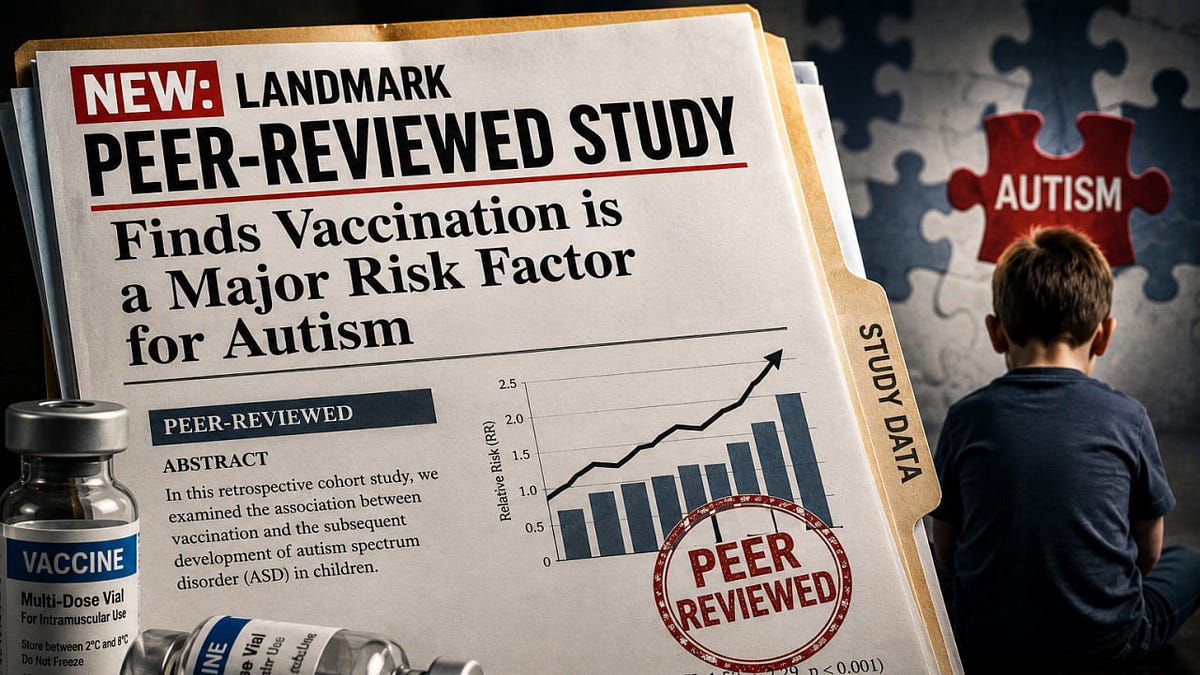
Now, our peer-reviewed study titledDeterminants of Autism Spectrum Disorder, officially published in theJournal of Independent Medicine, provides one of the most comprehensive syntheses on the possible causes of autism to date.
Most importantly, by systematically evaluating all known autism risk factors side by side, we found thatcombination and early-timed routine childhood vaccination represents a significant modifiable risk factor for autismwithin a broader multifactorial framework.We found 79% of studies evaluating vaccines or their components (107 of 136) reported evidence consistent with a vaccine–autism link. The evidence converged across epidemiologic, clinical, mechanistic, toxicologic, and neuropathologic domains.
This publication represents a major breakthrough through the longstanding censorship imposed by the Bio-Pharmaceutical Complex on the issue of vaccination and autism. It also marks Dr. Andrew Wakefield’s major return to the peer-reviewed scientific literature after enduring decades of coordinated attacks from the vaccine cartel.
By systematically integrating more than 300 studies across epidemiologic, clinical, mechanistic, toxicologic, molecular, and neurodevelopmental domains, our analysis identified a broad range of interacting ASD risk factors beyond vaccination, including advanced parental age, premature delivery, genetic susceptibility, sibling recurrence, maternal immune activation, in utero drug exposure, environmental toxicants, metabolic dysfunction, pesticide exposure, gut-brain axis disruption, and mitochondrial abnormalities. However, no single non-vaccine factor sufficiently explains the unprecedented rise in autism prevalence observed over recent decades.
Here’s what we found as described in the Abstract:
Background: Autism spectrum disorder (ASD) now affects more than one in 31 children in the United States, with prevalence rising sharply over recent decades. ASD is recognized as a complex neurodevelopmental disorder shaped by genetic, environmental, and iatrogenic influences. Clarifying the contribution of these determinants is critical to addressing the escalating public health burden.
Methods: We comprehensively examined epidemiologic, clinical, and mechanistic studies evaluating potential ASD risk factors, assessing outcomes, exposure quantification, strength and independence of associations, temporal relationships, internal and external validity, overall cohesiveness, and biological plausibility.
Source: The Vigilant Fox
