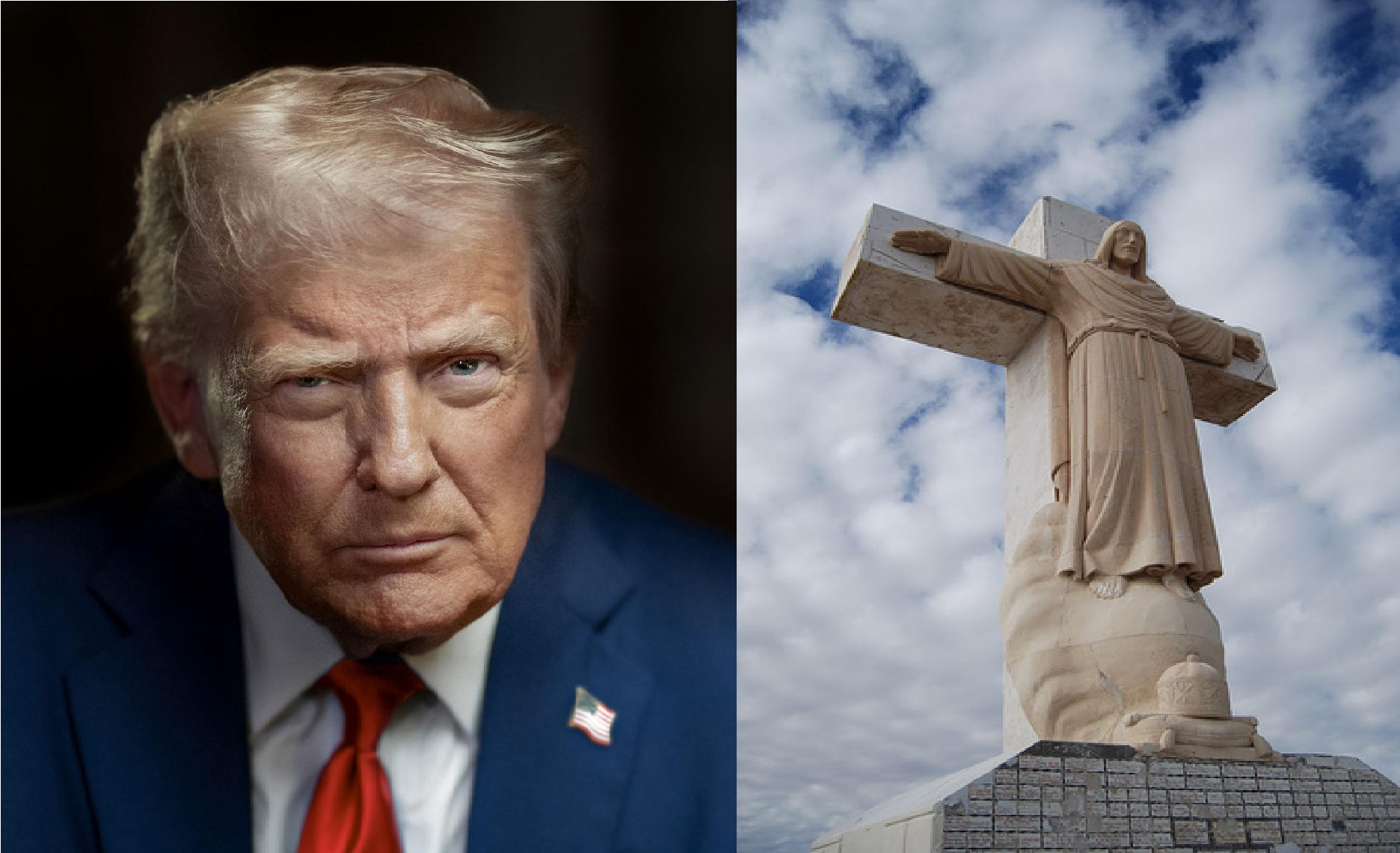
A remote mountain crowned by a towering statue of Jesus Christ has become the latest flashpoint inUS President Donald Trump's border crackdown. Federal officials are moving to seize land owned by the Catholic Church at Mount Cristo Rey, triggering a legal fight that cuts straight into religion, immigration and the limits of government power.
The clash centres on 14 acres at the base of the mountain, where the Trump administration wants to extend border infrastructure through eminent domain. The Catholic Diocese of Las Cruces says the project would rupture one of the region's most important pilgrimage sites and turn a place of worship into a militarised corridor.
Mount Cristo Rey rises above the point where Texas, New Mexico, and Mexico meet. At its summit stands a 29-foot limestone statue of Christ, completed in 1940 after years of labour by Mexican American workers from the now-vanished village of Smeltertown.
For generations, pilgrims from both sides of the border have climbed the mountain in acts of devotion. Some walk barefoot. Others ascend on their knees, carrying wooden crosses. Each autumn,as many as 40,000 worshippersgather there for the Feast of Christ the King, according to the diocese.
That tradition now sits directly in the path of federal construction plans.
In court filings submitted last week,the Department of Homeland Security said the land is needed to build and maintain fencing, vehicle barriers, surveillance systems, roads, and security infrastructure designed to secure the US-Mexico border. The government valued the property at $183,071.
'The erection of a border wall through or along this holy site could irreparably damage its religious and cultural sanctity, obstruct pilgrimage routes, and transfer sacred space into a symbol of division,' the Diocese of Las Cruces wrote in legal documents filed on 8 May.
What makes the dispute striking is not simply the land seizure itself. Eminent domain battles are common along the southern border. This one reaches directly into questions of religious freedom.
The diocese argues the government's actions would violate protections under both theFirst Amendment and the Religious Freedom Restoration Act.If the court grants the federal request quickly, church lawyers say the government could immediately take possession before those arguments are fully heard.
Kathryn Brack Morrow, an attorney representing the diocese, accused federal authorities of using 'heavy-handed tactics' and said the church would use 'all legal tools at its dispose to stop' the seizure.
Source: International Business Times UK
