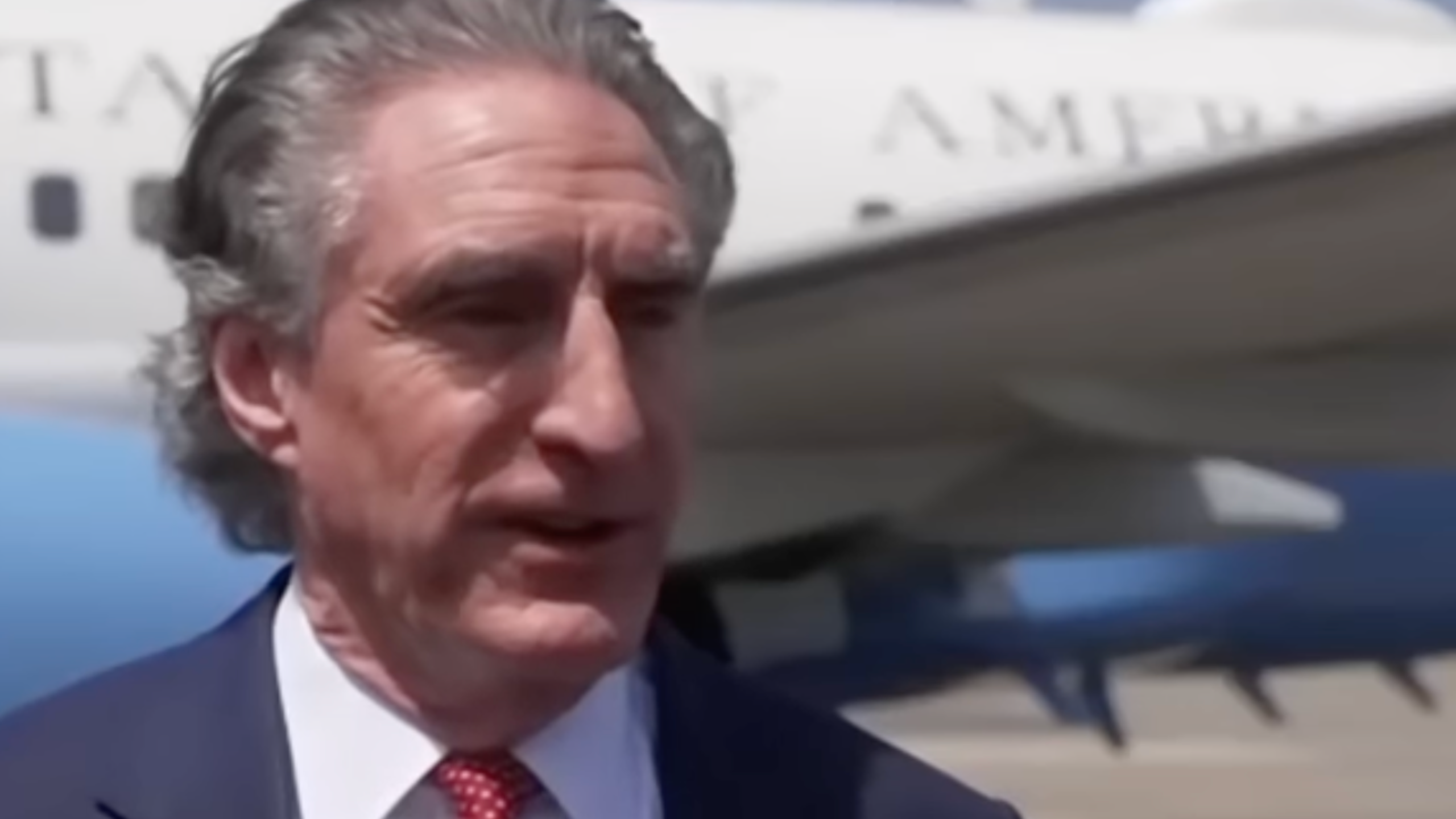
Interior Secretary Doug Burgum drew open mockery in Congress on Wednesday after appearing to overlook the existence of battery storage technology while attacking solar energy's reliability.
Testifying before theHouse Natural Resources Committeeon 13 May 2026, Burgum told Democrat Jared Huffman that solar energy projects in Nevada share one common flaw: 'When the sun goes down, they produce zero electricity.' Huffman responded by submitting a battery to the committee record, to audible amusement in the chamber.
The exchange cut to the centre of a wider debate about American energy policy, as data show China deploying battery storage at more than double the rate of any other economy on Earth while theTrump administration continues to position fossil fuels as the anchor of national energy security.
The full context of the remark matters. Burgum was responding to a reference to the Lazard analysis, a widely cited annual study that identifies solar power as among the cheapest forms of electricity generation on a per-unit basis. He did not dispute that framing directly. Instead, he shifted the argument to reliability.
'All of these projects you're describing in Nevada have one thing in common,' Burgum said. 'When the sun goes down, they produce zero electricity. And this nation over-rotated towards intermittent forms of energy. The idea that we could add intermittent and shut down baseload is what put our grid at deep risk.'
He added that the total cost of the grid, not just the incremental cost of a single source, had to factor into any honest assessment of solar's economics. 'The whole machine doesn't work when the sun goes down,' he continued, citing examples from other countries where intermittent energy had caused grid failures.
Representative Huffman, the ranking Democrat on the committee, then made his request. 'Chairman, I request unanimous consent to enter into the record this amazing new technology that apparently the secretary is unaware of,' Huffman said. 'It's a battery. China's figured it out. That's why they're cleaning our clock on clean energy.' Committee chairman Bruce Westerman, a Republican from Arkansas, could be seen smirking before intervening to close down the exchange. Burgum replied that China's status as the world's largest carbon emitter ought to be entered into the record too, to which Huffman replied that China also produced 'far more clean energy.' Both statements are factually accurate and are not mutually exclusive.
The scientific basis of Burgum's claim is narrow. Solar panels do not generate electricity at night. That much is physically correct. His argument, however, conspicuously omitted battery storage systems, which capture surplus solar generation during daylight hours and discharge it after dark. This is not an emerging or experimental technology. Grid-scale lithium-ion battery storage has been commercially deployed for over a decade and its costs have dropped roughly 84 per cent since 2015, according todata from Ember, a UK-based energy think tank.
China has scaled the technology at a speed that appears to vindicate Huffman's remark. By the end of the first half of 2025, China's cumulative installed battery storage capacity reached 101.3 GW, a year-on-year increase of 110 per cent, according to China's Energy Storage Alliance.
In 2024 alone, China added more battery storage than the United States and the European Union combined. During the same congressional hearing, another Democrat pressed Burgum on capacity figures directly: the United States added 53 GW of new power generation in 2025 against China's 543 GW, of which 434 GW came from renewables. The exchange was captured on the congressional live feed and reported across multiple outlets.
Source: International Business Times UK
