Home-Carbon Names DDK First Tier 1 Supplier for 3D Printed Saddles in Asia
Carbon, a Redwood City, California-based 3D printing technology company, has partnered withDDK Group, a manufacturer of high-performance bicycle saddles, to add its first saddle-specific Tier 1 contract manufacturing partner in Asia. The agreement establishes the Taiwanese supplier as a dedicated, vertically integrated production partner for brands bringing 3D printed saddles to market.
Its facility combines additive manufacturing of latticed saddles and final saddle assembly in one location in Asia. The California technology firm described that arrangement as a first-of-its-kind model for the company in the region. By placing multiple stages of saddle production under one roof, the site is intended to reduce customer time-to-market and capture the efficiencies associated with vertical integration of the supply chain.
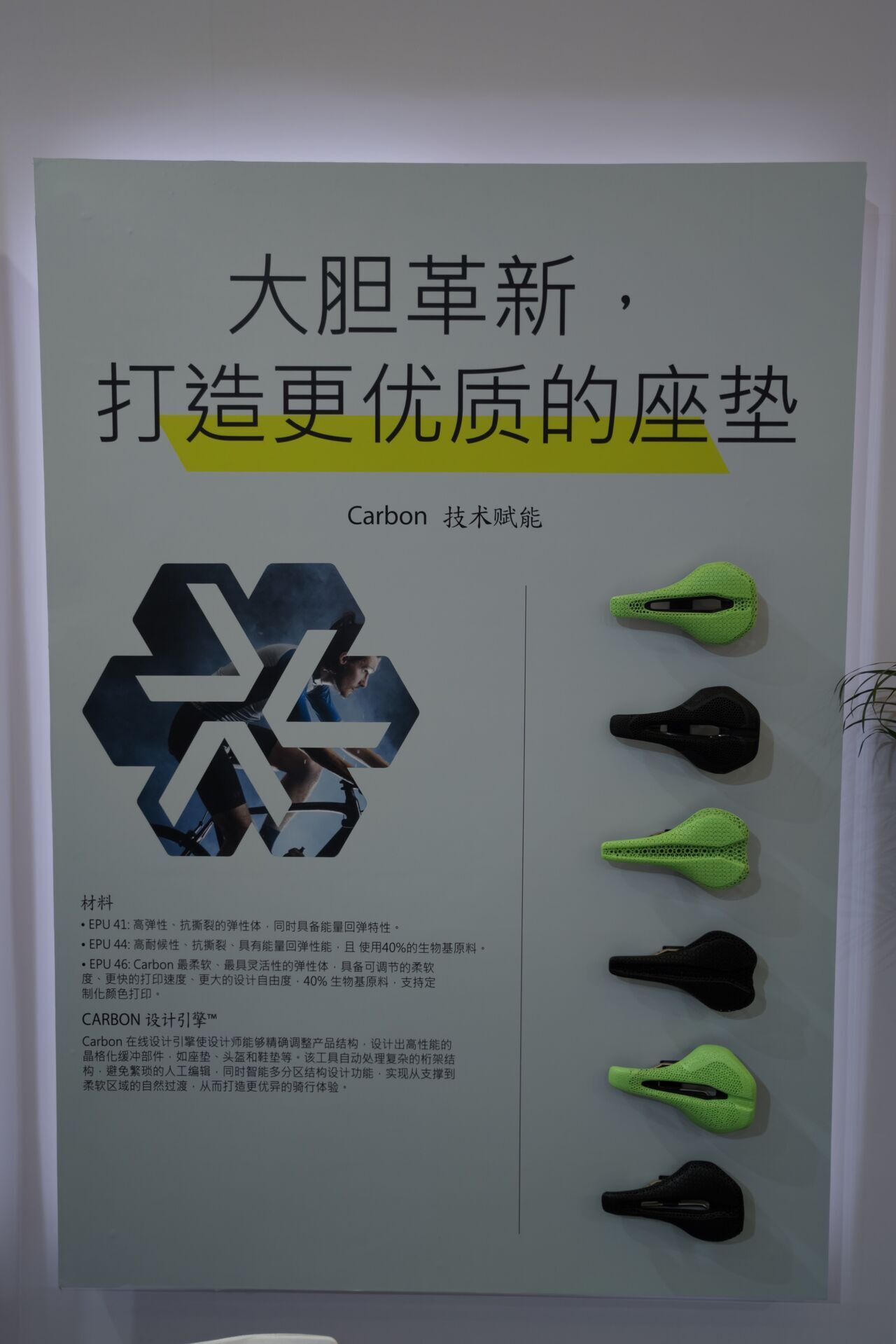
3D printed saddles, once positioned as flagship products, are now described as portfolio essentials across leading saddle brands. Carbon’s technology has enabled the production of nearly one million 3D printed saddles, while demand continues to outpace existing capacity. Adding a Tier 1 contract manufacturer focused exclusively on saddle production, with the capability to deliver a fully assembled saddle, expands that capacity.
“Bringing DDK online as the first Tier 1 supplier dedicated to printing saddles on the Carbon platform is a defining moment for the category,” said Philip DeSimone, Chief Executive Officer, Carbon. “3D printed saddles are no longer a flagship novelty — they’re a must-have in brand portfolios, and our customers need partners who can deliver them at scale, in the right geographies, with the right capabilities. DDK opens the door to a faster path from design to rider, and brings 3D printed performance within reach of a much wider range of riders, budgets, and skill levels.”
Expansion of manufacturing capacity in Asia broadens geographic access to 3D printed saddle production and creates a foundation for future entry into the OEM market. Added capacity is intended to make the technology more accessible to brands and end consumers.
Carbon develops production systems built around its Digital Light Synthesis (DLS) process, which combines printers, software, and materials for prototyping, low-volume production, and end-use part manufacturing. Founded in 1970, DDK produces saddles for racing, MTB, trekking, and city commuting. Its manufacturing operation includes foam production, cover processing, plastic injection, and metalwork, reflecting the vertical integration highlighted in the partnership announcement.
Carbon expands saddle production as scaling constraints sharpen
Carbon’s recent moves have focused less on adding new markets than on making polymer additive manufacturingbehave like a production system. A recent $60 million funding round, backed by existing investors, was directed toward expanding capacity, improving process efficiency, and supporting new hardware, materials, and automation tools. That push matters because the company’s saddle business was already operating at significant volume before the DDK agreement. Its lattice technology had been used by cycling brands includingFizik,Selle Italia, andTrekto produce hundreds of thousands of saddles, while six of the top ten riders in the 2025 Tour de France used saddles made with that process. In that context, adding a saddle-specific manufacturing partner in Asia reads less like category expansion than a response to an existing production bottleneck.
Leadership commentshave made that constraint even clearer. DeSimone has argued that polymer AM succeeds or fails on utilisation, yield, reliability, resin economics, and long qualification cycles rather than on machine performance alone. He described Carbon’s business as centered on end-use production, noting that customers running manufacturing lines use equipment very differently from prototyping shops, and that every application can require 12 to 24 months of testing before reaching volume output. Cycling was one of the strongest examples he cited, saying brands without a 3D saddle program were falling behind as the technology became established in the segment. Seen through that lens, the DDK partnership adds more than regional presence. It places lattice saddle 3D printing and final assembly inside one manufacturing structure at a moment when output, geography, and supply chain control have become more important than proving demand.
Source: 3D Printing Industry
