Home-New Study: Architecture Targets the Core Bottleneck in Battery Manufacturing
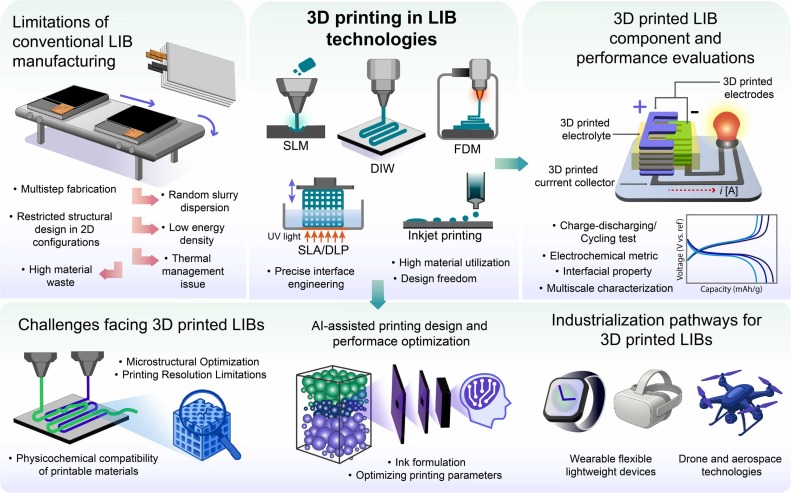
A study published inMaterials Science & Engineering Rargues that 3D printing is ready to move from laboratory prototyping to mainstream lithium battery manufacturing, provided several unresolved material and process problems are brought under control.
The central argument is that print-defined architecture, not just chemistry, is becoming a meaningful variable in battery performance. To make that case, the paper surveys experimental results across four printing techniques: direct ink writing, laser powder bed fusion, photopolymerization-based methods including stereolithography and digital light processing, and fused deposition modeling.
Engineering Performance Gains and Technical Limits
The performance comparisons it assembles are specific. Conventional slurry-cast electrodes achieve active material utilization of ~50-70% at practical currents. 3D printed architectures, by engineering interconnected pore networks that keep ion transport pathways open across thicker electrodes, push that figure to 80-90% at 1C.
One group surveyed in the review printed an LFP cathode ~1,500 µm thick, delivering an areal capacity of 7.5 mAh/cm², a benchmark value for state-of-the-art LFP cathodes. A cellulose-nanofiber-based full cell combining printed cathode and lithium-metal anode sustained 85% capacity retention after 3,000 cycles at 10C.
Solid electrolytes are where the manufacturing argument becomes hardest to dismiss. Oxide-based solid-state batteries require precise interfacial contact between brittle ceramic components, something conventional pressing and sintering handle poorly.
The review documents printed LLZO electrolyte structures retaining ionic conductivity of 1 mS/cm with interfacial resistance as low as 20 ohm·cm² after sintering. A composite LLZTO/PVDF interfacial layer printed at 50 µm thickness achieved 0.83 mS/cm at room temperature with 327% elongation before fracture.
The obstacles, though, are substantial and the review does not minimize them. Printing resolution below 100 µm remains inconsistent across techniques. Achieving ceramic loadings above 70 wt% while maintaining the rheological stability necessary for reliable deposition is described as a key scientific bottleneck.
Fused deposition modeling, among the most accessible and industrially mature techniques, is constrained by nozzle diameters of 200-400 µm, limiting structural resolution. Interfacial resistance between dissimilar printed layers, a problem that plagues solid-state designs specifically, has not been solved systematically.
Source: 3D Printing Industry
