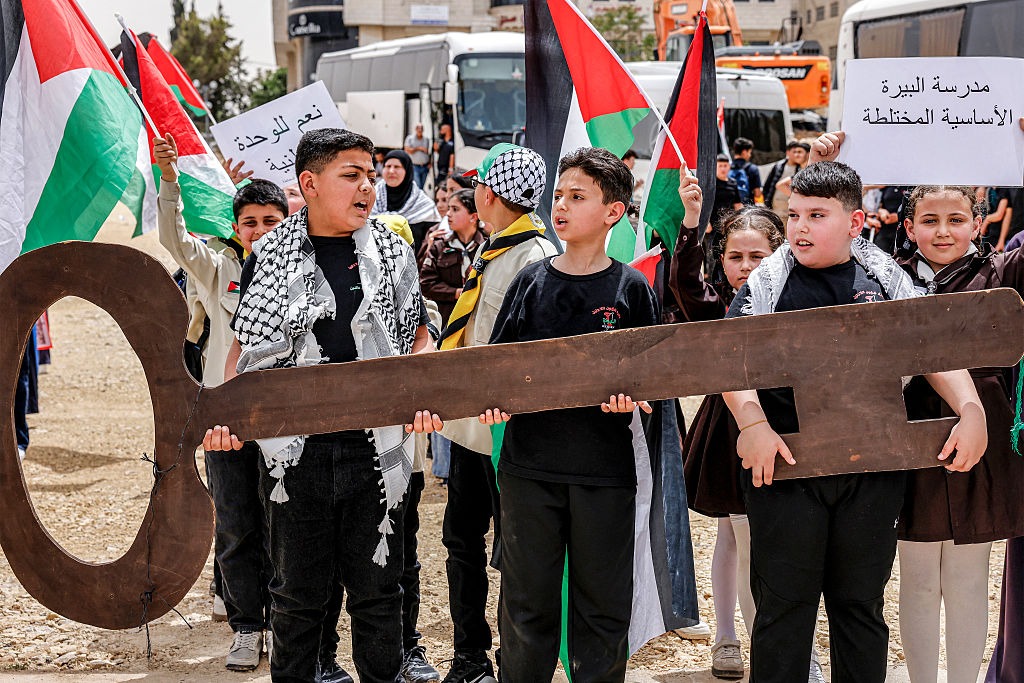
On May 11 and 12, the Palestinian Authorityorganizedmass rallies across the West Bank to commemorate the "Nakba" ("catastrophe") -- the term Palestinians use to describe the establishment of the State of Israel in 1948.
Hundreds of Palestinians marched through the streets of Ramallah, thede factocapital of the Palestinians, waving flags, carrying "keys of return," andchantingslogans such as "We live a newNakbaevery day" and "We will never forget the right of return."
Senior Palestinian officials, including top figures from the ruling Fatah faction and the Palestine Liberation Organization (PLO),participatedin the event, once again reaffirming their commitment to the Palestinian refugee issue and the so-called "right of return."
PLO Executive Committee member Wasel Abu Yousefsaidthat after 78 years, "the occupation [Israel] is trying to undermine the sacred right of return."
He added that the "right of return" for refugees will remain "a historical constant that cannot be forfeited by the passage of time."
At first glance, the "right of return" may sound humanitarian and symbolic. In reality, however, it represents one of the most extreme demands in the Israeli-Palestinian conflict.
When Palestinian leaders speak about the "right of return," they are not talking about resettling refugees in a future Palestinian state in the West Bank or Gaza Strip. They are demanding that millions of Palestinians classified as "refugees" – including descendants of the original refugees from 1948-49 – be allowed to settle inside Israel itself. The goal is to flood Israel with millions of Palestinians and transform Jews into a minority in their own country.
This demand fundamentally contradicts the idea of a "two-state solution." Under a genuine "two-state solution," Palestinians would establish their own independent state alongside Israel. Yet Palestinian leaders are effectively saying that they want not only a Palestinian state, but also the demographic destruction of Israel through mass migration.
No Israeli government – left, right, or center – could ever agree to national suicide.
This is why the "right of return" has remained one of the core obstacles to peace negotiations since the signing of the Oslo Accord between Israel and the PLO in 1993.
Source: Gatestone Institute :: Articles
