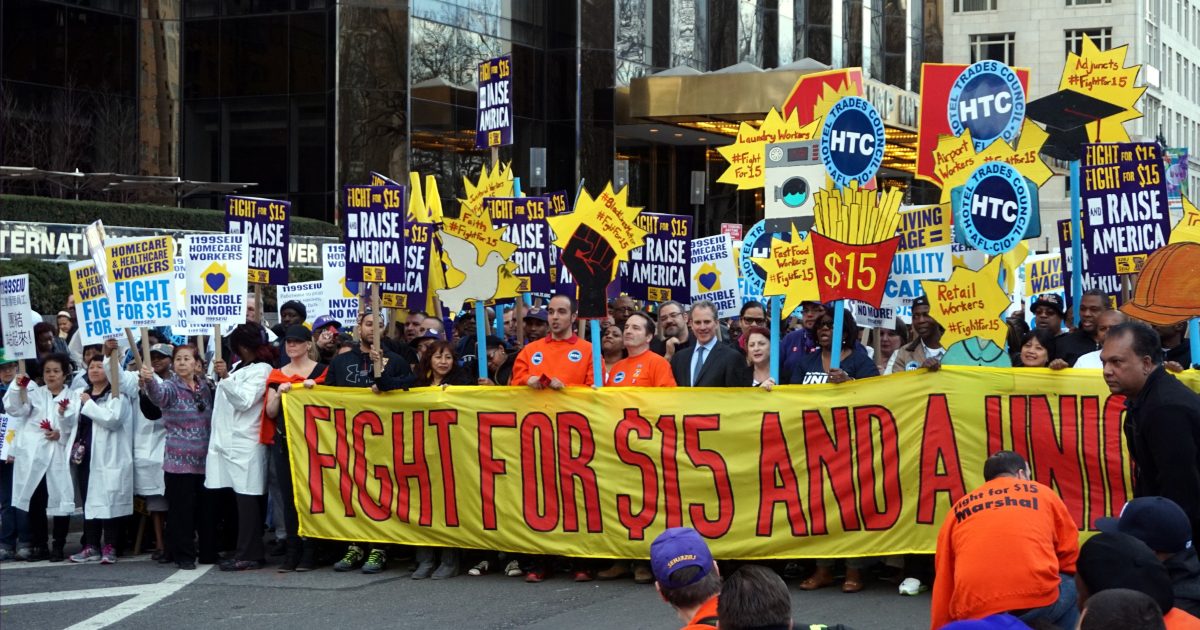
Four Democratic House members, Jesús “Chuy” García (IL-04), Delia Ramirez (IL-03), Lateefah Simon (CA-12), and Analilia Mejia (NJ-11), introduced theLiving Wage for AllAct on April 28, proposing to raisethe federal minimumwage to $25 an hour.
The bill is backed by Alexandria Ocasio-Cortez and a coalition of more than 100 organizations. Large employers would have until 2031 to comply, while smaller employers would have until 2038. After that, the minimum wage would adjust periodically to two-thirds of the national median wage, currently around $31 an hour.
The legislation is unlikely to passwith Republicanscontrolling both chambers of Congress. However, the economic damage caused by a forced multiplication of the minimum wagewould be staggering.
Thefederal minimum wagehas stood at $7.25 since 2009. According to theBureau of Labor Statistics, roughly 82,000 workers currently earn at that floor, approximately 0.05% of the 170 million-person U.S. labor force, or about one worker in every two thousand. To raise wages for that population, every employer and consumer in the country would absorb the cost.
Proponents claim the bill would benefit millions more, pointing toBLS datashowing 760,000 workers earn below the standard minimum wage. That figure is misleading. Those workers are tipped employees, legally paid $2.13 an hour under a separate federal provision on the assumption that tips make up the difference. This is a legal carve-out, not exploitation.
The Bureau of Labor StatisticsOccupational OutlookHandbook reports the median hourly wage for waiters and waitresses, including tips, was $16.23 in May 2024, more than double the standard minimum wage. Tipped workers who found the arrangement unprofitable could leave for minimum-wage jobs, which are plentiful. The market already corrects for this. The actual universe of workers this bill targets is 82,000.
The cost impact on prices can be modeled mathematically under explicit assumptions: all affected workers currently earn $7.25 an hour, wages rise to $25 an hour, employers pass 100% of the increase to consumers, and no automation or headcount reductions occur. This produces a ceiling estimate, not a prediction.
Quick-service restaurants(fast food) carry labor costs equal to roughly 25% of revenue. Raising wages from $7.25 to $25 an hour, a 245% increase, applied to that labor share produces a required price increase of approximately 61%. A $10 meal becomes $16.10. Fast-food operators typically run net profit margins of 3–6%, leaving no room to absorb the increase without passing it on to customers, cutting staff, or automating.
Retail labor costs, according to the National Retail Federation, run 10–15% of revenue. Applying the same math, prices would rise 24–37%. A $100 grocery bill becomes $124–$137. Grocery chains operating on 1–3% net margins face the same arithmetic as fast-food restaurants.
These figures assume only minimum-wage workers receive raises. In practice, the impact would be much larger. Workers currently earning $15 or $23 an hour, wages built over years of experience, cross-training, and demonstrated reliability, would be compressed to the same $25 floor as a worker hired that morning. To retain experienced staff, employers would need to push those workers’ wages to $30–$35 an hour, restoring the differential they had earned. The wage-bill increase cascades up the entire lower-wage structure, not just the bottom rung.
Source: The Gateway Pundit
