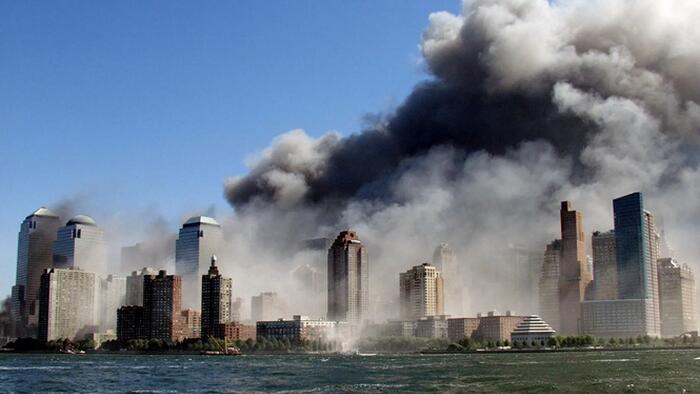
In a monumental deception that reshaped the Middle East and cost thousands of lives, Washington politicians a few presidencies ago peddled the myth of Saddam Hussein as the "twentieth hijacker" to propel America into the Iraq War. Thousands of Americans died, and scores of thousands of Iraqis perished, all fueled by boundless political and intellectual chicanery in the wake of the 9/11 attacks on New York City and the Pentagon.
Last November, Axios revealed damning new details from private lawsuits against the Saudi regime, uncovering evidence that one Saudi official—who acknowledges aiding two men who became hijackers—made a drawing of a plane and a mathematical formula that allegedly could have been used to fly into the World Trade Center. This marked the latest bombshell in a coverup that will celebrate its twenty-fifth birthday this year, highlighting the enduring secrecy surrounding foreign involvement in the deadliest terrorist attack on U.S. soil.
The push for war intensified in 2002 and early 2003, as the W. Bush administration exploited the trauma of 9/11 to justify invading Iraq. However, a critical obstacle emerged: a 2002 FBI memo that stated there was "incontrovertible evidence that there is support for these [9/11 hijacker] terrorists within the Saudi Government." Despite this, the narrative fixated on Saddam Hussein.
A joint House-Senate congressional investigation unearthed extensive evidence that the Saudi government, not Iraq's dictator, had propelled the hijackers. Yet the Bush administration succeeded in suppressing the key twenty-eight pages of that report detailing the Saudi role in the 9/11 attacks.
The late Rep. Walter Jones (R-NC) emerged as a fierce advocate for transparency, leading efforts to declassify those pages. In 2013, he declared: "If the 9/11 hijackers had outside help—particularly from one or more foreign governments—the press and the public have a right to know what our government has or has not done to bring justice to all of the perpetrators."
Those twenty-eight pages were finally released, mostly unredacted, in 2016. They exposed how Saudi government officials directly financed and provided diplomatic cover for several of the hijackers while they were in the United States shortly before unleashing havoc on September 11, 2001.
This sequence of events underscores what critics have long called the biggest bait-and-switch war of the century, diverting attention from Saudi connections to prosecute an unrelated conflict in Iraq, with revelations continuing to surface two decades later.
