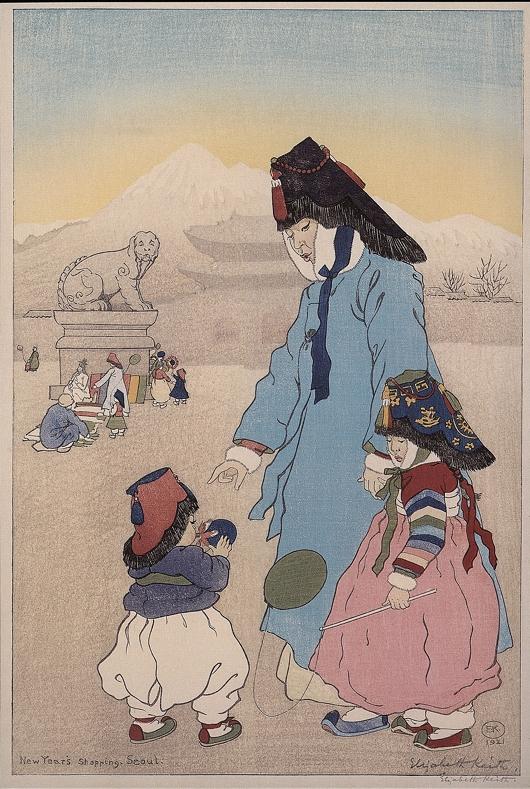
In the crisp morning light of Lunar New Year's Day in 1921, British painter Elizabeth Keith immortalized a vibrant scene at Gwanghwamun in colonial-era Korea: a young woman, believed to be a mother, accompanied by two children under the rosy winter sun above snow-covered Bugaksan. The girl donned a rainbow-striped jeogori and a gold-patterned headdress, while the younger boy wore colorful silk shoes and a snug winter cap. Keith's painting, titled “New Year’s shopping,” captures the festive spirit of Seollal, showcasing the “white-clad folk” of Korea in their most colorful attire.
Struck by the holiday's splendor, Keith wrote in her book Eastern Windows that Seollal is “Korea’s greatest festival” and that “everyone, young and old, dresses in their finest clothes and goes out.” This depiction from a century ago highlights a tradition deeply rooted in Korean culture, where new garments symbolized renewal at the turn of the year.
Fast forward to 2026, a century later, and households in the birthplace of hanbok rarely prepare the traditional five-colored New Year attire. Despite this domestic shift, hanbok has transformed globally into a symbol of K-culture, admired worldwide no longer as an unfamiliar costume from a distant land but as an iconic element of modern Korean identity.
To explore the current state of hanbok studies and practical ways to incorporate it into modern life during the holiday, The Hankook Ilbo met with Choi Jeong, professor of fashion design at Wonkwang University and president of the Korean Society of Hanbok Culture. Their discussion sheds light on hanbok's enduring relevance amid evolving fashion trends.
The exact origins of the custom of making new clothes for Lunar New Year remain unclear, though scholars assume it dates back as early as the Three Kingdoms period, when people donned clean garments to mark the new year. Detailed historical records, however, emerge only in late-Joseon seasonal texts.
Among these, “Gyeongdo Japji” from the late 18th century and “Yeolyang Sesigi” from 1819 provide vivid accounts of the tradition, illustrating how hanbok preparation was integral to Seollal celebrations in Joseon society.
Keith's evocative imagery, such as the kkachi durumagi—a colorful striped overcoat for girls—continues to inspire appreciation for hanbok's artistic and cultural depth, bridging historical practices with contemporary interest in Korean heritage.
