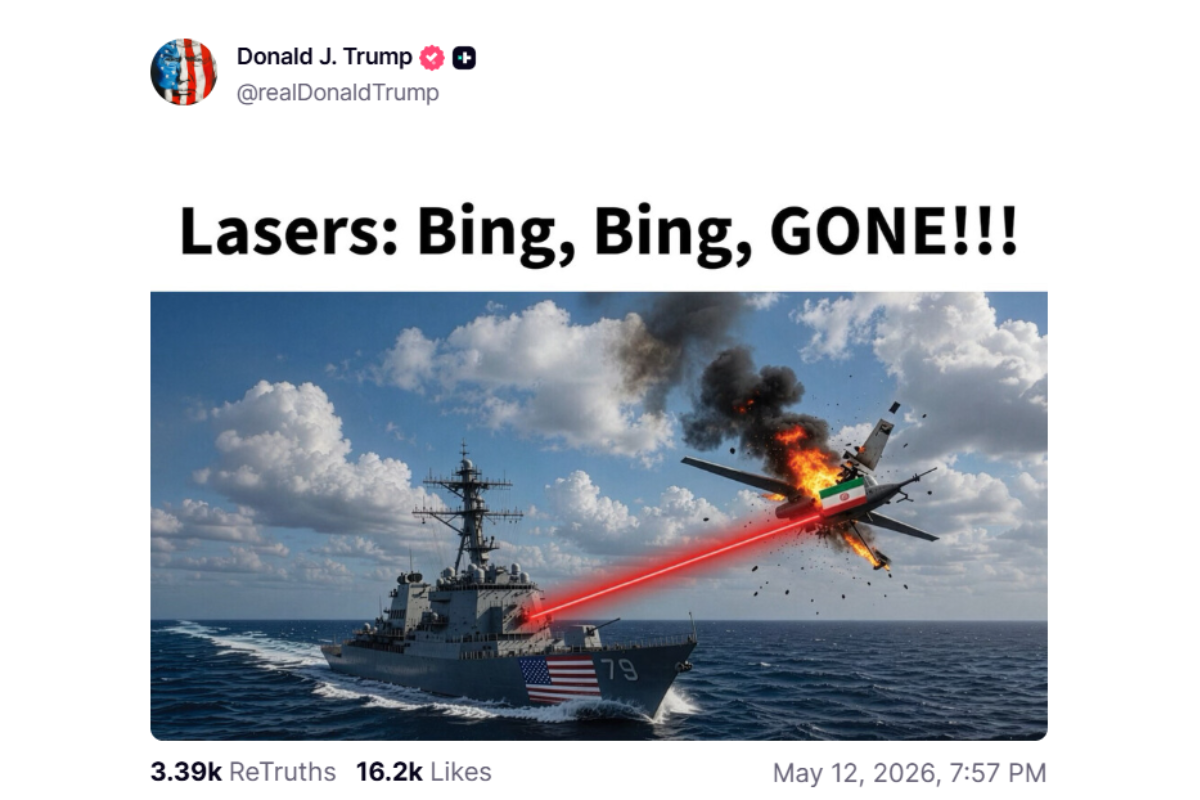
Donald Trump took to Truth Social on Monday to share a series of AI-generated images depicting American forces destroying Iranian military targets, captioningone post'Lasers: Bing, Bing, GONE!!!' andanother'Bye Bye, Fast Boats' — imagery that the official White House account subsequently amplified to 2.1 million views on X.
The posts arrived at a particularly fraught moment. The ceasefire between the US and Iran hung by a thread on Monday after Trump panned Tehran's latest proposal as a 'piece of garbage' and met with military leaders to plot his next move. Speaking to reporters, Trumpsaid: 'The ceasefire is on massive life support, where the doctor walks in and says, Sir, your loved one has approximately a one per cent chance of living.' He had also dismissed Tehran's latest negotiating proposal, calling it 'TOTALLY UNACCEPTABLE' in a separateposton social media.
One post showed a US warship directing what appeared to be a laser beam at an aircraft marked with the Iranian flag, with the plane caught mid-explosion. A second depicted a US drone positioned above several Iranian-flagged vessels in open water, the boats engulfed in flames as explosions tore through them simultaneously. Trump captioned the first 'Lasers: Bing, Bing, GONE!!!' and the second 'Bye Bye, Fast Boats.'
The images are digitally fabricated and depict no real military engagement, but their timing and tone signal something beyond online bravado. Posting them as ceasefire talks deteriorate suggests the White House is using social media as a tool of pressure — projecting military confidence at a moment when diplomatic options appear to be narrowing.
This is not the first time Trump has leaned on digitally generated imagery during the Iran standoff. In April, Trumpshared a photoof himself wearing aviators and holding a gun in front of a backdrop of explosions — a pattern that analysts say blurs the line between military communication and online spectacle.
The 'Bing, Bing, GONE' framing — specifically the laser imagery — has drawn scrutiny from defence analysts who say it overstates the current capabilities of US directed-energy weapons. A Congressional Research Service report on Navy shipboard lasers notes that lasers can generally engage only one target at a time and remain vulnerable to saturation attacks, precisely the type of swarm scenario Iran's naval doctrine is designed to create.
Acting Chief of Naval Operations Adm.James Kilbysaid he was 'not ready to go all in yet' on shipboard lasers, while Fleet Forces Commander Adm.Daryl Caudlesaid the Navy should be 'embarrassed' that directed-energy weapons have not yet matured into a dependable operational capability. The Pentagon itself, in other words, still views the technology as evolving rather than battle-ready.
Iran's so-called fast boats, meanwhile, are not considered a trivial threat by US military planners. The Defence Intelligence Agency has noted that IRGC Navy units train to conduct hit-and-run attacks against larger naval vessels using swarms of small boats combined with coastal missiles, naval mines, and maritime special operations forces — a doctrine that has shaped US naval planning in the Gulf for decades.
Bing, Bing, GONE!!!pic.twitter.com/pv1LfSriAX
Behind the memes, the diplomatic picture remains bleak. Trump has repeatedly set deadlines for Iran to agree to a deal, then pulled back even when Tehran did not comply — on no fewer thanfive occasionsin one month between March 21 and April 21.
Source: International Business Times UK
