Freddie Ponton21st Century Wire
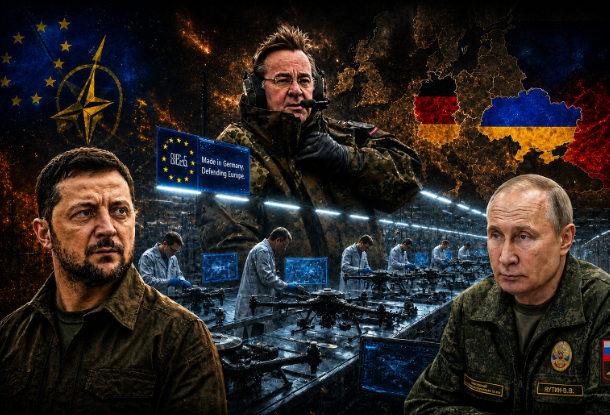
In February, under the white light of a Bavarian assembly hall, Ukrainian PresidentVolodymyr Zelenskyand German Defense Minister,Boris Pistorius,walkedpast rows of unfinished drones. Thejoint venturehosting them, linking Germany’sQuantum Systemswith Ukraine’sFrontline Robotics, is already producing aircraft for Ukraine, plans to scale toward 10,000 units a year, and has already sent its first batch east. This is what Berlin now calls support for Ukraine, not crates on a runway, not old equipment hauled out of Bundeswehr depots, but German soil giving Ukrainian war design an industrial home.
For years, German officials sold their Ukraine policy in the language of restraint, solidarity and defensive necessity, but today, that language is buckling under what Berlin is now doing in plain sight.Germanyhas signed onto Ukraine’sdefence innovation platform, opened itself tobattlefield-data sharing, backed joint ventures that turn Ukrainian combat know-how into German-produced drones and robots, and committed itself to work on long-range strike systems with a reach of up to 1,500 kilometres. The result is no longer the picture of a cautious donor helping from a distance. It is a state folding Ukraine’s war labs into its own industrial base and building the rear area of a long war against Russia on German territory.
IMAGE: Auterion CEO Lorenz Meier, Airlogix CEO Vitalii Kolesnichenko, Ukrainian President Volodymyr Zelenskyy, and German Chancellor Friedrich Merz with an Airlogix autonomous strike system. (Source: Auterion)
Germany Becomes the Factory Floor
The Munich drone line strips away the euphemism. Ukraine is not simply receiving German kit from stockpiles. Ukrainian battlefield-proven designs, software and operational lessons are being fused with German capital, German factory capacity and German political cover inside ventures built to scale weapons production for a war Berlin still insists it is not fighting. TheAuterion-Airlogix Joint Venture GmbHmakes the point even more bluntly. Registered in Germany and launched in February, it combines Airlogix’s battle-tested Ukrainian UAV platforms with Auterion’s autonomy software and is meant to produce thousands of autonomous, combat-ready systems in Germany for the Ukrainian armed forces. Every time Ukrainian engineers find a way through Russian jamming or air defences, German industry is there to absorb the lesson and turn it into volume.
IMAGE: During the Munich Security Conference, Auterion (Germany) and Airlogix (Ukraine) announced the launch of Auterion Airlogix Joint Venture GmbH – February 2026 (Source: Airlogix)
The named systems give the arrangement a harder outline. DuringZelensky’s Berlin visit in April,Germany and Ukraine signed animplementation arrangementunder their October 2025 defence-industry agreement covering the joint production of the unmanned systemsAnubisandSeth-X-G, with a contract value of€281 million.Anubis has been described as a heavy AI-guided deep-strike system with a range in the 1,500 to 1,600 kilometre band and a 45 kilogram warhead, while Seth-X is designed for attack missions in heavily contested environments. Production is planned in the thousands under German-backed joint-venture arrangements. Once those names are on the table, the fiction that Berlin is merely helping Ukraine hold the line becomes harder to maintain.
Brave1sits at the centre of this arrangement. The Ukrainian cluster was built to connect front-line units, developers, testing and procurement into a single accelerated loop, a wartime incubator where battlefield experience is turned into new weapons and quickly sent back to the field.Brave Germanyis the moment that loop jumps the border. Pistorius announced that Berlin would join Brave1 to support defence innovation, while Ukraine Defense MinisterMykhailo Fedorovhailed the initiative as a deepening of a partnership that already accounts for roughly a third of the security support reaching Ukraine. The most revealing line did not come from any grand strategic declaration. Pistorius said promising systems could be funded through the platform so they could be deployed early on the battlefield to test their effectiveness. In the brochures, this is presented as innovation, but in reality, it is nothing short of a war-lab pipeline.
The Aprildefence-data memorandummade the same reality harder to disguise. Germany and Ukraine agreed on a framework for exchanging defence-related data and cooperating on AI and weapons systems, giving German partners access to battlefield information drawn fromDELTAand other Ukrainian military platforms so AI models can be trained, analytical tools refined and German systems evaluated under real combat conditions. Fedorov called it the first project of this scale in the world focused on defence-related artificial intelligence solutions. Specialist reporting on the agreement makes the picture even more concrete. The data stream includes real-time battle management inputs, strike tracking and large annotated datasets generated from thousands of combat flights and ground engagements, exactly the kind of material AI developers rarely receive in peacetime. Ministries prefer to present this as digital cooperation, but in plain language, Germany is plugging parts of its defence industry into a live feed from the war.
Source: 21st Century Wire
