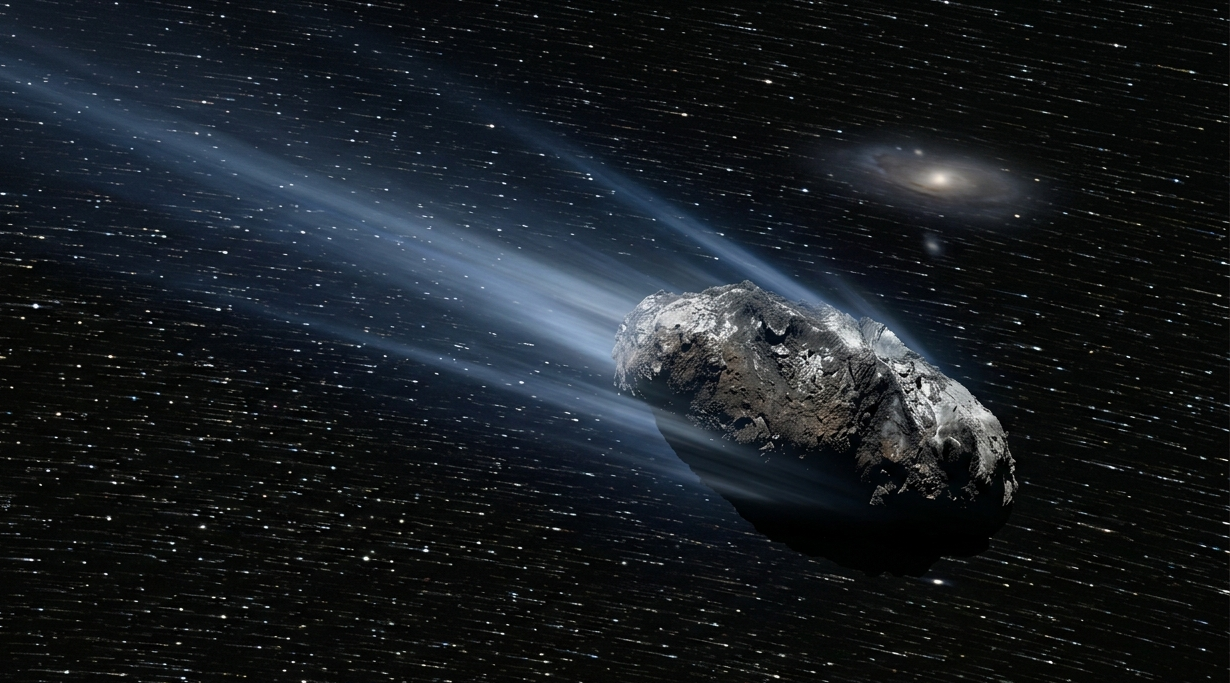
Astronomers have identified an unusual chemical signature in theinterstellar comet 3I/ATLAS, revealing that it contains 'heavy water' at levels far higher than anything observed in comets within our own solar system.
The discovery, based on high-precision observations using the Atacama Large Millimetre/submillimetre Array (ALMA), suggests the comet formed in an environment dramatically colder and chemically distinct from the region where Earth and its planetary neighbours originated.
Scientists say the findings offer a rare opportunity to directly study material from another star system, providingfresh insight into how planets and comets formacross the galaxy.
The key discovery involves deuterium-enriched water, often referred to as 'heavy water', which contains an extra neutron compared with normal hydrogen-based water molecules.
In 3I/ATLAS, researchers found that this heavy water exists at levels more than 30 times higher than those seen in typical solar system comets, and roughly 40 times higher than even Earth's oceans.
According to supporting scientific analysis, this extreme enrichment points to formation in a region of space with very low temperatures, likely below 30 Kelvin (-243°C), where chemical reactions proceed differently than in warmer environments.
Scientists explain that such isotopic 'fingerprints' act like a chemical record of the conditions under which the comet formed, effectively allowing researchers to reconstruct the environment of a distant planetary system.
Researchers describe the water ratio in 3I/ATLAS as a kind of cosmic thermometer, indicating the temperature and chemical conditions of its birthplace.
Salazar Manzano,lead author of the study and a doctoral student in the U-M Department of Astronomy, noted that 'the amount of deuterium with respect to ordinary hydrogen in water is higher than anything we've seen before in other planetary systems and planetary comets'.
This difference is significant because it implies that not all planetary systems form under similar conditions, challenging long-held assumptions that the early solar system represents a universal model for planetary formation.
Source: International Business Times UK
