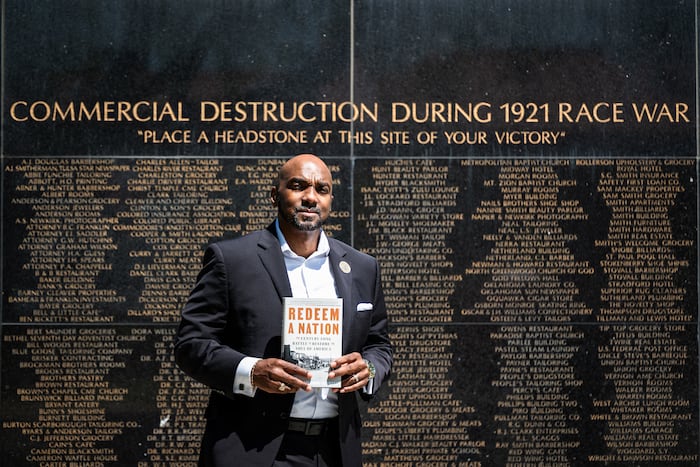
NEW YORK (AP) — It wasn’t until his junior year of college that civil rights attorney Damario Solomon-Simmons learned about a devastating massacre that took place in his hometown of Tulsa, Oklahoma.
His African American studies professor lectured about what is known today as the Tulsa Race Massacre — the days in 1921 when white mobs carried out a scorched-earth campaign against an outnumbered Black militia protecting the fabled Black Wall Street, a prosperous all-Black community.
“I actually told a teacher, ‘I’m from Tulsa. That’s not true,’” Solomon-Simmons recalled. “And of course, I was wrong.”
That day planted a seed for the then-aspiring attorney, who went on to lead a reparations campaign for the living survivors of the massacre and their descendants. Nearly 105 years later, no one has been compensated for what they lost, and none of the culprits have been held accountable.
That fight for reparations is the subject of Solomon-Simmons’ first book, “Redeem a Nation: The Century-Long Battle to Restore the Soul of America,” which is intended as a blueprint for justice in historic atrocities that Black Americans endured but never received reparations for. The book hits shelves Tuesday.
After the massacre, more than 35 city blocks of the neighborhood known as Greenwood were leveled in fires, an estimated 191 businesses were destroyed, and roughly 11,000 Black residents were displaced. The state of Oklahoma declared the death toll to be only 36 people, although many historians and experts who have studied the event put the death toll between 75 and 300.
Greenwood, founded in 1906, had been a bustling city within a city, with Black-owned grocery stores, soda fountains, cafes, barbershops, a movie theater, music venues, cigar and billiard parlors, tailors and dry cleaners, rooming houses and rental properties.
“If you can ignore Greenwood, which was the beacon of Black prosperity and Black progress in the history of this country, then you can ignore Black people in general,” Solomon-Simmons recently told The Associated Press. “I think that’s why people around the nation are so focused on the work that we’re doing, because they understand what it means to all of Black America.”
Solomon-Simmons’s book comes just months before the United States will mark 250 years since its founding in 1776. That was 89 years before the institution of chattel slavery — meaning an enslaved person was held as legal property of another — was abolished. The civil rights attorney questions the idea that Americans can truly celebrate the country's accomplishments when it has yet to pay reparations, which historians say informs modern day disparities in wealth between Black and white people.
“We cannot talk about what America has been and will be, without making sure that these issues are discussed and we get reparatory justice for both” slavery and the Tulsa massacre, Solomon-Simmons said.
Source: WPLG
