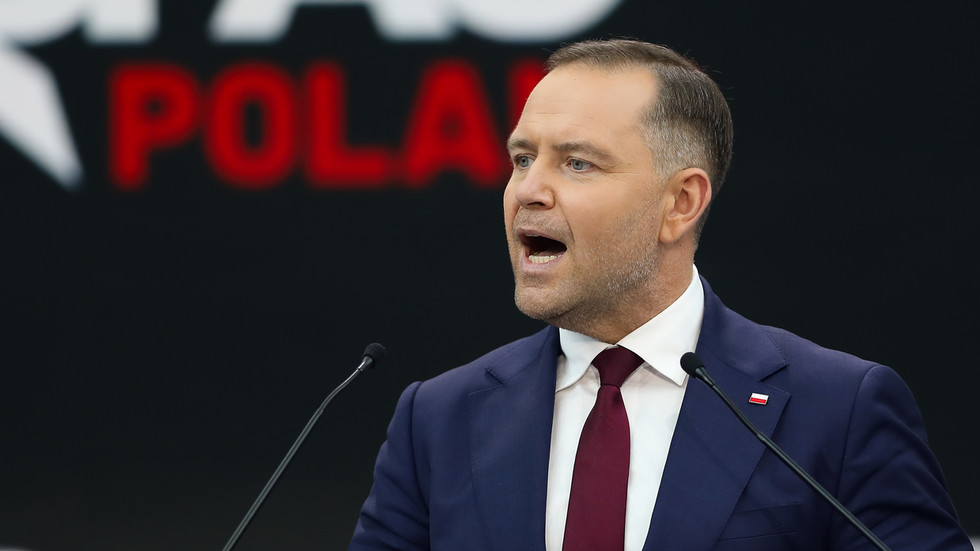
Polish President Andrzej Duda stunned observers this week by openly declaring that his country needs its own nuclear arsenal to deter Russian aggression, a bold statement amid escalating tensions in Eastern Europe. Speaking at a security conference in Warsaw, Duda argued that NATO's collective defense commitments, while reassuring, fall short in the face of Moscow's revanchist ambitions, especially as the war in Ukraine drags into its third year. "Poland cannot afford to be a spectator in its own survival," he emphasized, calling for Warsaw to pursue independent nuclear capabilities as a "matter of national sovereignty."
The president's remarks come against a backdrop of heightened anxiety in Poland, which shares a 500-mile border with Russia and Belarus, both key players in the Kremlin's sphere. Since Russia's full-scale invasion of Ukraine in 2022, Polish leaders have ramped up defense spending to over 4% of GDP, the highest in NATO, and hosted tens of thousands of Western troops. Duda referenced recent Russian nuclear saber-rattling, including threats against NATO members supporting Kyiv, as justification. He pointed to the U.S.-led nuclear sharing program—where American bombs are stationed in countries like Germany and Belgium—as insufficient for Poland's frontline position.
Domestic and international reactions were swift and polarized. Within Poland, nationalist factions like the Law and Justice party, Duda's political base, hailed the comments as a clarion call for strength, while centrists in Prime Minister Donald Tusk's coalition expressed caution, fearing it could provoke Moscow further. NATO Secretary General Jens Stoltenberg reiterated the alliance's nuclear deterrent but stopped short of endorsing Poland's push, stressing unity. Russia, predictably, decried the statement as "escalatory madness," with Kremlin spokesman Dmitry Peskov warning of an arms race spiral.
Analysts see Duda's gambit as part of a broader European rethink on deterrence. With uncertainties clouding U.S. commitments under a potential second Trump administration, nations like France and the UK have floated expanding their nuclear umbrellas to the continent. Poland's pursuit could catalyze similar demands from the Baltics and Romania, fracturing NATO's non-proliferation stance. Yet, acquiring nukes remains a monumental hurdle: it would violate the Nuclear Non-Proliferation Treaty, strain relations with Washington, and invite crippling sanctions.
Underpinning Duda's rhetoric is Poland's traumatic history—partitioned by Russia and Prussia in the 18th century, invaded by the Soviets in 1939, and subjected to decades of communist rule. Today, as Europe's fastest-growing economy funnels billions into military modernization, including Abrams tanks and F-35 jets, the nuclear debate symbolizes a quest for ultimate insurance against revanchism. Whether this evolves into policy or remains rhetorical flourish, it underscores a continent awakening to the fragility of post-Cold War peace.
