Home-Evaporation-Driven Droplet Fission Study Points to Nanoscale Fabrication Potential
Research fromKing Abdullah University of Science and Technology,Okinawa Institute of Science and Technology Graduate University, and theMax Planck Institute for Polymer Researchshows that ordinary pipetting can leave evaporating water drops carrying enough charge to undergo repeated Coulomb fissions on lubricated surfaces, a result that could inform nanoscale fabrication and other droplet-based manufacturing processes. Published inProceedings of the National Academy of Sciences, the study reports more than 60 successive fission cycles over about 30 minutes, with each event producing a fine liquid jet that breaks into 40 to 50 microdroplets within microseconds.
Charged droplets have been studied for well over a century. In 1882, Lord Rayleigh established the stability limit for electrically charged droplets, a threshold beyond which a droplet becomes unstable and undergoes Coulomb fission. Later experiments confirmed that behavior mainly for levitated droplets. Sessile droplets, however, had not been reported to undergo Coulomb fission during evaporation on surfaces. According to the researchers, contact-line pinning prevented the shape changes needed for that instability to emerge.
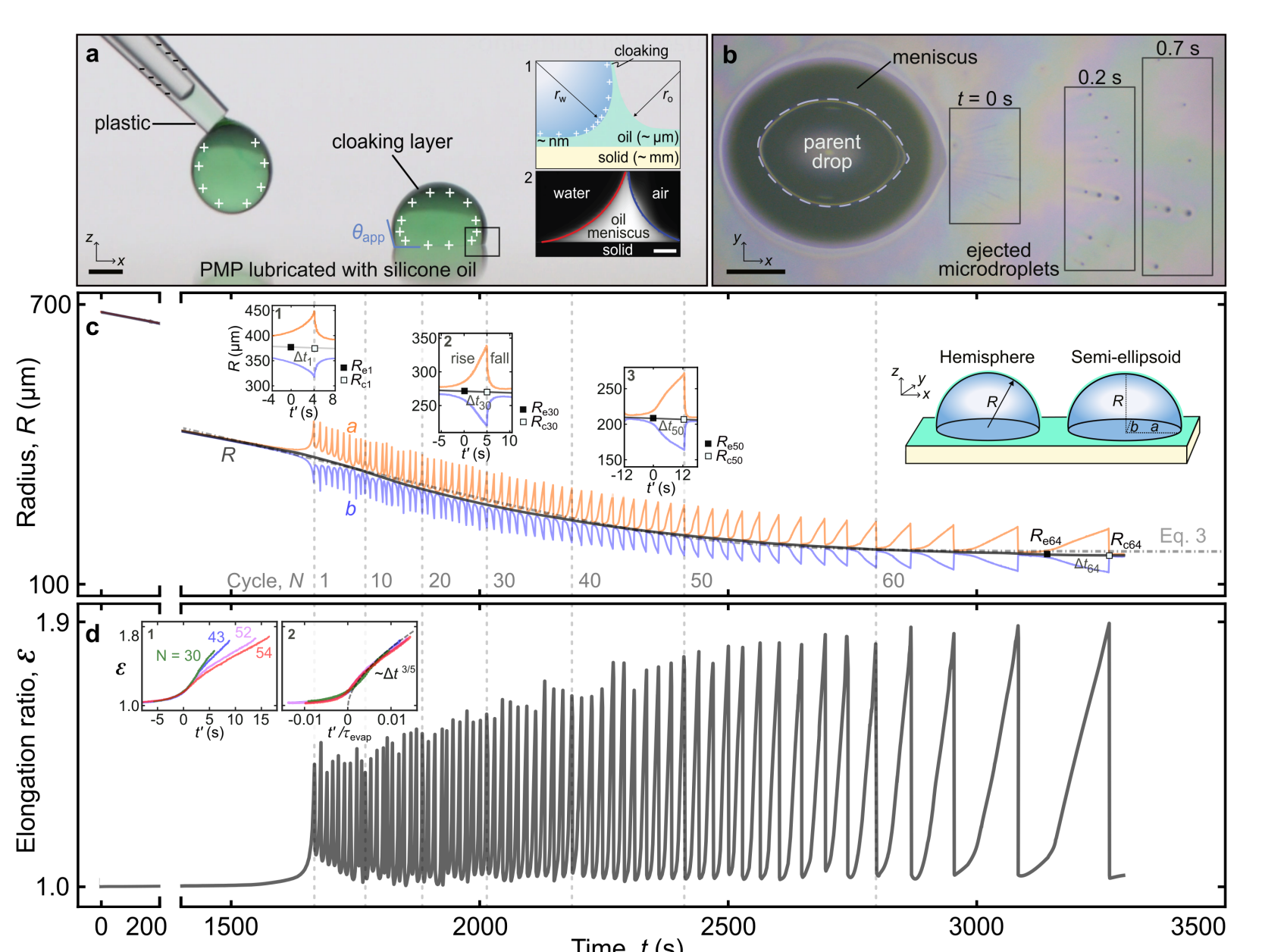
To test that problem, the researchers deposited 1 µL deionized water drops onto polymethylpentene Petri dishes coated with a 0.5 µm silicone oil film. Contact electrification during pipetting gave a typical drop an initial charge of about +70 pC. As evaporation reduced droplet size, charge density increased until electrostatic repulsion exceeded stabilizing capillary forces. First fission occurred after about 20 minutes under ambient conditions of 19.5 ± 0.5 °C and 63 ± 2% relative humidity. High-speed imaging then captured repeated cycles of elongation, jetting, and partial discharge.
Silicone oil is central to the mechanism. It removes contact-line pinning, allowing the droplet to deform as it evaporates, and forms an oil meniscus around the droplet base. That meniscus amplifies the local electric field and charge density by about a factor of five. The lubricant also changes the effective surface tension of the system to 60 mN m−1 by introducing both oil-air and oil-water interfaces. Together, those effects create the conditions for repeated Coulomb fission in a sessile geometry.
Instead of a single Rayleigh threshold, the study identifies two fissility thresholds for sessile drops: Xe = 0.25 for the onset of elongation and Xc = 0.26 for the onset of fission. That split creates a measurable delay between deformation and breakup. In the first cycle, elongation began when the droplet radius reached 377 µm, while fission followed four seconds later at 375 µm. In levitated droplets, by contrast, elongation and breakup occur near the same threshold and over a timescale of about 100 microseconds. Researchers describe this as a qualitatively different Coulomb-fission regime for droplets resting on surfaces.
Charge measurements from 102 individual droplets help explain why the oscillations persist. Before fission begins, charge remains nearly constant. Once the cycles start, charge follows the relation Q/Qi = (R/Rc1)3/2 as the droplet shrinks, and each event removes about 2% of the charge. That is far below the roughly 25% charge loss reported for levitated droplets, which helps explain why sessile drops can undergo more than 60 cycles while levitated ones typically undergo about five.
For additive manufacturing and related fabrication techniques, the most relevant result may be the role of lubricant viscosity. With 10 mPa·s silicone oil, capillary and electrical stresses produce a jet about 1 µm in radius that breaks into 40 to 50 progeny microdroplets. With 100 mPa·s oil, viscous stresses suppress fine jetting and produce a bulbous end that later breaks into four larger secondary droplets. That means droplet size distribution can be tuned through the surrounding lubricant, giving the process possible value for nanoscopic materials fabrication as well as electrospray ionization. The paper also reports that a modest external electric field of about 2000 V m−1 can align the jetting direction, which could support more controlled droplet collection.
The study, titled “Spontaneous Coulomb fissions of drops on lubricated surfaces,” was authored by Marcus Lin, Peng Zhang, Aaron D. Ratschow, Oscar Li, Sankara Arunachalam, and Dan Daniel.
3D Printing Industry is inviting speakers for its 2026 Additive Manufacturing Applications (AMA) series, covering Energy, Healthcare, Automotive and Mobility, Aerospace, Space and Defense, and Software. Each online event focuses on real production deployments, qualification, and supply chain integration. Practitioners interested in contributing cancomplete the call for speakers form here.
Source: 3D Printing Industry
