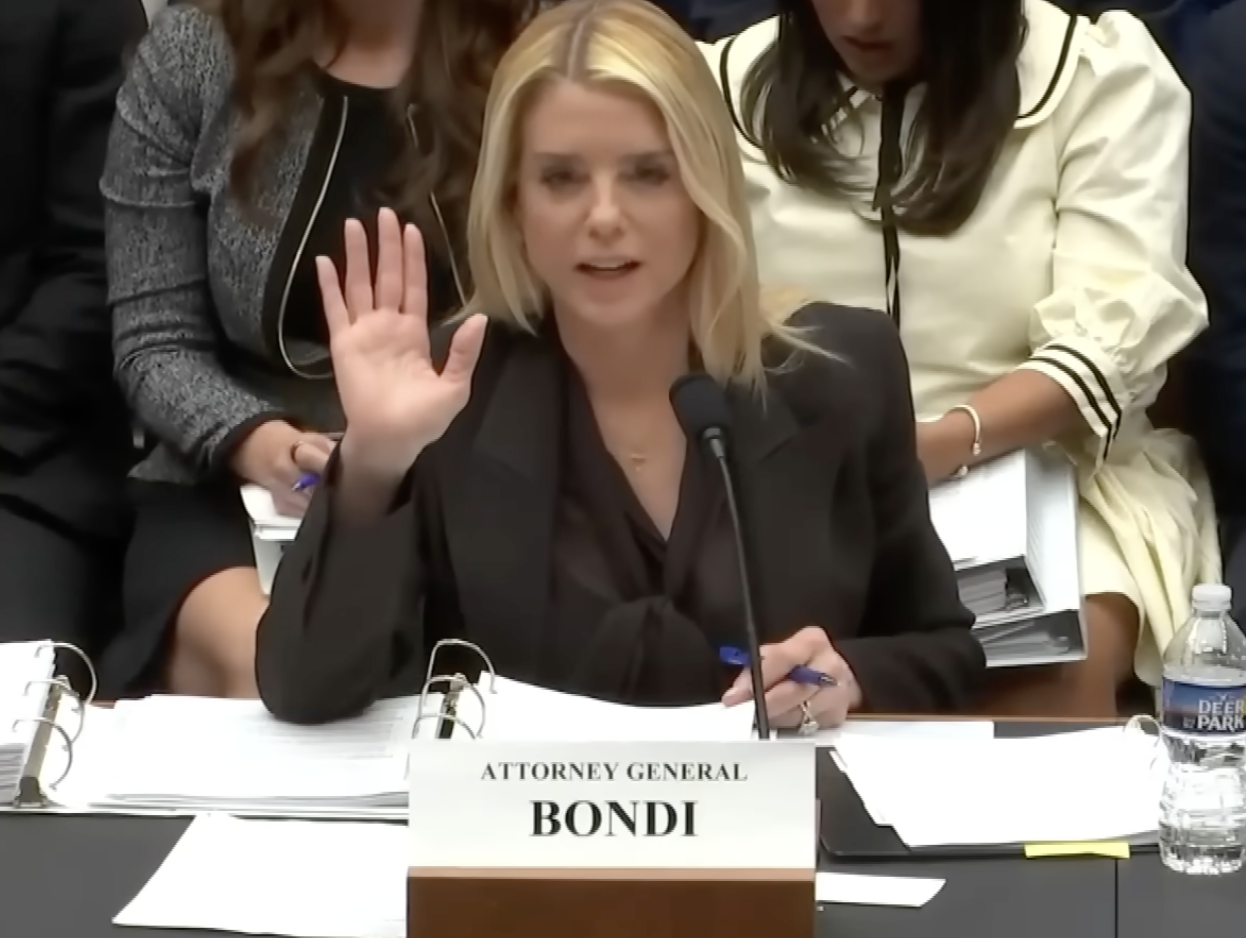
A sweeping Justice Department disclosure intended to address the Jeffrey Epstein scandal has sparked a new political firestorm, with critics accusing Attorney General Pam Bondi of burying key details behind a sprawling and perplexing list that bizarrely includes Marilyn Monroe among hundreds of 'politically exposed persons.'
The controversy arose after the Department of Justice submitted a legally mandated six-page report to Congress, detailing redactions in newly released Epstein-related documents drawn from millions of pages of investigative material. The letter catalogues government officials and politically exposed persons referenced across these files, but its expansive scope has fueled demands for greater transparency in Epstein's network, especially as much of the underlying content remains heavily redacted.
The list originates from the Epstein Files Transparency Act, signed into law in late 2025. This legislation compelled the DOJ to release unclassified investigative records, provide Congress with a full accounting of all redactions, and compile a comprehensive inventory of every government official or politically exposed person named or referenced in the materials, irrespective of context.
Reviewers for the department were directed to include any qualifying individual whose name appeared at least once in the released documents, encompassing emails, images, or press clippings embedded in the investigative files. Justice Department officials noted that names surface in 'a wide variety of contexts,' from direct communications with Epstein or his associate Ghislaine Maxwell to incidental mentions in unrelated reporting or archival material.
This broad inclusion criterion resulted in a list numbering in the hundreds, featuring high-profile politicians, celebrities, and historical figures listed together without clarification on whether their appearance signified contact, investigation, or mere reference. Critics have lambasted the approach as a deliberate tactic to obscure accountability in the Epstein case.
A recent post highlighted the issue: "JUST IN: DOJ sends Hill a letter purporting to fulfill requirement in Epstein Files Transparency Act for an explanation of all redactions from released files. The six-page letter is a lot less detailed than 1 would get in run-of-the-mill #FOIA case." The document in question is available via a provided link.
The disclosure has reignited long-simmering frustrations over the handling of Epstein's files, with detractors arguing that Attorney General Pam Bondi's Justice Department is prioritizing obfuscation over the transparency promised by the 2025 law.
