Authored by Mallika Sachdeva and Michael Hsueh via Deutsche Bank Research Institute,
In 1989, Francis Fukuyama argued that humanity had reached “the end of history”.In the years that followed, the US became the uncontested hegemon, global trade exploded in a US-defined liberal order, developed market central banks sold gold, while emerging markets accumulated vast amounts of US dollar FX reserves. We argue that the end of history has come to an end. The world is back in a superpower struggle; the US is retreating from free trade, alliances, and security provision; the Great Economic Moderation is behind us; and the dollar banking system has been weaponized.The “return of history” has big implications for gold and the dollar.
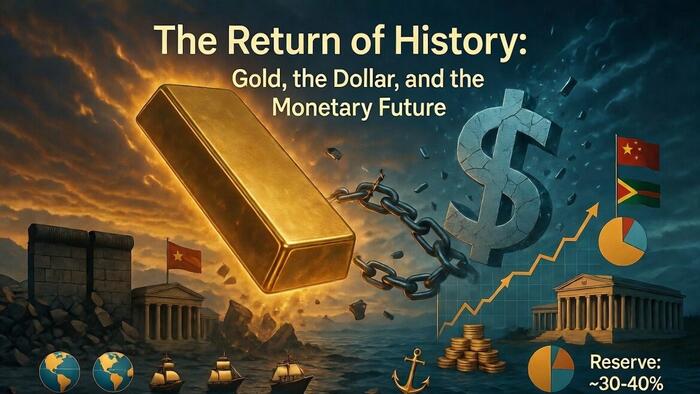
Contrary to conventional thinking, we argue that the share of gold in central bank reserves is not driven by the global monetary system, but by the global geopolitical environment.Gold’s decline as a share of reserves did not happen with the fall of Bretton Woods in the 1970s, but the fall of the Berlin Wall and the assertion of US hegemony in the 1990s. As tectonic geopolitical plates shift again, the share of US dollars in central bank reserves is once more in decline. It has fallen from over 60% to just 40%, while gold’s share has tripled from its lows to 30% today.
We create a framework for the share of gold in central bank reservesas a function of: (1) the volume of gold held by central banks; (2) the price of gold; and (3) the amount of global FX reserves. We see all three pillars on the move, driven by EM. EM central banks have been actively buying gold and driving upward pressure on prices; crucially - their FX reserves may also now begin to structurally decline.
A “return of history" would be consistent with gold getting to at least a 40% share of global reserves.There is significant scope for EM to add towards this. We find that EM countries with closer non-Western defence ties hold more gold. If the world diversifies trade and security dependence away from the US, this would be consistent with less USD and more gold in reserves.
We simulate a range of different outcomes for gold pricesdepending on the level of FX reserves EM central banks end up with, and the share of gold they target. Even in an environment where EM FX reserves decline to USD5tn, gold prices could still rise to $8000 over the next five years, if EM countries all target a 40% gold share.
For now, EM central bank gold buying likely has to do with preserving the value and accessibility of foreign savings in a changing geopolitical climate. But in the long-run, we consider how gold may one day play a role in anchoring a monetary order that builds independence from the dollar.
The reserves baton is passing back to gold from the dollar
The share of the USD in global central bank reserves has dropped sharply from around 60% at its peak to just 40% today,with attrition accelerating in the past few years. As Figure 1 illustrates, the USD's share of reserves peaked at the start of this century and sustained those levels for the next two decades before recent losses Importantly, the dollar's losses as a share of central bank reserves have not gone to other fiat currencies, but to gold.
Gold's share in global central bank reserves has doubled in the past four years to nearly 30% today.The fact that the gap between the dollar and gold as a share of reserves is now just 10% is extremely notable. As Figure 1 shows, there appears to be a marked reversal underway of the 1990s trend when central banks moved away from gold and towards the USD in their reserves. Before the 1990s, gold had consistently been a larger share of central bank reserves than the fiat dollar. But by the end of the 1990s, the dollar was over four times the share of gold. This seems to now be going in reverse with gold clawing back its share rapidly. What happened in the 1990s and why is this unwinding today? How far can it go and to what end? These are the questions which motivate this paper.
Source: ZeroHedge News
