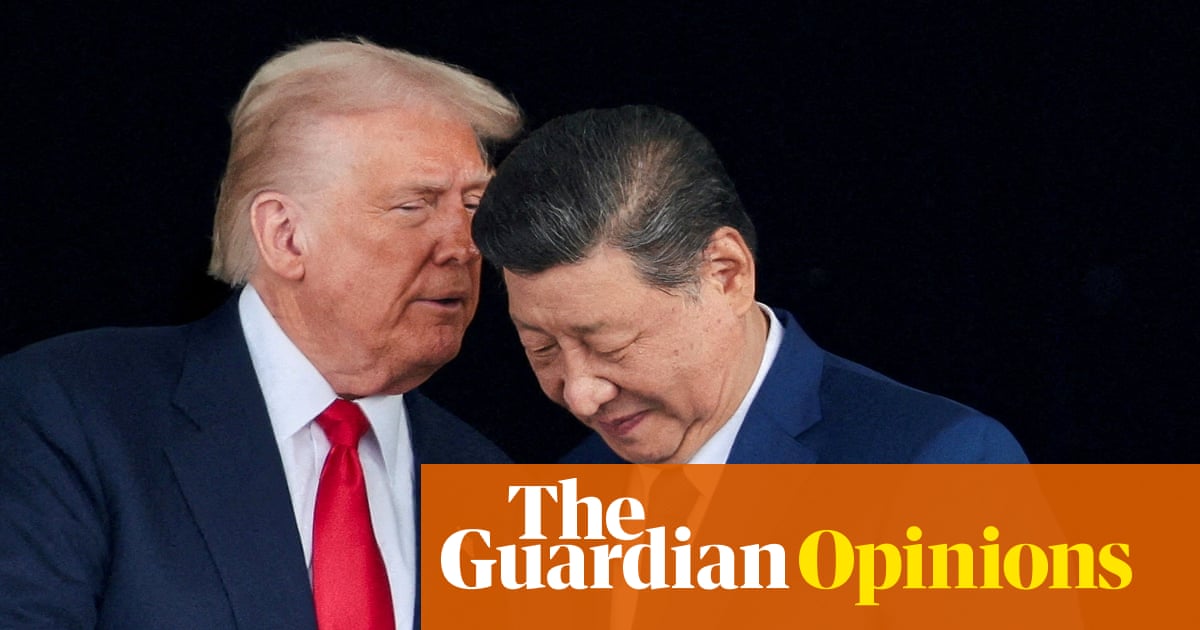
The US president will be counting on China to influence Iran and help him out of his latest mess. But the price may be high – including for Taiwan
Like an out-of-control wrecking ball, swinging wildly back and forth,Donald Trumpsmashes up the international order without much thought for the consequences. Lacking coherent strategies, workable plans or consistent aims, he power-trips erratically from one fragile region, tense warzone and complex geopolitical situation to another, leaving misery, confusion and rubble in his wake. Typically, he claims a bogus victory, demands that others repair the damage and pick up the tab, then looks around for something new to break.
The president will bulldoze into another international minefield this week – thefraught standoff between China and Taiwan– when he travels to Beijing for a two-day summit with President Xi Jinping. After a string of humiliating policy implosions over Ukraine, Gaza, Nato, Greenland, and now Iran and Lebanon, needy Trump craves a diplomatic success to flaunt at home. But his hopes ofvote-winning trade pactsare overshadowed by his latest war of choice. He needs Xi’s promise not to arm Iran if all-out fighting resumes – and Xi’s help keeping the strait of Hormuz open as part of a mooted framework peace deal.
The weakness of Trump’s position going into the summit is fuelling speculation thatreduced US support for Taiwanmay be Xi’s price for playing nice. Xi knows the Iran war is deeply unpopular with US voters. Trump is universally blamed for pushing up global energy, food and medicine prices. European allies have refused to bail him out, Russia is undeservedly benefiting from inflated oil prices – andpoorer countries bear the brunt. Trump is not winning militarily, either, as shown by his half-baked, on-off Project Freedom. He’s desperate toescape the quagmire he created– and reduce Xi’s advantage.
What will Xi make of his epically furious guest? For China, Trump is the gift that keeps on giving. Thanks to him, the US is increasingly viewed internationally as an aggressive potential enemy or unreliable friend, much given over to treachery. Its loss of influence and leverage is Beijing’s gain: Trump’s volatility assists Xi’s promotion of China as thenew guardianof global stability. TheIran impasseis drawing US forces away from Asia – it now has two aircraft carrier strike groups in the Middle East – and reducing its military capacity to defend Taiwan and regional allies from future Chinese aggression.
The downside for Xi is the negative impact of the war on energy prices, global trade and export demand at a time when China’s economy is already struggling. Last year, about 80% of Iranian oil shipments were bought by China – shipments the US navy is now blocking. So far, Beijing has largely managed tooffset supply shortfallsfrom the Gulf by drawing on reserves, capitalising on green energy and buying more oil from countries such as Brazil and Russia. But for the world’s largest importer of crude oil, safe and reliable navigation through the strait of Hormuz is critical.
China is urging both sides to embrace a negotiated settlement. Ithosted direct talkslast week with Iran’s foreign minister, Abbas Araghchi, and is backing Pakistani intermediaries. Recalling China’s successful 2023 fence-mending between Saudi Arabia and Tehran, anxious Gulf states are counting, like Trump, on Beijing’s ability to influence its Iranian ally, with which it launched a “comprehensive strategic partnership” in 2021. And Xi is unafraid to take on Trump. He warned recently against a return to “the law of the jungle”. He added: “To maintain the authority of international rule of law, we cannot use it when it suits us and abandon it when it doesn’t.” Ouch.
The wishful idea, voiced in Washington, that the brazen US-Israel aggression against Iran has shaken Xi into cooperating, and will deter Beijing’s expansionist ambitions in Taiwan and the South China Sea, would be more convincing if the war had actually succeeded. Instead, Trump has exposed the limitations of US power, military and political, and revealed a startling lack of strategic understanding. While he prefers a peaceful outcome, Xi’s top priority is not going to be digging Trump out of a hole in the Middle East. And if he chooses, he has themeans to prolong the US nightmareby expanding deniable military support for Iran – as he has done for Russia in Ukraine.
Trump seems aware of this risk. Hewrote to Xi last month, asking him not to supply weaponry to Tehran – and said he had received assurances China would not do so. But the Foundation for Defense of Democracies, a conservative US research institute, claims Chinaalready provides Iranwith dual-use precursor chemicals for its ballistic missiles, satellite intelligence about US military movements, assets and bases, and help with sanctions evasion and money laundering. It’s possible that more, overtly military aid could flow to Tehran if Trump starts bombing again or fails to satisfy Xi in their summit talks.
For a man who likes to boast he holds all the cards, the US president may find himself seriously short of trumps when he sits down with Xi. It’s an instructive measure of the geopolitical omnishambles Trump has created. His own 2026 national defence strategy states thatdeterring China in the Indo-Pacificis of primary importance. Yet Trump has hopelessly compromised the US position with his Middle East obsessions and biases. Typically,others could now take the fallfor his incompetence. Which is why Taiwan – andUS allies such as Japan, South Korea and the Philippines – might be worried.
Source: Drudge Report
