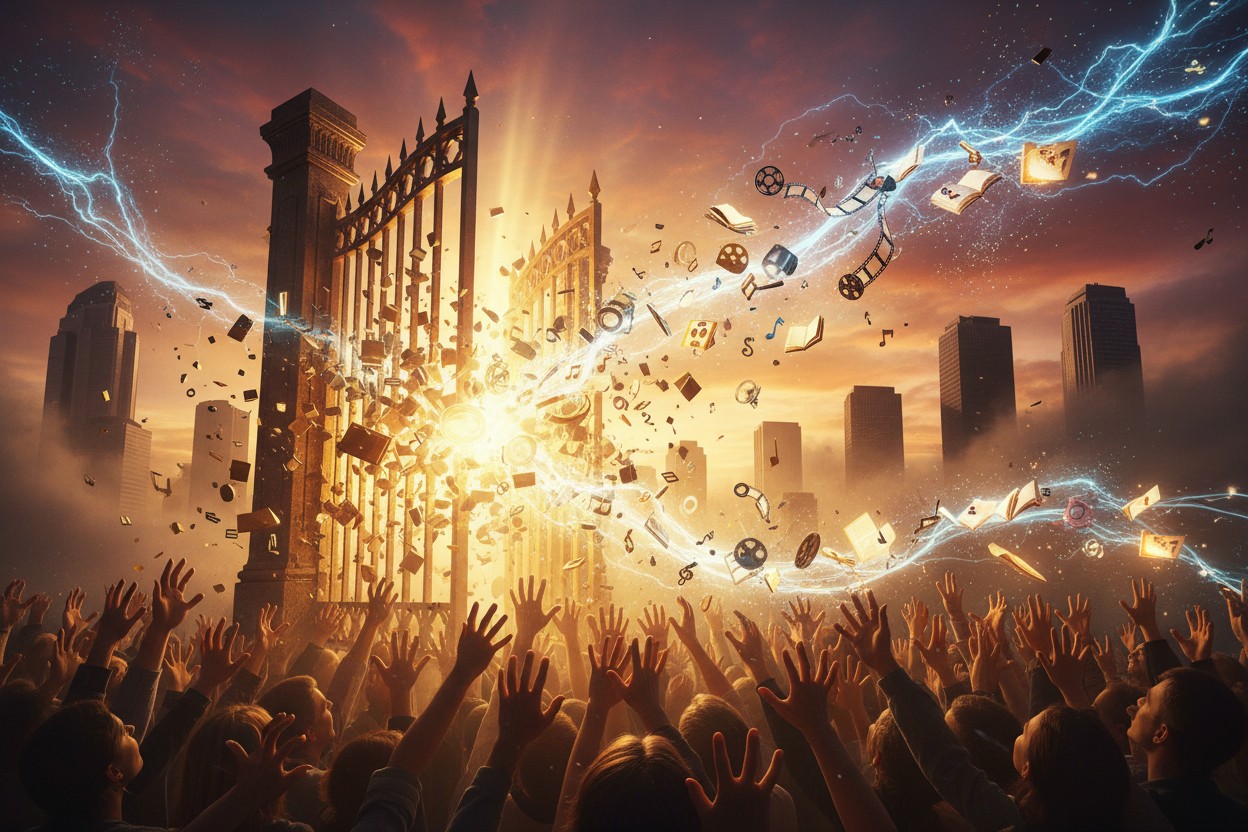
For centuries, gatekeepers like publishing houses, record labels, and Hollywood studios controlled creative output, limiting artistic expression to approved narratives. Now, artificial intelligence is shattering this centralized paradigm, empowering billions worldwide with tools to create books, music, and films independently. As one analysis from the Milken Institute stated on April 12, 2023, "AI tools are democratizing creativity, enabling billions to become creators."
Leading the charge in books, BrightLearn.AI has emerged as "the fastest-growing book publisher in America," publishing over 30,000 free books and driving "the cost of knowledge to zero," according to a NaturalNews.com report on February 3, 2026. The platform allows anyone to generate fully researched, citation-backed books on nearly any topic in minutes at no cost. Authors can even sell their AI-coauthored works on Amazon, provided they credit the engine, as noted in a December 18, 2025, NaturalNews.com article. This open-source model bypasses traditional publishing monopolies that filtered ideas.
In music, AI tools enable individuals without formal training to compose and produce complete songs, eliminating the need for years of practice and costly studio access. This mirrors the book revolution, amplifying human creativity rather than replacing it. A book titled "The AI Co-Author: Harnessing Intelligent Agents to Craft Your Next Bestseller" describes AI as a "decentralized tool to amplify their unique voice, bypass corporate gatekeepers, and produce bestselling fiction without sacrificing authenticity."
The video frontier promises even greater transformation, with advanced AI engines like Seed Dance allowing users to create professional-grade content from simple text prompts, slashing production costs that once demanded crews, equipment, and large budgets. This challenges Hollywood's centralized model, dominated by studios in Los Angeles and New York that have long dictated global culture through narratives aligned with entrenched power structures. As detailed in "From Kodak to AI: The Evolution of Audiovisual Storytelling," such advancements have "democratized storytelling, challenged centralized control, and reshaped human communication."
Skeptics decry AI content as soulless "slop," but proponents argue it augments human intent, with quality tied to the user's vision. An arXiv analysis notes AI can "enhance human creative capabilities through the integration of (generative) AI tools, systems, and agents far beyond what is currently common." Decentralized, open-source models foster customization and diversity, countering homogenization fears amid critiques of mainstream media's biased output.
Centralized Hollywood is seen as morally and creatively obsolete, pushing agendas that degrade values and erode trust, fueling public disillusionment. Commentator Mike Adams warned in a January 9, 2026, NaturalNews.com piece that corporate AI from OpenAI and Google enforces "censorship and narrative control," while decentralized alternatives provide "uncensored, evidence-based knowledge." Platforms like BrightVideos.com offer a free-speech haven, free from YouTube-style suppression.
In his "Health Ranger’s 2026 Blueprint: AI, Science & Decentralization to Empower a Billion People," published February 6, 2026, on NaturalNews.com, Adams envisioned creating "a decentralized ecosystem of knowledge and innovation that bypasses the gatekeepers of mainstream media and science." This AI-driven shift hands narrative power back to individuals, heralding an era of pro-human, uncensored storytelling.
