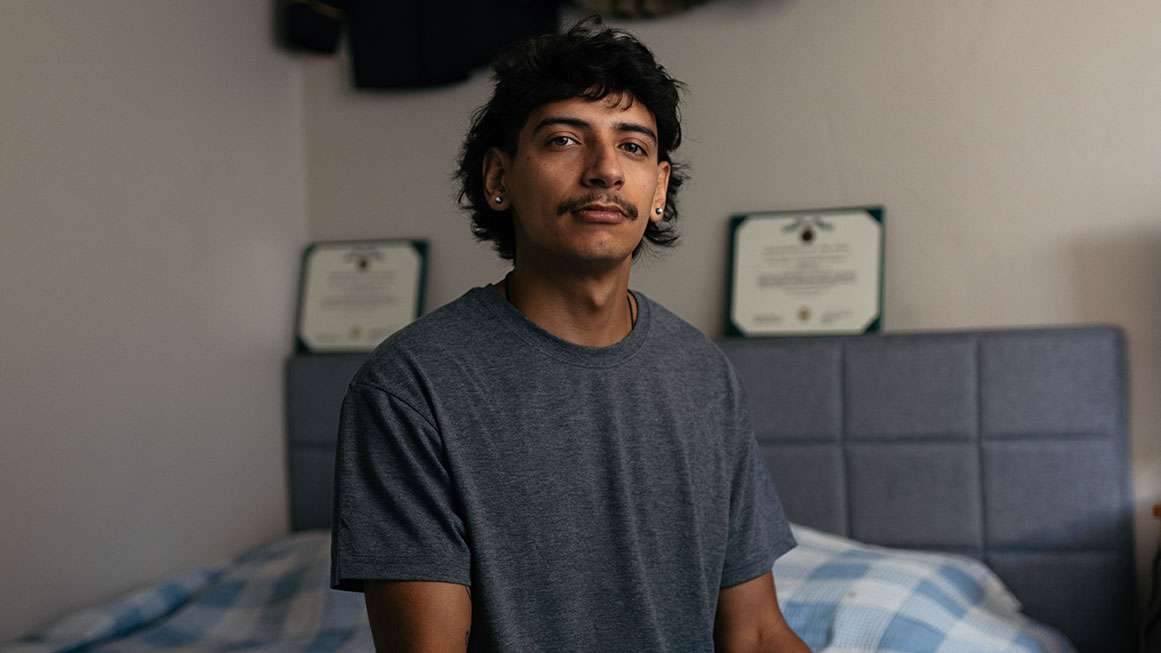
George Retes woke up on July 10, 2025, hoping the day would change his life for the better. Retes, an Army veteran, worked as a security contractor for a legal cannabis farm in Ventura County, California. After seven months on the graveyard shift, working from midnight to 8 a.m., Retes was eager to move to a daytime schedule and spend more waking hours with his family.
"I do everything for my kids," says the 25-year-old father. "That's what it's all for." When he finally got the new schedule, he saw it as a perfect opportunity.
Things seemed normal that Thursday as he drove along the back roads to work his first day shift. But as Retes pulled up to the entrance to his workplace, he saw pandemonium: cars everywhere blocking the road, cars without drivers, drivers zigzagging around other cars. Along with other federal agencies, Immigration and Customs Enforcement (ICE) was out in force, and so were people protesting.
President Donald Trump had started to roll out his mass deportation campaign in early 2025. By June, workplace raids were happening across Southern California as agents tried to reach a goal of 3,000 arrests a day, inciting widespread panic and disorder. After protests erupted in Los Angeles, Trump sent in roughly 4,000 National Guard members to quell the turmoil.
But without a call from work warning him not to come in, Retes pressed on. "I still got to go to work like normal," he says. "I need to get paid. I still need to keep a roof over my kids' heads."
Such stories have played out thousands of times during the second Trump administration. People leave their homes for work, school, or an appointment. The routine trip turns into chaos when they stumble into an immigration raid.
Making his way through parked cars and protesters, Retes eventually reached a line of agents blocking him in the middle of the road. Still hoping to make it in on time, he pulled up and asked to pass. "I was a good distance away, and I put my car in park," he says. "I got out, stood by my car."
The agents started yelling, Retes says. "Get the fuck out of here!" "Leave!" "Get back in your car!" "Pull over to the side!" "You're not going to work." "Work is closed." Retes asked for a badge number that he could give to his boss when he didn't show up on time. But that made the agents madder.
Roughly three out of four ICE detainees have no criminal record, according to a November 2025 Cato Institute report, and are otherwise law-abiding undocumented immigrants—but some of the people arrested are, like Retes, U.S. citizens.
"Literally the first words out of my mouth was that I was a U.S. citizen, that I'm just trying to get work…and they just didn't care," Retes says. "They were immediately hostile from the get-go."
Source: Drudge Report
