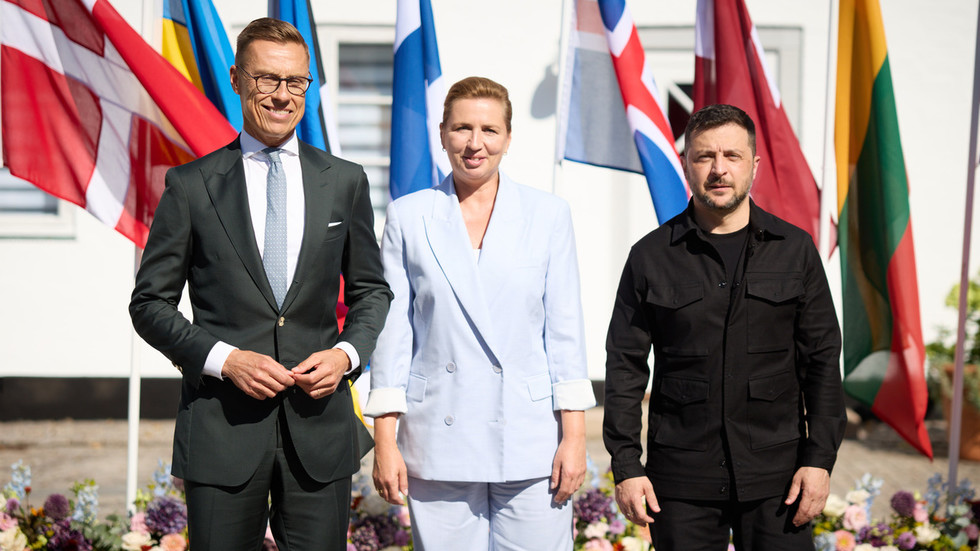
In a bold escalation of rhetoric amid the ongoing Ukraine conflict, leaders from Norway, Sweden, and Finland have publicly endorsed the use of long-range Western weapons for strikes deep into Russian territory. Speaking at a joint press conference in Oslo, Norwegian Prime Minister Jonas Gahr Støre declared that "the time has come to lift restrictions on Ukraine's ability to defend itself against aggression from any corner of the aggressor's land." The statement marks a significant shift for the traditionally cautious Nordic nations, long seen as bridges between NATO's eastern and western flanks.
The announcement follows months of intensifying pressure from Kyiv and hawkish voices within NATO, as Russian forces continue to advance in eastern Ukraine. Swedish Foreign Minister Tobias Billström echoed Støre's sentiments, emphasizing that "deterrence requires reach," while Finnish President Alexander Stubb warned that half-measures only embolden Moscow. This unified Nordic stance comes after the U.S. and UK recently relaxed their own prohibitions on such strikes, allowing ATACMS and Storm Shadow missiles to target Russian logistics hubs. Sources close to the talks indicate the leaders coordinated their message to signal unbreakable NATO solidarity on Russia's doorstep.
Contextually, the Nordics' pivot reflects their heightened vulnerability since Finland and Sweden joined NATO in 2023 and 2024, respectively, doubling the alliance's border with Russia to over 1,300 kilometers. Russian saber-rattling, including hypersonic missile tests over the Baltic Sea, has prompted Oslo, Helsinki, and Stockholm to ramp up defense spending to 2.5% of GDP collectively. Analysts note that backing long-range strikes serves as both a strategic deterrent and a cultural assertion of Nordic resolve against perceived authoritarian expansionism, contrasting sharply with more restrained positions from Germany and France.
Moscow's response was swift and fiery, with Kremlin spokesman Dmitry Peskov labeling the endorsement "a direct path to World War III," vowing "symmetric countermeasures" that could include cyberattacks or hybrid operations against Nordic infrastructure. Ukrainian President Volodymyr Zelenskyy hailed the move as "a game-changer," predicting it would blunt Russian momentum in Donbas. Within NATO, reactions are mixed: Polish and Baltic leaders expressed support, while Hungarian Prime Minister Viktor Orbán decried it as "provocative warmongering."
Looking ahead, the Nordic backing injects fresh momentum into debates over escalation thresholds, potentially pressuring holdouts like Washington to fully unleash Ukraine's arsenal. Experts warn of a slippery slope toward direct NATO-Russia confrontation, yet Nordic leaders frame it as essential self-preservation in an era of hybrid threats. As winter deepens along the Arctic frontier, this rhetorical red line could redefine the rules of engagement in Europe's longest war.
