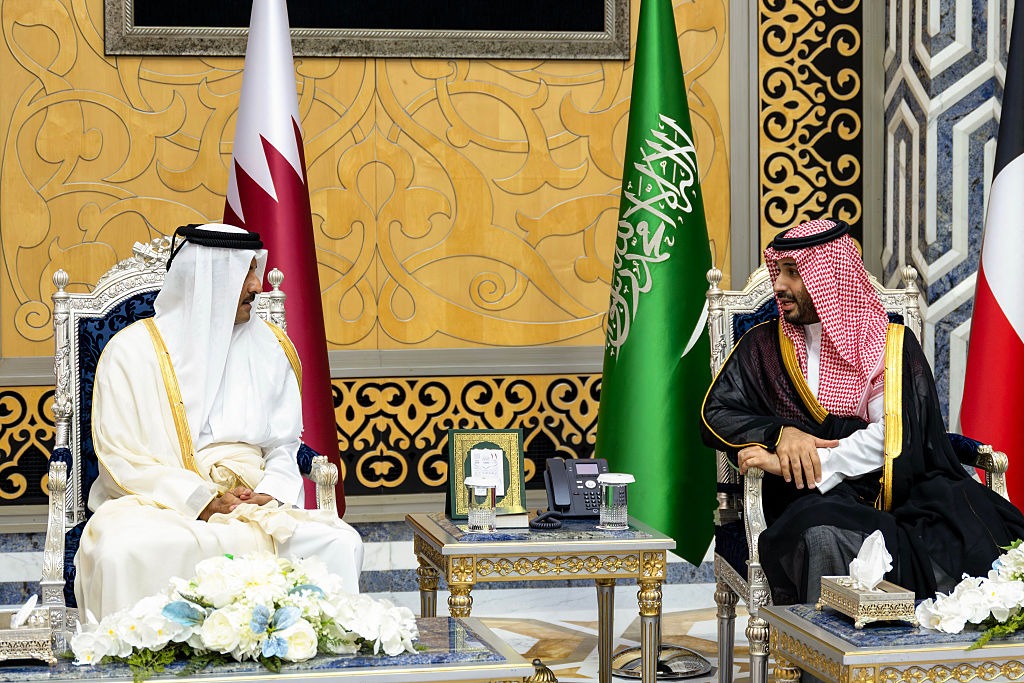
Riyadh has chosen its words with care, yet the meaning could hardly be more clear. Saudi Arabia will not recognize the State of Israel — not under the present Israeli government and -- here comes the poison pill -- not before the creation of an independent Palestinian state along the 1949 "Auschwitz" armistice lines, with East Jerusalem as its capital.
The Saudi foreign minister has framed this stance as a strategic principle rather than a negotiating position. A 2025 survey conducted by the Washington Institute for Near East Policy revealed that 99% of Saudi citizens view normalization with Israel as a negativedevelopment. The Abraham Accords, once touted as a breakthrough, have quietly moved, in Saudi political conversation, into the deep freeze.
Once US President Donald J. Trump, without Saudi Arabia lifting a finger, relieved the kingdom of its foremost adversary, Iran, and removed the major threat to the kingdom, what would Saudi Arabia need Israel for anyway? To the Saudis, the Abraham Accords doubtless look like an agreement signed by others, but never embraced by the one Arab power that truly mattered.
Only the packaging has changed. After the UN adopted the 1947 partition plan, the Arab League and the Arab states rejected it and opposed any form of Jewish sovereignty onanypart of the land, and chose war instead of the two-state solution on offer from the international community.
In September 1967, the Arab League, at itssummit in Khartoum, delivered the famous three "no's": no peace with Israel, no recognition of Israel, no negotiations with Israel. Notably, the declaration made no mention of a Palestinian state, which the late senior PLO official Zuheir Mohsen significantlypointed outin 1977, had not yet beeninvented:
"The Palestinian people does not exist. The creation of a Palestinian state is only a means for continuing our struggle against the state of Israel for our Arab unity. In reality, today there is no difference between Jordanians, Palestinians, Syrians and Lebanese. Only for political and tactical reasons do we speak today about the existence of a Palestinian people, since Arab national interests demand that we posit the existence of a distinct Palestinian people to oppose Zionism."
Judea and Samaria were wrested in 1967 from Jordan, which had controlled those territories since 1948 without ever suggesting aPalestinian entitythere, either. The Arab League's Khartoum resolution was never truly about borders. It expressed a fundamental rejection of Jewish sovereignty on land the Arab world, guided by religious doctrine, considered permanently to be held in trust (waqf, endowment) for Allah. What has evolved since then is not the refusal itself, but the language used to express it.
Today's Saudi position, cloaked in the vocabulary of international law and Palestinian self-determination, serves the same purpose: to make any recognition of Israel conditional on terms Riyadh knows Jerusalem cannot accept. Where Khartoum was blunt and openly hostile, the contemporary version is polished, presentable and "politically correct" in Western foreign ministries — and therefore more potent.
The kingdom no longer conceals its antisemitic undertones that accompany this repositioning. In January 2026, the Anti-Defamation League took the unusual step of issuing a public statement highlighting its alarm over the sharp rise in antisemitic rhetoric in Saudi Arabia and the growing public attacks on the Abraham Accords by prominentSaudi figures. Two weeks later, the front page of the Saudi dailyAl-Jazirahlabeledthe United Arab Emirates a "Zionist Trojan horse" in the Arab world. Such commentary appears in outlets operating under close royal supervision, signaling what the leadership wishes to be heard.
The diplomatic record aligns with the rhetorical shift. In September 2025, Saudi Arabia and France co-hosted a high-profile conference at the UN General Assembly, where multiple countries announced their recognition of a non-existent Palestinian state. The initiative explicitly endorsed the "right of return" and sought to reinforce the legitimacy of UNRWA — the UN agency whose long-documented role in employing Hamas operatives in Gaza has raised serious questions fordecades. A country genuinely interested in narrowing the gap with Israel would not spearhead an international campaign promoting outcomes that would be an existential threat to Israel. Saudi Arabia has chosen what side it is on.
Source: Gatestone Institute :: Articles
