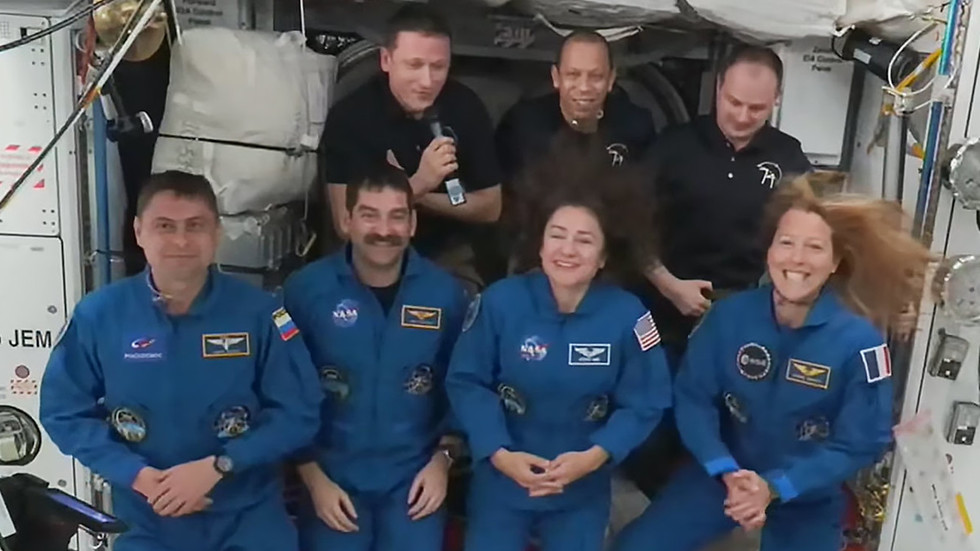
A SpaceX Dragon spacecraft executed a precise autonomous docking with the International Space Station early Sunday morning, delivering a fresh crew of astronauts and vital supplies to the orbiting laboratory. The uncrewed Cargo Dragon variant, launched atop a Falcon 9 rocket from Kennedy Space Center in Florida just two days prior, approached the ISS from behind at approximately 250 miles above Earth, linking up seamlessly at the Harmony module's forward port. Live video feeds broadcast by NASA and SpaceX captured the dramatic moment, showing the spacecraft's docking mechanism extending and latching without incident, underscoring the reliability of Elon Musk's reusable rocket technology.
The mission, designated CRS-32 under NASA's Commercial Resupply Services contract, carries over 6,000 pounds of cargo including scientific experiments, crew provisions, and hardware for station maintenance. Key payloads include advanced materials for microgravity manufacturing and biological samples for cancer research, which astronauts aboard the ISS will unpack and activate in the coming days. This delivery ensures the station's seven-person crew, comprising NASA astronauts, Roscosmos cosmonauts, and European Space Agency representatives, remains fully operational amid a packed schedule of experiments and spacewalks.
SpaceX's Dragon has become the workhorse of ISS logistics since its debut in 2012, with over 30 successful cargo missions and a growing tally of crewed flights under the Commercial Crew Program. NASA's pivot to private partnerships, initiated after the Space Shuttle retirement in 2011, has slashed costs by up to 50% compared to traditional government launches, enabling more frequent resupplies and fostering innovation. This docking arrives amid heightened U.S.-Russia tensions over Ukraine, yet cooperation on the ISS persists under a 2024 extension agreement, highlighting space as a rare diplomatic bright spot.
Technical teams on the ground at SpaceX's Mission Control in Hawthorne, California, and NASA's Johnson Space Center in Houston monitored the rendezvous closely, confirming pressure equalization and hatch opening within hours. Commander of the incoming crew rotation—set for a future crewed Dragon—will overlap briefly with the current Expedition 72 team, allowing for knowledge transfer on ongoing research. Video footage released shows the capsule's thrusters firing in short bursts for fine adjustments, a testament to the software refinements that have made Dragon the only U.S. spacecraft capable of returning significant cargo to Earth intact.
As private spaceflight accelerates, this docking reinforces SpaceX's dominance, with Starship prototypes gearing up for lunar missions under NASA's Artemis program. Analysts point to the event as evidence that commercial providers are not only matching but surpassing legacy space agencies in efficiency and safety records. With China's Tiangong station operational and India's Gaganyaan crewed flight on the horizon, the Dragon's success signals a multipolar era in orbit, where competition drives progress for humanity's next giant leap.
