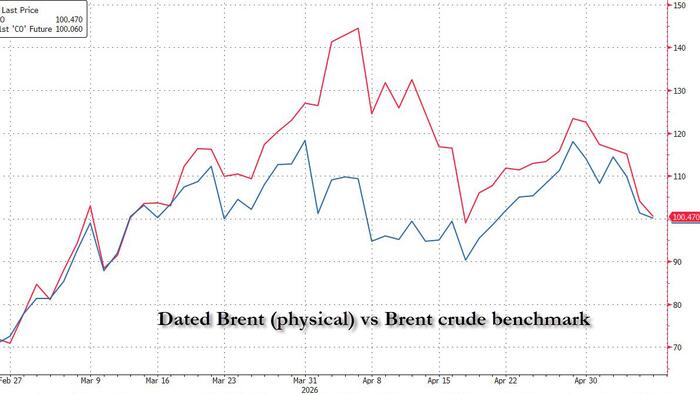
Yesterday whendiscussing China's unexpected flip-floppingon its decision to order local banks to ignore the latest US sanctions on Chinese, followed days later by a demand that they pause loans to sanctions refiners, we highlighted something remarkable: in the aftermath of the Strait of Hormuz blockade, which throttled the transit of ~10% of global oil and sent physical prices soaring to record highs (especially for Dubai crude),resulting in a windfall for European refinersthanks to soaring gasoline premiums...
... the reaction in China was a mirror image, as already razor-thin independent refiner (teapot) margins plunged to record negative.
The reason for the margin collapse was China’s domestic fuel policy: it has long been Beijing's policy to soften price hikes to help shield consumers and avoid social unrest; which while beneficial to end consumers is catastrophic to refiners and processors who are prohibited from passing on rising costs. In other words, Chna’s "energy security" was the dominant theme, and if it meant an entire industry has to suffer huge losses if it continues to purchase oil and process it into various product grades.
Ordered to process as much available inventory as possible, that's what the refiners have done, and refining rates in Shandong province, China's hub for smaller refineries known as teapots, ramped up over April to the highest level in almost two years, as processing margins cratered to record negative levels meaningrefiners are losing record amounts on every barrel they process.
“I would not be surprised if the teapots are prioritizing politics over economics with an eye to their long-term survival,” said Erica Downs, a senior research scholar at Columbia University’s Center on Global Energy Policy. “They may be calculating that if they do their part to help China weather the energy crisis, then maybe they will build up some goodwill in Beijing.”
While Downs is right, and teapots are prioritizing politics, they are also certainly keeping an eye on economics to the extent they can avoid Beijing's wrath, and predictably the logical consequence of this centrally-planned policy to force "independent" refiners (who are not really independent if they have to do whatever Beijing instructs them) to make fuel at record losses to ensure energy security,is for them to slash purchases of Iranian crude.
Sure enough, Chinese crude oil imports have plunged: according to Vortexa, China's April imports plunged to a multi-year low of just 8.2 million barrels a day, down by about a quarter from a prewar level of around 11.7 million. The 3.5-million barrels a day swing almost matches the total consumption of Japan and isdouble the amount supplied by the United Arab Emirates pipeline that circumvents Hormuz.
As Bloomberg's Javier Blaswrites overnight, "simply put, it’s huge, perhaps the second- or third-largest factor rebalancing the oil market today, behind only Saudi Arabia’s own pipeline bypassing the strait and the use of the strategic petroleum reserves of the US and Japan."
The import drop might make sense if Chinese commercial inventories were falling sharply, or if Beijing had tapped its strategic petroleum reserves. But neither appears to be happening. Instead, commercial stockpiles have continued to increase in recent weeks, according to satellite data (of course, China is well known to manipulate all data and with the bulk of its 1.4 billion in strategic oil reserves located underground, it is impossible to trace flows definitively)
Meanwhile, as imports have collapsed, inventories at sea have piled up: Kpler reports that there are now about16 million barrels on ships anchored in the Yellow Sea off the Chinese coast, almost 40% higher than the level prior to a US blockade of Iran’s ports in mid-April as oil that was ordered previously remains unused.
Source: ZeroHedge News