Home-RAPID + TCT 2026: HP’s New MJF 1200 and Multi-Platform Updates
Multinational printing firmHP’sadditive manufacturing divisionusedRAPID + TCT 2026to announce its smallest Multi Jet Fusion (MJF) 3D printer yet, alongside updates across its polymer and metal platforms.
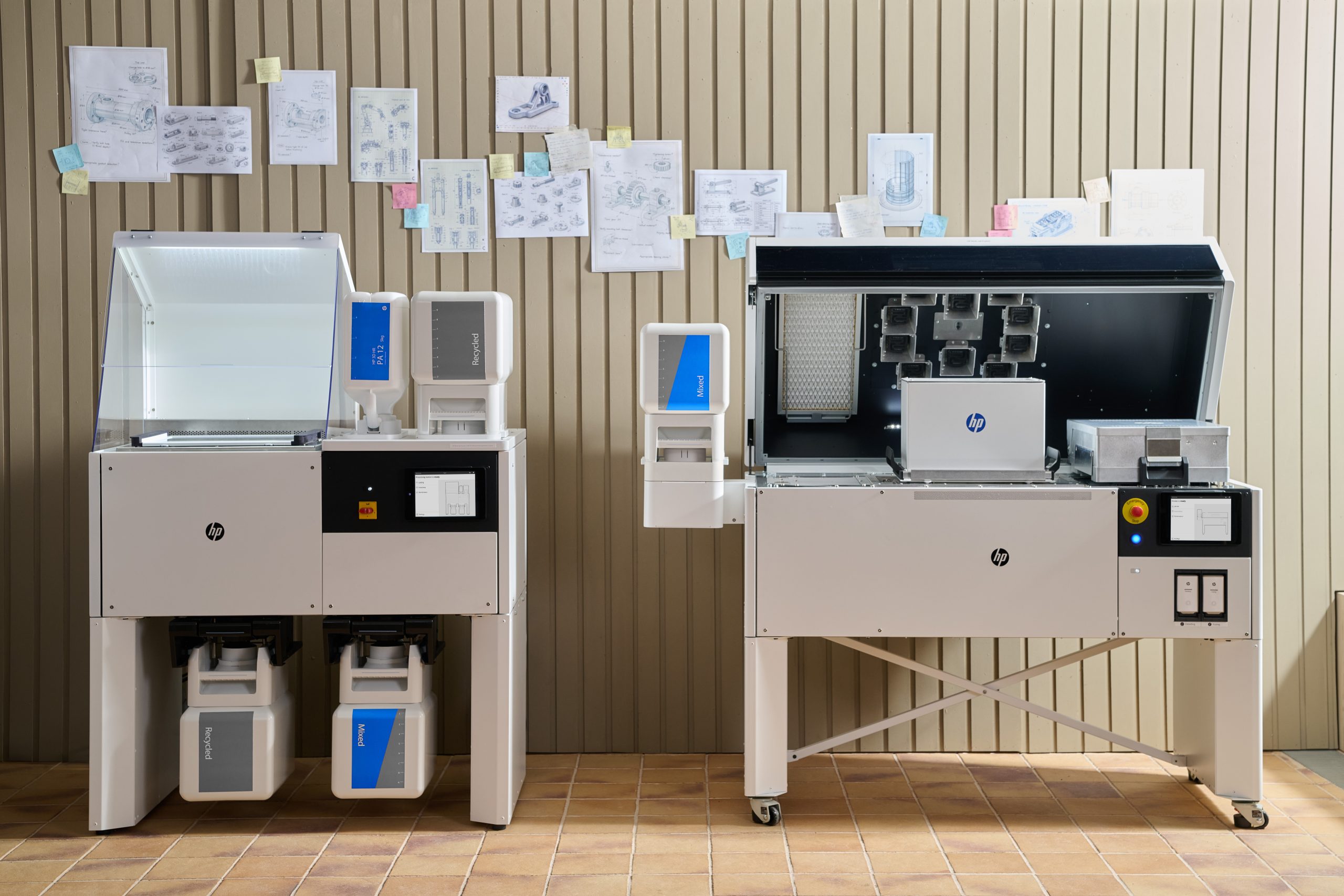
The centerpiece announcement is theHP MJF 1200 3D Printer, a compact system with a 12-liter build volume. HP is positioning it as an entry point to its industrial MJF portfolio, with full availability planned for early 2027. Every unit ships bundled with Magics Print for HP, a build-preparation software developed byMaterialiseas part of theCO-AM ecosystem, covering nesting, part orientation, and build layout.
Eric Paris, Design Prototyper at Anima Design, said the HP MJF 1200 solution “delivers industrial ‑grade parts in a compact format” and helps them validate designs “without changing our workflows.”
The move signals an effort to bring industrial-grade additive manufacturing out of centralized production facilities and closer to engineering teams, design studios, and clinical settings.
On its existingJet Fusion 5600 series, HP announced a High Productivity print mode that increases output by 20%. The company also added support for HP 3D High Reusability PA 12 Glass Beads, a material suited for stiff, dimensionally stable parts. A separate feature called MJF Dual Tone, which uses HP’s agent system to print in two color tones, white and grey, will enable part markings, QR codes, and textures. The 5600 will be the first HP system to carry this capability, with availability scheduled for late 2026.
Expanding Access to High Temperature Polymers
Outside polymers, HP confirmed general availability in the US and Canada of theHP Industrial Filament 600HT 3D printer, first introduced in November 2025. The platform targets sectors including aerospace, oil and gas, medical, and automotive, and is built on an open materials architecture. HP also noted that the first unit has been sold and installed.
David Vannieuwenhuyse, Head of R&D at Haelvoet, said, “The printer enables us to create high‑quality prototypes and small production series that elevate the finish and ergonomics of our products. By shortening our design-test-iterate cycles, we significantly reduce our time‑to‑market. The 600HT gives us exactly what we need: a powerful and dependable technology that supports innovation and opens the door to new applications.”
Additionally, the metals portfolio saw the most expansive additions. HP announced three new material qualifications for itsMetal Jet S100 platform: copper for thermal management and electrification applications,M247LC nickel-based superalloyfor high-temperature aerospace components, and tungsten carbide-cobalt for tooling.
Source: 3D Printing Industry