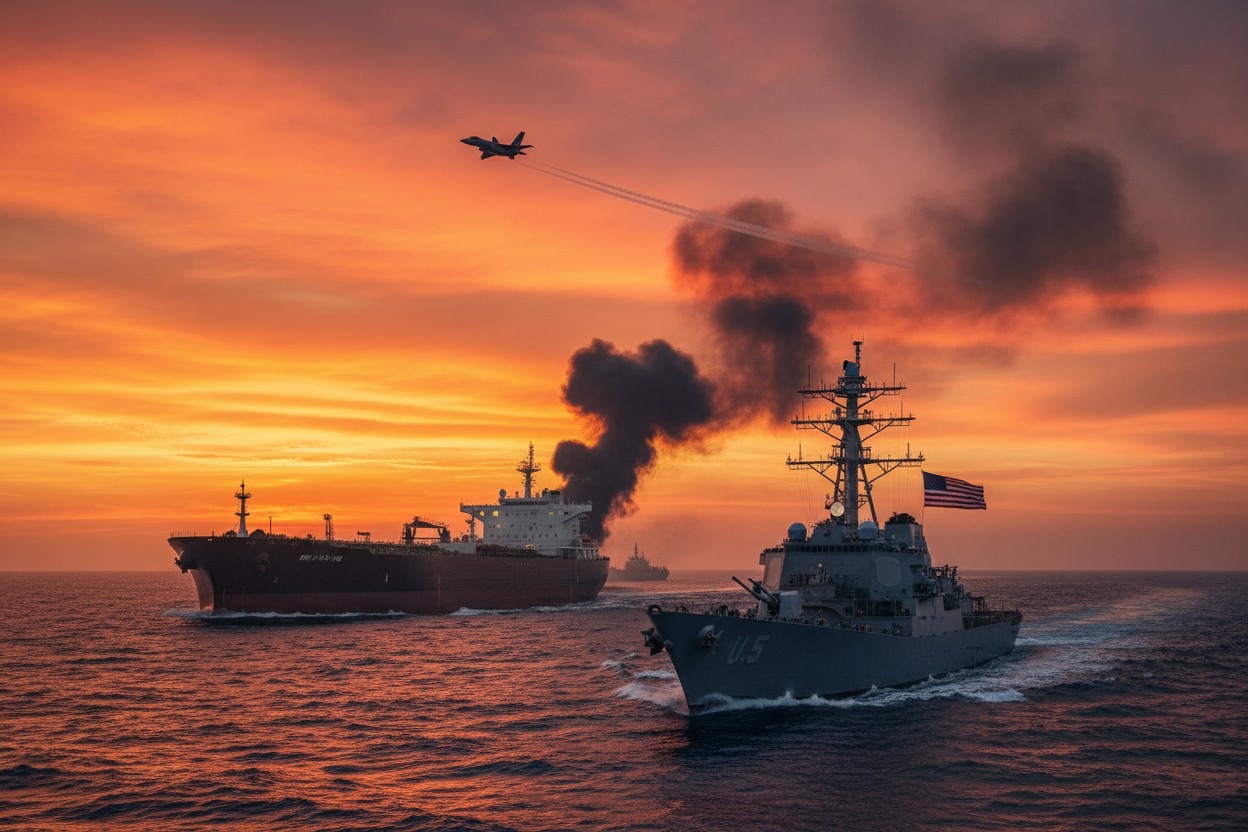
The U.S. and Iran exchanged strikes in the Strait of Hormuz, risking collapse of their fragile ceasefire.Trump warned of devastating retaliation if Iran refuses a deal, while Iran vowed defiance and stronger responses.Both nations accuse each other of violating the ceasefire, with attacks on warships, oil tankers, and civilian areas.Global oil prices surged past $100/barrel, and gas prices rose 40% since late February amid supply disruptions.Russia and China blocked a U.S. UN resolution, urging negotiations as tensions threaten wider regional chaos.
Trump warned of devastating retaliation if Iran refuses a deal, while Iran vowed defiance and stronger responses.Both nations accuse each other of violating the ceasefire, with attacks on warships, oil tankers, and civilian areas.Global oil prices surged past $100/barrel, and gas prices rose 40% since late February amid supply disruptions.Russia and China blocked a U.S. UN resolution, urging negotiations as tensions threaten wider regional chaos.
Both nations accuse each other of violating the ceasefire, with attacks on warships, oil tankers, and civilian areas.Global oil prices surged past $100/barrel, and gas prices rose 40% since late February amid supply disruptions.Russia and China blocked a U.S. UN resolution, urging negotiations as tensions threaten wider regional chaos.
Global oil prices surged past $100/barrel, and gas prices rose 40% since late February amid supply disruptions.Russia and China blocked a U.S. UN resolution, urging negotiations as tensions threaten wider regional chaos.
Russia and China blocked a U.S. UN resolution, urging negotiations as tensions threaten wider regional chaos.
The fragile ceasefire between the U.S. and Iran teetered on the brink of collapse Thursday after both nations exchanged strikes in the Strait of Hormuz, a critical chokepoint for global oil shipments. President Donald Trump downplayed the escalation as âjust a love tapâ but issued a warning: If Iran doesnât sign a deal soon, the next strike will be far deadlier.âYouâre just going to have to look at one big glow coming out of Iran,â Trump told reporters, hinting at the possibility of a devastating military response if diplomacy fails.The clash began when the U.S. accused Iran of launching an âunprovokedâ missile, small-boat, and drone attack on three American destroyers â theUSS Mason,USS Rafael Peralta, andUSS Truxtunâ as they patrolled the strait. Iran countered that the U.S. violated the ceasefire first by striking an Iranian oil tanker in its territorial waters and bombing civilian areas near Bandar Khamir, Qeshm Island, and Sirik.U.S. Central Command (CENTCOM) confirmed it targeted Iranian launch sites, command centers, and surveillance nodes in âself-defense.â A senior U.S. official toldFox Newsthat strikes hit Qeshm port, Bandar Abbas, and the Bandar Kargan naval checkpoint in Minab. Iranâs Revolutionary Guard Corps (IRGC) claimed its forces inflicted âsignificant damageâ on U.S. warships, though CENTCOM denied any American losses.A ceasefire under fireDespite the exchange, Trump insisted the April 7 ceasefire remains intact, even as he threatened far harsher strikes if Iran doesnât capitulate.âThey trifled with us today. We blew them away,â he said. âI call that a trifle.âIranâs response was defiant. Ebrahim Azizi, head of Iranâs parliamentary national security committee, posted on X: âMaking the same mistake again and again wonât get you a different answer; only a stronger one. Respect the new maritime regime of Iran.âThe confrontation wasnât limited to the strait. The United Arab Emirates reported intercepting Iranian drones and missiles, while explosions rocked Tehran and Bandar Abbas. Iranian state media blamed the U.S. and âenemy units,â with some reports suggesting UAE involvement.The flare-up comes as Iran reviews a U.S. proposal to end the war, which began February 28 after U.S.-Israeli airstrikes on Iranian soil. Trump claimed Tehran has âagreed in principleâ to a deal banning nuclear weapons but warned, âWhen they agree, it doesnât mean much because the next day they forget they agreed.âIranâs foreign minister, Abbas Araghchi, accused the U.S. of sabotaging diplomacy with âreckless military adventure.ââEvery time a diplomatic solution is on the table, the US opts for a reckless military adventure,â he wrote on X. âIranians never bow to pressure.âRussia and China, meanwhile, vetoed a U.S.-backed UN Security Council resolution on the crisis, calling it âone-sided.â Moscowâs UN envoy, Vassily Nebenzia, urged negotiations instead of escalation.The cost of warThe conflict has already disrupted global energy markets, with Brent crude surging past $100 a barrel. Since the war began, 20 Middle Eastern refineries have shut down or reduced operations, cutting over 2.3 million barrels per day from global supply.At home, Americans face soaring gas prices; they are already up 40% since late February. Trump, who campaigned on energy independence, now risks political blowback if the crisis drags on.A region on edgeThe Strait of Hormuz remains a powder keg. If Iran blocks the waterway through which 20% of the worldâs oil flows, the economic fallout could be catastrophic. Russia and China, both major buyers of Iranian oil, stand ready to exploit the chaos, while U.S. allies in the Gulf brace for further attacks.For now, the ceasefire holds, but barely. Trumpâs âlove tapâ may soon give way to something far more destructive if diplomacy fails. And with both sides digging in, the question isnât if the next escalation will come, but when.Sources for this article include:RT.comReuters.comSkyNews.com.auTheGuardian.com
âYouâre just going to have to look at one big glow coming out of Iran,â Trump told reporters, hinting at the possibility of a devastating military response if diplomacy fails.The clash began when the U.S. accused Iran of launching an âunprovokedâ missile, small-boat, and drone attack on three American destroyers â theUSS Mason,USS Rafael Peralta, andUSS Truxtunâ as they patrolled the strait. Iran countered that the U.S. violated the ceasefire first by striking an Iranian oil tanker in its territorial waters and bombing civilian areas near Bandar Khamir, Qeshm Island, and Sirik.U.S. Central Command (CENTCOM) confirmed it targeted Iranian launch sites, command centers, and surveillance nodes in âself-defense.â A senior U.S. official toldFox Newsthat strikes hit Qeshm port, Bandar Abbas, and the Bandar Kargan naval checkpoint in Minab. Iranâs Revolutionary Guard Corps (IRGC) claimed its forces inflicted âsignificant damageâ on U.S. warships, though CENTCOM denied any American losses.A ceasefire under fireDespite the exchange, Trump insisted the April 7 ceasefire remains intact, even as he threatened far harsher strikes if Iran doesnât capitulate.âThey trifled with us today. We blew them away,â he said. âI call that a trifle.âIranâs response was defiant. Ebrahim Azizi, head of Iranâs parliamentary national security committee, posted on X: âMaking the same mistake again and again wonât get you a different answer; only a stronger one. Respect the new maritime regime of Iran.âThe confrontation wasnât limited to the strait. The United Arab Emirates reported intercepting Iranian drones and missiles, while explosions rocked Tehran and Bandar Abbas. Iranian state media blamed the U.S. and âenemy units,â with some reports suggesting UAE involvement.The flare-up comes as Iran reviews a U.S. proposal to end the war, which began February 28 after U.S.-Israeli airstrikes on Iranian soil. Trump claimed Tehran has âagreed in principleâ to a deal banning nuclear weapons but warned, âWhen they agree, it doesnât mean much because the next day they forget they agreed.âIranâs foreign minister, Abbas Araghchi, accused the U.S. of sabotaging diplomacy with âreckless military adventure.ââEvery time a diplomatic solution is on the table, the US opts for a reckless military adventure,â he wrote on X. âIranians never bow to pressure.âRussia and China, meanwhile, vetoed a U.S.-backed UN Security Council resolution on the crisis, calling it âone-sided.â Moscowâs UN envoy, Vassily Nebenzia, urged negotiations instead of escalation.The cost of warThe conflict has already disrupted global energy markets, with Brent crude surging past $100 a barrel. Since the war began, 20 Middle Eastern refineries have shut down or reduced operations, cutting over 2.3 million barrels per day from global supply.At home, Americans face soaring gas prices; they are already up 40% since late February. Trump, who campaigned on energy independence, now risks political blowback if the crisis drags on.A region on edgeThe Strait of Hormuz remains a powder keg. If Iran blocks the waterway through which 20% of the worldâs oil flows, the economic fallout could be catastrophic. Russia and China, both major buyers of Iranian oil, stand ready to exploit the chaos, while U.S. allies in the Gulf brace for further attacks.For now, the ceasefire holds, but barely. Trumpâs âlove tapâ may soon give way to something far more destructive if diplomacy fails. And with both sides digging in, the question isnât if the next escalation will come, but when.Sources for this article include:RT.comReuters.comSkyNews.com.auTheGuardian.com
âYouâre just going to have to look at one big glow coming out of Iran,â Trump told reporters, hinting at the possibility of a devastating military response if diplomacy fails.The clash began when the U.S. accused Iran of launching an âunprovokedâ missile, small-boat, and drone attack on three American destroyers â theUSS Mason,USS Rafael Peralta, andUSS Truxtunâ as they patrolled the strait. Iran countered that the U.S. violated the ceasefire first by striking an Iranian oil tanker in its territorial waters and bombing civilian areas near Bandar Khamir, Qeshm Island, and Sirik.U.S. Central Command (CENTCOM) confirmed it targeted Iranian launch sites, command centers, and surveillance nodes in âself-defense.â A senior U.S. official toldFox Newsthat strikes hit Qeshm port, Bandar Abbas, and the Bandar Kargan naval checkpoint in Minab. Iranâs Revolutionary Guard Corps (IRGC) claimed its forces inflicted âsignificant damageâ on U.S. warships, though CENTCOM denied any American losses.A ceasefire under fireDespite the exchange, Trump insisted the April 7 ceasefire remains intact, even as he threatened far harsher strikes if Iran doesnât capitulate.âThey trifled with us today. We blew them away,â he said. âI call that a trifle.âIranâs response was defiant. Ebrahim Azizi, head of Iranâs parliamentary national security committee, posted on X: âMaking the same mistake again and again wonât get you a different answer; only a stronger one. Respect the new maritime regime of Iran.âThe confrontation wasnât limited to the strait. The United Arab Emirates reported intercepting Iranian drones and missiles, while explosions rocked Tehran and Bandar Abbas. Iranian state media blamed the U.S. and âenemy units,â with some reports suggesting UAE involvement.The flare-up comes as Iran reviews a U.S. proposal to end the war, which began February 28 after U.S.-Israeli airstrikes on Iranian soil. Trump claimed Tehran has âagreed in principleâ to a deal banning nuclear weapons but warned, âWhen they agree, it doesnât mean much because the next day they forget they agreed.âIranâs foreign minister, Abbas Araghchi, accused the U.S. of sabotaging diplomacy with âreckless military adventure.ââEvery time a diplomatic solution is on the table, the US opts for a reckless military adventure,â he wrote on X. âIranians never bow to pressure.âRussia and China, meanwhile, vetoed a U.S.-backed UN Security Council resolution on the crisis, calling it âone-sided.â Moscowâs UN envoy, Vassily Nebenzia, urged negotiations instead of escalation.The cost of warThe conflict has already disrupted global energy markets, with Brent crude surging past $100 a barrel. Since the war began, 20 Middle Eastern refineries have shut down or reduced operations, cutting over 2.3 million barrels per day from global supply.At home, Americans face soaring gas prices; they are already up 40% since late February. Trump, who campaigned on energy independence, now risks political blowback if the crisis drags on.A region on edgeThe Strait of Hormuz remains a powder keg. If Iran blocks the waterway through which 20% of the worldâs oil flows, the economic fallout could be catastrophic. Russia and China, both major buyers of Iranian oil, stand ready to exploit the chaos, while U.S. allies in the Gulf brace for further attacks.For now, the ceasefire holds, but barely. Trumpâs âlove tapâ may soon give way to something far more destructive if diplomacy fails. And with both sides digging in, the question isnât if the next escalation will come, but when.Sources for this article include:RT.comReuters.comSkyNews.com.auTheGuardian.com
The clash began when the U.S. accused Iran of launching an âunprovokedâ missile, small-boat, and drone attack on three American destroyers â theUSS Mason,USS Rafael Peralta, andUSS Truxtunâ as they patrolled the strait. Iran countered that the U.S. violated the ceasefire first by striking an Iranian oil tanker in its territorial waters and bombing civilian areas near Bandar Khamir, Qeshm Island, and Sirik.U.S. Central Command (CENTCOM) confirmed it targeted Iranian launch sites, command centers, and surveillance nodes in âself-defense.â A senior U.S. official toldFox Newsthat strikes hit Qeshm port, Bandar Abbas, and the Bandar Kargan naval checkpoint in Minab. Iranâs Revolutionary Guard Corps (IRGC) claimed its forces inflicted âsignificant damageâ on U.S. warships, though CENTCOM denied any American losses.A ceasefire under fireDespite the exchange, Trump insisted the April 7 ceasefire remains intact, even as he threatened far harsher strikes if Iran doesnât capitulate.âThey trifled with us today. We blew them away,â he said. âI call that a trifle.âIranâs response was defiant. Ebrahim Azizi, head of Iranâs parliamentary national security committee, posted on X: âMaking the same mistake again and again wonât get you a different answer; only a stronger one. Respect the new maritime regime of Iran.âThe confrontation wasnât limited to the strait. The United Arab Emirates reported intercepting Iranian drones and missiles, while explosions rocked Tehran and Bandar Abbas. Iranian state media blamed the U.S. and âenemy units,â with some reports suggesting UAE involvement.The flare-up comes as Iran reviews a U.S. proposal to end the war, which began February 28 after U.S.-Israeli airstrikes on Iranian soil. Trump claimed Tehran has âagreed in principleâ to a deal banning nuclear weapons but warned, âWhen they agree, it doesnât mean much because the next day they forget they agreed.âIranâs foreign minister, Abbas Araghchi, accused the U.S. of sabotaging diplomacy with âreckless military adventure.ââEvery time a diplomatic solution is on the table, the US opts for a reckless military adventure,â he wrote on X. âIranians never bow to pressure.âRussia and China, meanwhile, vetoed a U.S.-backed UN Security Council resolution on the crisis, calling it âone-sided.â Moscowâs UN envoy, Vassily Nebenzia, urged negotiations instead of escalation.The cost of warThe conflict has already disrupted global energy markets, with Brent crude surging past $100 a barrel. Since the war began, 20 Middle Eastern refineries have shut down or reduced operations, cutting over 2.3 million barrels per day from global supply.At home, Americans face soaring gas prices; they are already up 40% since late February. Trump, who campaigned on energy independence, now risks political blowback if the crisis drags on.A region on edgeThe Strait of Hormuz remains a powder keg. If Iran blocks the waterway through which 20% of the worldâs oil flows, the economic fallout could be catastrophic. Russia and China, both major buyers of Iranian oil, stand ready to exploit the chaos, while U.S. allies in the Gulf brace for further attacks.For now, the ceasefire holds, but barely. Trumpâs âlove tapâ may soon give way to something far more destructive if diplomacy fails. And with both sides digging in, the question isnât if the next escalation will come, but when.Sources for this article include:RT.comReuters.comSkyNews.com.auTheGuardian.com
The clash began when the U.S. accused Iran of launching an âunprovokedâ missile, small-boat, and drone attack on three American destroyers â theUSS Mason,USS Rafael Peralta, andUSS Truxtunâ as they patrolled the strait. Iran countered that the U.S. violated the ceasefire first by striking an Iranian oil tanker in its territorial waters and bombing civilian areas near Bandar Khamir, Qeshm Island, and Sirik.U.S. Central Command (CENTCOM) confirmed it targeted Iranian launch sites, command centers, and surveillance nodes in âself-defense.â A senior U.S. official toldFox Newsthat strikes hit Qeshm port, Bandar Abbas, and the Bandar Kargan naval checkpoint in Minab. Iranâs Revolutionary Guard Corps (IRGC) claimed its forces inflicted âsignificant damageâ on U.S. warships, though CENTCOM denied any American losses.A ceasefire under fireDespite the exchange, Trump insisted the April 7 ceasefire remains intact, even as he threatened far harsher strikes if Iran doesnât capitulate.âThey trifled with us today. We blew them away,â he said. âI call that a trifle.âIranâs response was defiant. Ebrahim Azizi, head of Iranâs parliamentary national security committee, posted on X: âMaking the same mistake again and again wonât get you a different answer; only a stronger one. Respect the new maritime regime of Iran.âThe confrontation wasnât limited to the strait. The United Arab Emirates reported intercepting Iranian drones and missiles, while explosions rocked Tehran and Bandar Abbas. Iranian state media blamed the U.S. and âenemy units,â with some reports suggesting UAE involvement.The flare-up comes as Iran reviews a U.S. proposal to end the war, which began February 28 after U.S.-Israeli airstrikes on Iranian soil. Trump claimed Tehran has âagreed in principleâ to a deal banning nuclear weapons but warned, âWhen they agree, it doesnât mean much because the next day they forget they agreed.âIranâs foreign minister, Abbas Araghchi, accused the U.S. of sabotaging diplomacy with âreckless military adventure.ââEvery time a diplomatic solution is on the table, the US opts for a reckless military adventure,â he wrote on X. âIranians never bow to pressure.âRussia and China, meanwhile, vetoed a U.S.-backed UN Security Council resolution on the crisis, calling it âone-sided.â Moscowâs UN envoy, Vassily Nebenzia, urged negotiations instead of escalation.The cost of warThe conflict has already disrupted global energy markets, with Brent crude surging past $100 a barrel. Since the war began, 20 Middle Eastern refineries have shut down or reduced operations, cutting over 2.3 million barrels per day from global supply.At home, Americans face soaring gas prices; they are already up 40% since late February. Trump, who campaigned on energy independence, now risks political blowback if the crisis drags on.A region on edgeThe Strait of Hormuz remains a powder keg. If Iran blocks the waterway through which 20% of the worldâs oil flows, the economic fallout could be catastrophic. Russia and China, both major buyers of Iranian oil, stand ready to exploit the chaos, while U.S. allies in the Gulf brace for further attacks.For now, the ceasefire holds, but barely. Trumpâs âlove tapâ may soon give way to something far more destructive if diplomacy fails. And with both sides digging in, the question isnât if the next escalation will come, but when.Sources for this article include:RT.comReuters.comSkyNews.com.auTheGuardian.com
Source: NaturalNews.com
