Freddie Ponton21st Century Wire
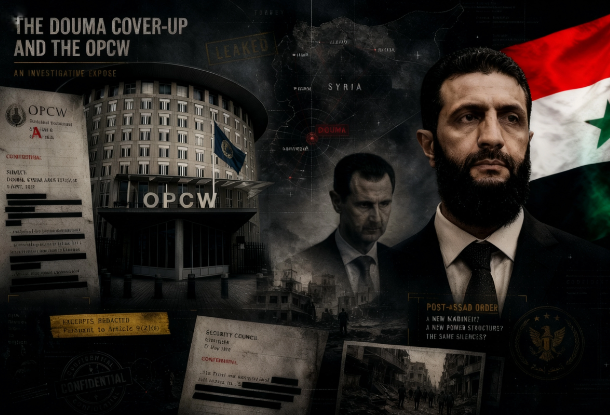
Before theOrganisation for the Prohibition of Chemical Weapons(OPCW), the international chemical weapons watchdog, claimed chlorine was likely used in thealleged April 2018 Douma attackin Syria, its ownleaked original draftsaid the victims’ symptoms were inconsistent with chlorine exposure and that a non-chemical incident could not be ruled out. What followed was not a minor editing quarrel, but a decisive shift in how a murky event would be framed, institutionalized, and then absorbed into the Western case against Damascus.
DOCUMENT: OPCW report on the progress of the fact-finding mission regarding the incident of alleged use of toxic chemicals as a weapon in Douma, Syrian Arab Republic, on 7 April 2018 –OPCW Original Draft Report(Source: Wikileaks)OPCW Original Draft ReportThe newly resurfaced Douma documents leave little room for the claim that the scandal boils down to routine drafting choices. Read side by side, the original report and thereplacement versionshow how caution was pared back while language pointing to the Syrian government’s guilt grew firmer. The first draft said samples showed contact with “one or more substances containing reactive chlorine,” listed several possible chemicals, and stressed that “the actual chemical was not identified.” It also said the cylinders found at the scene only “might have been the sources” and admitted there was “insufficient evidence to affirm this.
DOCUMENT: OPCW report on the progress of the fact-finding mission regarding the incident of alleged use of toxic chemicals as a weapon in Douma, Syrian Arab Republic, on 7 April 2018 –OPCW Replacement version(Source: Wikileaks)OPCW Replacement ReportThat restraint did not survive. In the rewritten draft, the ambiguity narrowed sharply, with the text claiming that high levels of chlorinated organic derivatives showed that chlorine, or another reactive chlorine-containing chemical, had been present, and that investigators had sufficient evidence to determine that the cylinders were the likely source of a toxic release. An inquiry that initially read like an unresolved technical investigation was thus steered toward a conclusion with obvious political value.
The most revealing deletion came in the toxicology section. The original draft recorded that the victims’ visible symptoms, especially the rapid and heavy frothing from the mouth and nose, were “not consistent” with chlorine-containing choking or blood agents. It also noted that the large number of bodies found piled inside rooms near possible escape routes was “at odds” with chlorine intoxication. Then came the line that likely made the passage intolerable to senior officials, namely that the contradiction between the chemical findings and the symptoms “cannot be rationalised,” and that a “non-chemical-related incident” had to remain among the possible explanations. Those findings were cut from the replacement draft.
This documentary trail strongly reinforcesAaron Maté’s 2021 reportingthat toxicology evidence cutting against the official Douma narrative was buried rather than addressed. In his latest piece,‘Highly Protected’: OPCW confirms it buried critical evidence in Syria chemical weapons probe, Maté goes further and shows that the watchdog has now effectively admitted, in its own words, that key toxicology findings were classified and withheld from the Douma final report.” But the toxicology issue was not the only warning sign.Ian Henderson’s engineering assessmentconcluded there was a higher probability that the cylinders had been manually placed at the two locations rather than dropped from aircraft, a finding that also cut against the public narrative and was kept out of the final report. LeakedOPCW Douma documentslater published by WikiLeaks showed a senior OPCW official ordering that Henderson’s report be removed from the organization’s document registry and that all traces of its storage be erased.
The same institutional reflex isevident in the treatment ofBrendan Whelan, the veteran OPCW inspector who challenged the handling of the Douma case from within the organisation. After raising concerns about unethical conduct in the investigation, Whelan was censured by the OPCW leadership, only to later win a ruling before theILO Administrative Tribunalthat forced the organization to reverse its decision and pay damages and costs. That ruling did not settle every disputed fact in Douma, but it shattered the OPCW’s attempt to portray internal dissent as misconduct rather than a warning that critical evidence had been mishandled. Readers who want a concise breakdown of what Whelan’s legal victory means for the Douma scandal should watch Kit Klarenberg’s live analysis, alongside the ongoing coverage by independent platforms likeSyriana Analysisand its hostKevork Almassian, who have been among the few consistently documenting these disclosures and giving space to the whistleblowers’ side of the story.
VIDEO: Whistleblower Vindicated: OPCW’s Syria Case Exposed | Kit Klarenberg (SourceSyrian Analysis| YouTube)
.Taken together, these episodes point to more than one awkward omission. Toxicology findings that did not fit chlorine were removed, an engineering assessment pointing away from an aerial attack was buried, and an inspector who challenged the process was punished before being vindicated. The cumulative impression is of an institution managing contradictions instead of confronting them.
The consequence chain can be traced step by step. First came the erased draft, which left the cause of death unresolved and openly acknowledged that the symptoms did not fit chlorine. Then came the replacement version, where those contradictions disappeared, and the interpretation hardened. That shift fed into theMarch 2019 final report, which declared there were “reasonable grounds” that a toxic chemical had been used and that it was likely molecular chlorine. In January 2023, theInvestigation and Identification Teamwent further and attributed the attack to the Syrian Arab Air Forces. Western governments then treated those findings as authoritative, withFrance, Germany, the United States and the United Kingdompraising what they called the OPCW’s “independent, unbiased, and expert work.
Source: 21st Century Wire
