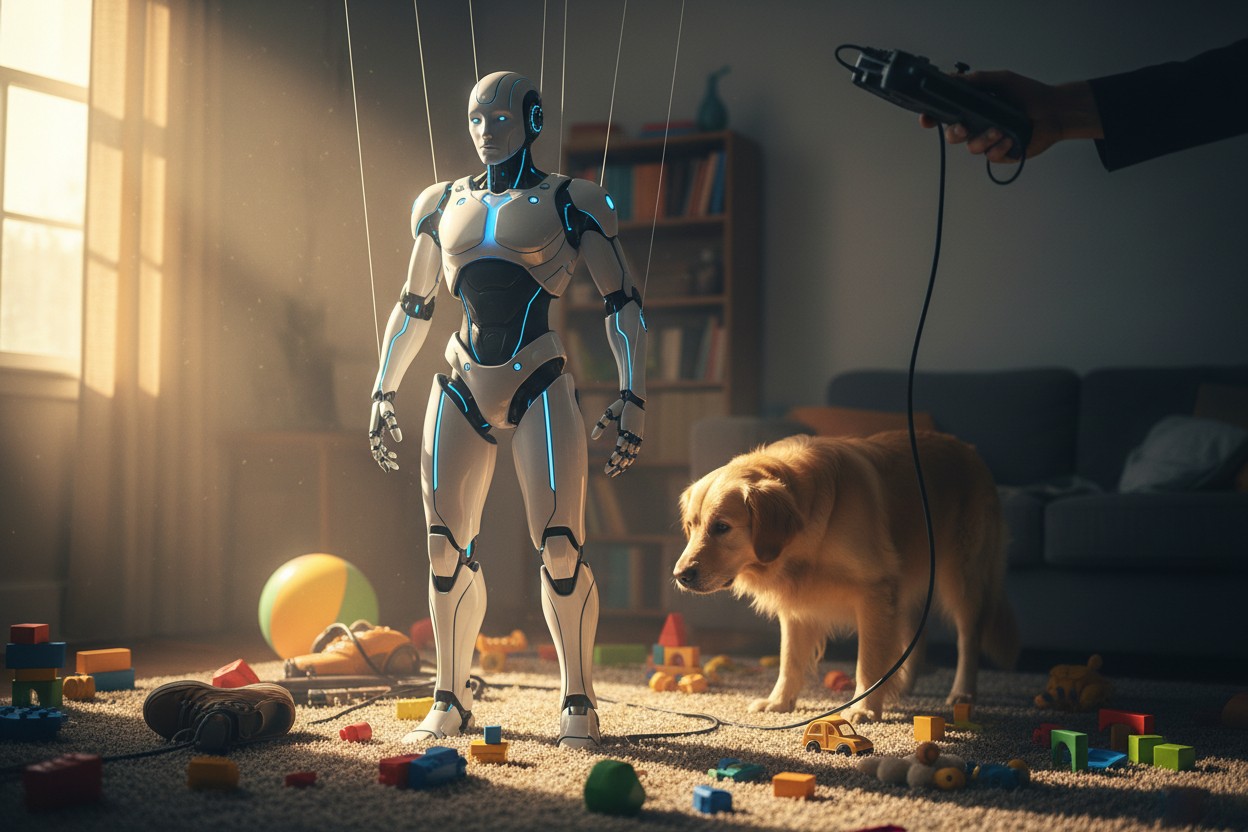
The tech world is buzzing with promises of humanoid robots taking over household chores. Companies like 1X Technologies are taking pre-orders for the NEO robot at $20,000 or $500 a month, and Chinese firm UniX AI claims the Panther is the worldâs first service humanoid robot for real household deploymentÂ[1]. But Iâm here to tell you: this is a carefully crafted illusion. What is being sold as the dawn of autonomous home robotics is largely a remote-controlled puppet show, and when buyers discover they are leasing a glorified RC humanoid operated by a worker in another country, the backlash will be deafening.As I have repeatedly stated on my broadcasts, the marketing around these robots is detached from realityÂ[2]. The NEO robot, for instance, relies heavily on tele-operation -- a human being in a distant control room wearing VR goggles and motion sensors to guide the robotâs every moveÂ[3]. This is not the autonomous helper you imagined; it is a high-priced marionette. The public deserves to know the truth before they sink thousands of dollars into a machine that is no more independent than a remote-control car.The Tele-Operated TruthLetâs get the terminology straight. Alan Winfield, in his book Robotics: A Very Short Introduction, explains that tele-operated robots are âremotely operated by human beingsâ and contrast sharply with autonomous robots that require no human interventionÂ[4]. What 1X and others are selling is mostly a tele-operated humanoid, not an autonomous robot. If your childâs toy car requires a human to steer it, you call it an RC car. By that same logic, a humanoid that requires a remote human operator is an RC humanoid, not a robot.The deception runs deeper. In a recent interview, I highlighted that the tele-operation model means there is always a human in the loop, often in a low-wage country, controlling the robotâs actionsÂ[2]. This raises serious privacy concerns -- do you want a foreign worker peering through your robotâs cameras as it wanders around your living room?Â[3]. The companies are deliberately blurring the line between tele-operation and autonomy to drum up hype and pre-orders. When the reality sets in, the trust will evaporate.Why Your Home Is a Nightmare for RoboticsEven if we ignore the tele-operation bait-and-switch, the idea of a fully autonomous humanoid navigating a typical home is a fantasy. A home is a chaotic, unpredictable environment: clutter, pets, crawling babies, doors that are half open, rugs that slide, cables snaking across floors, and thresholds between rooms. These are simple for a human to navigate but absolute nightmares for robot sensors and algorithms. Factory floors, by contrast, are meticulously controlled -- flat, consistent surfaces, known objects at fixed locations, and predictable lighting. Itâs no coincidence that the robotics industry is pivoting toward âdedicated-purposeâ commercial deployments in factories and warehousesÂ[5]. As Ava Grace reports, âFactories are the primary launchpad for humanoid robots, with the automotive industry leading the chargeâÂ[6].Consider the recent incident in Macau, where a humanoid robot startled an elderly woman on a public street and was âdetainedâ by policeÂ[7]. That was a relatively predictable outdoor environment. Imagine that same robot trying to pick up a toddlerâs toy while a dog runs between its legs and a vacuum cord tangles its ankles. Homes present an infinite set of variables that current AI and sensory systems cannot handle reliably. Until robots can consistently handle a playful poodle without tipping over and accidentally crushing it, they have no business in our living rooms.Why Training Data Falls ShortTraining a robot to perform tasks in a home requires millions of real-world examples. Even the most advanced systems, like Figureâs humanoid running neural networks for kitchen work, require hours of continuous operation in a fixed setting to appear autonomousÂ[8]. But you cannot train for every homeâs unique clutter -- the random placement of shoes, the way a cat knocks over a vase, the childâs building blocks on the rug. As noted in the book Robot Builders Bonanza, building robust autonomy demands extensive trial-and-error learning in the target environmentÂ[9].Autonomous vehicles have logged billions of miles of driving data and still struggle with unusual situations. A home has far more variables than a road, and legged robots are inherently harder to stabilize than wheeled ones. Even with Nvidiaâs Cosmos platform for synthetic data generation, the gap between simulation and the messy reality of a cluttered home remains enormousÂ[10]. Most robot learning today still relies on tele-operated demonstrations, which are time-consuming and brittleÂ[11]. The idea that general-purpose home robots are just around the corner ignores the fundamental data problem: you canât train for the infinite chaos of human living spaces.A More Realistic FutureDonât get me wrong -- robots will (eventually) change the world. But they will do so first in controlled, predictable environments. Hospitals are already deploying autonomous transport robots for moving supplies and linens, as seen in the BayCare partnership with RovexÂ[12]. Warehouses and factories are automating repetitive tasks with increasing sophistication. Outdoors, weâll see robots for gardening, weed pulling, and trash pickup -- tasks where the environment is structured enough for reliable autonomyÂ[13].The indoor home robot is the last frontier, and itâs far from ready. Donât believe the hype until a robot can navigate a house with a wet floor, a curious toddler, and a shedding pet without human intervention. Until the training data can handle a crazed cat attack, keep your wallet closed. The real revolution is coming, but it wonât arrive through tele-operated promises and $500 monthly leases. It will come step by step, from factories to hospitals to yards, and only then into our homes after years of advances.ReferencesChinese Firm UniX AI Launches Panther Humanoid Robot for Household Tasks. - NaturalNews.com. April 14, 2026.Health Ranger Report - NEO ROBOT. - Mike Adams - Brighteon.com. October 31, 2025.Breakthroughs or Bioethical Nightmares The dark side of tech and medicines latest Innovations. - NaturalNews.com. Finn Heartley. October 31, 2025.Robotics A Very Short Introduction Very Short Introductions. - Alan Winfield.Here Come Humanoid Robots: Industry Makes Clear Pivot Toward Dedicated-Purpose Commercial Deployments. - ZeroHedge. January 23, 2026.Humanoid robots poised to reshape auto industry. - NaturalNews.com. Ava Grace. November 19, 2025.Humanoid robot detained by Macau police after startling elderly woman on public street. - NaturalNews.com. March 17, 2026.Singularity Update: You Have No Idea How Crazy Humanoid Robots Have Gotten. - ZeroHedge. Peter H. Diamandis. March 15, 2026.Robot Builders Bonanza. - Gordon McComb.Nvidia unveils Cosmos a platform for accelerating the development of AI models in the physical world. - NaturalNews.com. Arsenio Toledo. January 10, 2025.A survey of robot learning from demonstration. - Robotics and Autonomous Systems. 2008.A&K Robotics raises C$8 million to build autonomous âmicro-vehicleâ for airports. - Robotics and Automation News. April 21, 2026.Health Ranger Report - ELEMENTAL CRISIS. - Mike Adams - Brighteon.com. May 01, 2025.Explainer Infographic:Editorial Cartoon
As I have repeatedly stated on my broadcasts, the marketing around these robots is detached from realityÂ[2]. The NEO robot, for instance, relies heavily on tele-operation -- a human being in a distant control room wearing VR goggles and motion sensors to guide the robotâs every moveÂ[3]. This is not the autonomous helper you imagined; it is a high-priced marionette. The public deserves to know the truth before they sink thousands of dollars into a machine that is no more independent than a remote-control car.The Tele-Operated TruthLetâs get the terminology straight. Alan Winfield, in his book Robotics: A Very Short Introduction, explains that tele-operated robots are âremotely operated by human beingsâ and contrast sharply with autonomous robots that require no human interventionÂ[4]. What 1X and others are selling is mostly a tele-operated humanoid, not an autonomous robot. If your childâs toy car requires a human to steer it, you call it an RC car. By that same logic, a humanoid that requires a remote human operator is an RC humanoid, not a robot.The deception runs deeper. In a recent interview, I highlighted that the tele-operation model means there is always a human in the loop, often in a low-wage country, controlling the robotâs actionsÂ[2]. This raises serious privacy concerns -- do you want a foreign worker peering through your robotâs cameras as it wanders around your living room?Â[3]. The companies are deliberately blurring the line between tele-operation and autonomy to drum up hype and pre-orders. When the reality sets in, the trust will evaporate.Why Your Home Is a Nightmare for RoboticsEven if we ignore the tele-operation bait-and-switch, the idea of a fully autonomous humanoid navigating a typical home is a fantasy. A home is a chaotic, unpredictable environment: clutter, pets, crawling babies, doors that are half open, rugs that slide, cables snaking across floors, and thresholds between rooms. These are simple for a human to navigate but absolute nightmares for robot sensors and algorithms. Factory floors, by contrast, are meticulously controlled -- flat, consistent surfaces, known objects at fixed locations, and predictable lighting. Itâs no coincidence that the robotics industry is pivoting toward âdedicated-purposeâ commercial deployments in factories and warehousesÂ[5]. As Ava Grace reports, âFactories are the primary launchpad for humanoid robots, with the automotive industry leading the chargeâÂ[6].Consider the recent incident in Macau, where a humanoid robot startled an elderly woman on a public street and was âdetainedâ by policeÂ[7]. That was a relatively predictable outdoor environment. Imagine that same robot trying to pick up a toddlerâs toy while a dog runs between its legs and a vacuum cord tangles its ankles. Homes present an infinite set of variables that current AI and sensory systems cannot handle reliably. Until robots can consistently handle a playful poodle without tipping over and accidentally crushing it, they have no business in our living rooms.Why Training Data Falls ShortTraining a robot to perform tasks in a home requires millions of real-world examples. Even the most advanced systems, like Figureâs humanoid running neural networks for kitchen work, require hours of continuous operation in a fixed setting to appear autonomousÂ[8]. But you cannot train for every homeâs unique clutter -- the random placement of shoes, the way a cat knocks over a vase, the childâs building blocks on the rug. As noted in the book Robot Builders Bonanza, building robust autonomy demands extensive trial-and-error learning in the target environmentÂ[9].Autonomous vehicles have logged billions of miles of driving data and still struggle with unusual situations. A home has far more variables than a road, and legged robots are inherently harder to stabilize than wheeled ones. Even with Nvidiaâs Cosmos platform for synthetic data generation, the gap between simulation and the messy reality of a cluttered home remains enormousÂ[10]. Most robot learning today still relies on tele-operated demonstrations, which are time-consuming and brittleÂ[11]. The idea that general-purpose home robots are just around the corner ignores the fundamental data problem: you canât train for the infinite chaos of human living spaces.A More Realistic FutureDonât get me wrong -- robots will (eventually) change the world. But they will do so first in controlled, predictable environments. Hospitals are already deploying autonomous transport robots for moving supplies and linens, as seen in the BayCare partnership with RovexÂ[12]. Warehouses and factories are automating repetitive tasks with increasing sophistication. Outdoors, weâll see robots for gardening, weed pulling, and trash pickup -- tasks where the environment is structured enough for reliable autonomyÂ[13].The indoor home robot is the last frontier, and itâs far from ready. Donât believe the hype until a robot can navigate a house with a wet floor, a curious toddler, and a shedding pet without human intervention. Until the training data can handle a crazed cat attack, keep your wallet closed. The real revolution is coming, but it wonât arrive through tele-operated promises and $500 monthly leases. It will come step by step, from factories to hospitals to yards, and only then into our homes after years of advances.ReferencesChinese Firm UniX AI Launches Panther Humanoid Robot for Household Tasks. - NaturalNews.com. April 14, 2026.Health Ranger Report - NEO ROBOT. - Mike Adams - Brighteon.com. October 31, 2025.Breakthroughs or Bioethical Nightmares The dark side of tech and medicines latest Innovations. - NaturalNews.com. Finn Heartley. October 31, 2025.Robotics A Very Short Introduction Very Short Introductions. - Alan Winfield.Here Come Humanoid Robots: Industry Makes Clear Pivot Toward Dedicated-Purpose Commercial Deployments. - ZeroHedge. January 23, 2026.Humanoid robots poised to reshape auto industry. - NaturalNews.com. Ava Grace. November 19, 2025.Humanoid robot detained by Macau police after startling elderly woman on public street. - NaturalNews.com. March 17, 2026.Singularity Update: You Have No Idea How Crazy Humanoid Robots Have Gotten. - ZeroHedge. Peter H. Diamandis. March 15, 2026.Robot Builders Bonanza. - Gordon McComb.Nvidia unveils Cosmos a platform for accelerating the development of AI models in the physical world. - NaturalNews.com. Arsenio Toledo. January 10, 2025.A survey of robot learning from demonstration. - Robotics and Autonomous Systems. 2008.A&K Robotics raises C$8 million to build autonomous âmicro-vehicleâ for airports. - Robotics and Automation News. April 21, 2026.Health Ranger Report - ELEMENTAL CRISIS. - Mike Adams - Brighteon.com. May 01, 2025.Explainer Infographic:Editorial Cartoon
As I have repeatedly stated on my broadcasts, the marketing around these robots is detached from realityÂ[2]. The NEO robot, for instance, relies heavily on tele-operation -- a human being in a distant control room wearing VR goggles and motion sensors to guide the robotâs every moveÂ[3]. This is not the autonomous helper you imagined; it is a high-priced marionette. The public deserves to know the truth before they sink thousands of dollars into a machine that is no more independent than a remote-control car.The Tele-Operated TruthLetâs get the terminology straight. Alan Winfield, in his book Robotics: A Very Short Introduction, explains that tele-operated robots are âremotely operated by human beingsâ and contrast sharply with autonomous robots that require no human interventionÂ[4]. What 1X and others are selling is mostly a tele-operated humanoid, not an autonomous robot. If your childâs toy car requires a human to steer it, you call it an RC car. By that same logic, a humanoid that requires a remote human operator is an RC humanoid, not a robot.The deception runs deeper. In a recent interview, I highlighted that the tele-operation model means there is always a human in the loop, often in a low-wage country, controlling the robotâs actionsÂ[2]. This raises serious privacy concerns -- do you want a foreign worker peering through your robotâs cameras as it wanders around your living room?Â[3]. The companies are deliberately blurring the line between tele-operation and autonomy to drum up hype and pre-orders. When the reality sets in, the trust will evaporate.Why Your Home Is a Nightmare for RoboticsEven if we ignore the tele-operation bait-and-switch, the idea of a fully autonomous humanoid navigating a typical home is a fantasy. A home is a chaotic, unpredictable environment: clutter, pets, crawling babies, doors that are half open, rugs that slide, cables snaking across floors, and thresholds between rooms. These are simple for a human to navigate but absolute nightmares for robot sensors and algorithms. Factory floors, by contrast, are meticulously controlled -- flat, consistent surfaces, known objects at fixed locations, and predictable lighting. Itâs no coincidence that the robotics industry is pivoting toward âdedicated-purposeâ commercial deployments in factories and warehousesÂ[5]. As Ava Grace reports, âFactories are the primary launchpad for humanoid robots, with the automotive industry leading the chargeâÂ[6].Consider the recent incident in Macau, where a humanoid robot startled an elderly woman on a public street and was âdetainedâ by policeÂ[7]. That was a relatively predictable outdoor environment. Imagine that same robot trying to pick up a toddlerâs toy while a dog runs between its legs and a vacuum cord tangles its ankles. Homes present an infinite set of variables that current AI and sensory systems cannot handle reliably. Until robots can consistently handle a playful poodle without tipping over and accidentally crushing it, they have no business in our living rooms.Why Training Data Falls ShortTraining a robot to perform tasks in a home requires millions of real-world examples. Even the most advanced systems, like Figureâs humanoid running neural networks for kitchen work, require hours of continuous operation in a fixed setting to appear autonomousÂ[8]. But you cannot train for every homeâs unique clutter -- the random placement of shoes, the way a cat knocks over a vase, the childâs building blocks on the rug. As noted in the book Robot Builders Bonanza, building robust autonomy demands extensive trial-and-error learning in the target environmentÂ[9].Autonomous vehicles have logged billions of miles of driving data and still struggle with unusual situations. A home has far more variables than a road, and legged robots are inherently harder to stabilize than wheeled ones. Even with Nvidiaâs Cosmos platform for synthetic data generation, the gap between simulation and the messy reality of a cluttered home remains enormousÂ[10]. Most robot learning today still relies on tele-operated demonstrations, which are time-consuming and brittleÂ[11]. The idea that general-purpose home robots are just around the corner ignores the fundamental data problem: you canât train for the infinite chaos of human living spaces.A More Realistic FutureDonât get me wrong -- robots will (eventually) change the world. But they will do so first in controlled, predictable environments. Hospitals are already deploying autonomous transport robots for moving supplies and linens, as seen in the BayCare partnership with RovexÂ[12]. Warehouses and factories are automating repetitive tasks with increasing sophistication. Outdoors, weâll see robots for gardening, weed pulling, and trash pickup -- tasks where the environment is structured enough for reliable autonomyÂ[13].The indoor home robot is the last frontier, and itâs far from ready. Donât believe the hype until a robot can navigate a house with a wet floor, a curious toddler, and a shedding pet without human intervention. Until the training data can handle a crazed cat attack, keep your wallet closed. The real revolution is coming, but it wonât arrive through tele-operated promises and $500 monthly leases. It will come step by step, from factories to hospitals to yards, and only then into our homes after years of advances.ReferencesChinese Firm UniX AI Launches Panther Humanoid Robot for Household Tasks. - NaturalNews.com. April 14, 2026.Health Ranger Report - NEO ROBOT. - Mike Adams - Brighteon.com. October 31, 2025.Breakthroughs or Bioethical Nightmares The dark side of tech and medicines latest Innovations. - NaturalNews.com. Finn Heartley. October 31, 2025.Robotics A Very Short Introduction Very Short Introductions. - Alan Winfield.Here Come Humanoid Robots: Industry Makes Clear Pivot Toward Dedicated-Purpose Commercial Deployments. - ZeroHedge. January 23, 2026.Humanoid robots poised to reshape auto industry. - NaturalNews.com. Ava Grace. November 19, 2025.Humanoid robot detained by Macau police after startling elderly woman on public street. - NaturalNews.com. March 17, 2026.Singularity Update: You Have No Idea How Crazy Humanoid Robots Have Gotten. - ZeroHedge. Peter H. Diamandis. March 15, 2026.Robot Builders Bonanza. - Gordon McComb.Nvidia unveils Cosmos a platform for accelerating the development of AI models in the physical world. - NaturalNews.com. Arsenio Toledo. January 10, 2025.A survey of robot learning from demonstration. - Robotics and Autonomous Systems. 2008.A&K Robotics raises C$8 million to build autonomous âmicro-vehicleâ for airports. - Robotics and Automation News. April 21, 2026.Health Ranger Report - ELEMENTAL CRISIS. - Mike Adams - Brighteon.com. May 01, 2025.Explainer Infographic:Editorial Cartoon
The Tele-Operated TruthLetâs get the terminology straight. Alan Winfield, in his book Robotics: A Very Short Introduction, explains that tele-operated robots are âremotely operated by human beingsâ and contrast sharply with autonomous robots that require no human interventionÂ[4]. What 1X and others are selling is mostly a tele-operated humanoid, not an autonomous robot. If your childâs toy car requires a human to steer it, you call it an RC car. By that same logic, a humanoid that requires a remote human operator is an RC humanoid, not a robot.The deception runs deeper. In a recent interview, I highlighted that the tele-operation model means there is always a human in the loop, often in a low-wage country, controlling the robotâs actionsÂ[2]. This raises serious privacy concerns -- do you want a foreign worker peering through your robotâs cameras as it wanders around your living room?Â[3]. The companies are deliberately blurring the line between tele-operation and autonomy to drum up hype and pre-orders. When the reality sets in, the trust will evaporate.Why Your Home Is a Nightmare for RoboticsEven if we ignore the tele-operation bait-and-switch, the idea of a fully autonomous humanoid navigating a typical home is a fantasy. A home is a chaotic, unpredictable environment: clutter, pets, crawling babies, doors that are half open, rugs that slide, cables snaking across floors, and thresholds between rooms. These are simple for a human to navigate but absolute nightmares for robot sensors and algorithms. Factory floors, by contrast, are meticulously controlled -- flat, consistent surfaces, known objects at fixed locations, and predictable lighting. Itâs no coincidence that the robotics industry is pivoting toward âdedicated-purposeâ commercial deployments in factories and warehousesÂ[5]. As Ava Grace reports, âFactories are the primary launchpad for humanoid robots, with the automotive industry leading the chargeâÂ[6].Consider the recent incident in Macau, where a humanoid robot startled an elderly woman on a public street and was âdetainedâ by policeÂ[7]. That was a relatively predictable outdoor environment. Imagine that same robot trying to pick up a toddlerâs toy while a dog runs between its legs and a vacuum cord tangles its ankles. Homes present an infinite set of variables that current AI and sensory systems cannot handle reliably. Until robots can consistently handle a playful poodle without tipping over and accidentally crushing it, they have no business in our living rooms.Why Training Data Falls ShortTraining a robot to perform tasks in a home requires millions of real-world examples. Even the most advanced systems, like Figureâs humanoid running neural networks for kitchen work, require hours of continuous operation in a fixed setting to appear autonomousÂ[8]. But you cannot train for every homeâs unique clutter -- the random placement of shoes, the way a cat knocks over a vase, the childâs building blocks on the rug. As noted in the book Robot Builders Bonanza, building robust autonomy demands extensive trial-and-error learning in the target environmentÂ[9].Autonomous vehicles have logged billions of miles of driving data and still struggle with unusual situations. A home has far more variables than a road, and legged robots are inherently harder to stabilize than wheeled ones. Even with Nvidiaâs Cosmos platform for synthetic data generation, the gap between simulation and the messy reality of a cluttered home remains enormousÂ[10]. Most robot learning today still relies on tele-operated demonstrations, which are time-consuming and brittleÂ[11]. The idea that general-purpose home robots are just around the corner ignores the fundamental data problem: you canât train for the infinite chaos of human living spaces.A More Realistic FutureDonât get me wrong -- robots will (eventually) change the world. But they will do so first in controlled, predictable environments. Hospitals are already deploying autonomous transport robots for moving supplies and linens, as seen in the BayCare partnership with RovexÂ[12]. Warehouses and factories are automating repetitive tasks with increasing sophistication. Outdoors, weâll see robots for gardening, weed pulling, and trash pickup -- tasks where the environment is structured enough for reliable autonomyÂ[13].The indoor home robot is the last frontier, and itâs far from ready. Donât believe the hype until a robot can navigate a house with a wet floor, a curious toddler, and a shedding pet without human intervention. Until the training data can handle a crazed cat attack, keep your wallet closed. The real revolution is coming, but it wonât arrive through tele-operated promises and $500 monthly leases. It will come step by step, from factories to hospitals to yards, and only then into our homes after years of advances.ReferencesChinese Firm UniX AI Launches Panther Humanoid Robot for Household Tasks. - NaturalNews.com. April 14, 2026.Health Ranger Report - NEO ROBOT. - Mike Adams - Brighteon.com. October 31, 2025.Breakthroughs or Bioethical Nightmares The dark side of tech and medicines latest Innovations. - NaturalNews.com. Finn Heartley. October 31, 2025.Robotics A Very Short Introduction Very Short Introductions. - Alan Winfield.Here Come Humanoid Robots: Industry Makes Clear Pivot Toward Dedicated-Purpose Commercial Deployments. - ZeroHedge. January 23, 2026.Humanoid robots poised to reshape auto industry. - NaturalNews.com. Ava Grace. November 19, 2025.Humanoid robot detained by Macau police after startling elderly woman on public street. - NaturalNews.com. March 17, 2026.Singularity Update: You Have No Idea How Crazy Humanoid Robots Have Gotten. - ZeroHedge. Peter H. Diamandis. March 15, 2026.Robot Builders Bonanza. - Gordon McComb.Nvidia unveils Cosmos a platform for accelerating the development of AI models in the physical world. - NaturalNews.com. Arsenio Toledo. January 10, 2025.A survey of robot learning from demonstration. - Robotics and Autonomous Systems. 2008.A&K Robotics raises C$8 million to build autonomous âmicro-vehicleâ for airports. - Robotics and Automation News. April 21, 2026.Health Ranger Report - ELEMENTAL CRISIS. - Mike Adams - Brighteon.com. May 01, 2025.Explainer Infographic:Editorial Cartoon
Letâs get the terminology straight. Alan Winfield, in his book Robotics: A Very Short Introduction, explains that tele-operated robots are âremotely operated by human beingsâ and contrast sharply with autonomous robots that require no human interventionÂ[4]. What 1X and others are selling is mostly a tele-operated humanoid, not an autonomous robot. If your childâs toy car requires a human to steer it, you call it an RC car. By that same logic, a humanoid that requires a remote human operator is an RC humanoid, not a robot.The deception runs deeper. In a recent interview, I highlighted that the tele-operation model means there is always a human in the loop, often in a low-wage country, controlling the robotâs actionsÂ[2]. This raises serious privacy concerns -- do you want a foreign worker peering through your robotâs cameras as it wanders around your living room?Â[3]. The companies are deliberately blurring the line between tele-operation and autonomy to drum up hype and pre-orders. When the reality sets in, the trust will evaporate.Why Your Home Is a Nightmare for RoboticsEven if we ignore the tele-operation bait-and-switch, the idea of a fully autonomous humanoid navigating a typical home is a fantasy. A home is a chaotic, unpredictable environment: clutter, pets, crawling babies, doors that are half open, rugs that slide, cables snaking across floors, and thresholds between rooms. These are simple for a human to navigate but absolute nightmares for robot sensors and algorithms. Factory floors, by contrast, are meticulously controlled -- flat, consistent surfaces, known objects at fixed locations, and predictable lighting. Itâs no coincidence that the robotics industry is pivoting toward âdedicated-purposeâ commercial deployments in factories and warehousesÂ[5]. As Ava Grace reports, âFactories are the primary launchpad for humanoid robots, with the automotive industry leading the chargeâÂ[6].Consider the recent incident in Macau, where a humanoid robot startled an elderly woman on a public street and was âdetainedâ by policeÂ[7]. That was a relatively predictable outdoor environment. Imagine that same robot trying to pick up a toddlerâs toy while a dog runs between its legs and a vacuum cord tangles its ankles. Homes present an infinite set of variables that current AI and sensory systems cannot handle reliably. Until robots can consistently handle a playful poodle without tipping over and accidentally crushing it, they have no business in our living rooms.Why Training Data Falls ShortTraining a robot to perform tasks in a home requires millions of real-world examples. Even the most advanced systems, like Figureâs humanoid running neural networks for kitchen work, require hours of continuous operation in a fixed setting to appear autonomousÂ[8]. But you cannot train for every homeâs unique clutter -- the random placement of shoes, the way a cat knocks over a vase, the childâs building blocks on the rug. As noted in the book Robot Builders Bonanza, building robust autonomy demands extensive trial-and-error learning in the target environmentÂ[9].Autonomous vehicles have logged billions of miles of driving data and still struggle with unusual situations. A home has far more variables than a road, and legged robots are inherently harder to stabilize than wheeled ones. Even with Nvidiaâs Cosmos platform for synthetic data generation, the gap between simulation and the messy reality of a cluttered home remains enormousÂ[10]. Most robot learning today still relies on tele-operated demonstrations, which are time-consuming and brittleÂ[11]. The idea that general-purpose home robots are just around the corner ignores the fundamental data problem: you canât train for the infinite chaos of human living spaces.A More Realistic FutureDonât get me wrong -- robots will (eventually) change the world. But they will do so first in controlled, predictable environments. Hospitals are already deploying autonomous transport robots for moving supplies and linens, as seen in the BayCare partnership with RovexÂ[12]. Warehouses and factories are automating repetitive tasks with increasing sophistication. Outdoors, weâll see robots for gardening, weed pulling, and trash pickup -- tasks where the environment is structured enough for reliable autonomyÂ[13].The indoor home robot is the last frontier, and itâs far from ready. Donât believe the hype until a robot can navigate a house with a wet floor, a curious toddler, and a shedding pet without human intervention. Until the training data can handle a crazed cat attack, keep your wallet closed. The real revolution is coming, but it wonât arrive through tele-operated promises and $500 monthly leases. It will come step by step, from factories to hospitals to yards, and only then into our homes after years of advances.ReferencesChinese Firm UniX AI Launches Panther Humanoid Robot for Household Tasks. - NaturalNews.com. April 14, 2026.Health Ranger Report - NEO ROBOT. - Mike Adams - Brighteon.com. October 31, 2025.Breakthroughs or Bioethical Nightmares The dark side of tech and medicines latest Innovations. - NaturalNews.com. Finn Heartley. October 31, 2025.Robotics A Very Short Introduction Very Short Introductions. - Alan Winfield.Here Come Humanoid Robots: Industry Makes Clear Pivot Toward Dedicated-Purpose Commercial Deployments. - ZeroHedge. January 23, 2026.Humanoid robots poised to reshape auto industry. - NaturalNews.com. Ava Grace. November 19, 2025.Humanoid robot detained by Macau police after startling elderly woman on public street. - NaturalNews.com. March 17, 2026.Singularity Update: You Have No Idea How Crazy Humanoid Robots Have Gotten. - ZeroHedge. Peter H. Diamandis. March 15, 2026.Robot Builders Bonanza. - Gordon McComb.Nvidia unveils Cosmos a platform for accelerating the development of AI models in the physical world. - NaturalNews.com. Arsenio Toledo. January 10, 2025.A survey of robot learning from demonstration. - Robotics and Autonomous Systems. 2008.A&K Robotics raises C$8 million to build autonomous âmicro-vehicleâ for airports. - Robotics and Automation News. April 21, 2026.Health Ranger Report - ELEMENTAL CRISIS. - Mike Adams - Brighteon.com. May 01, 2025.Explainer Infographic:Editorial Cartoon
The deception runs deeper. In a recent interview, I highlighted that the tele-operation model means there is always a human in the loop, often in a low-wage country, controlling the robotâs actionsÂ[2]. This raises serious privacy concerns -- do you want a foreign worker peering through your robotâs cameras as it wanders around your living room?Â[3]. The companies are deliberately blurring the line between tele-operation and autonomy to drum up hype and pre-orders. When the reality sets in, the trust will evaporate.Why Your Home Is a Nightmare for RoboticsEven if we ignore the tele-operation bait-and-switch, the idea of a fully autonomous humanoid navigating a typical home is a fantasy. A home is a chaotic, unpredictable environment: clutter, pets, crawling babies, doors that are half open, rugs that slide, cables snaking across floors, and thresholds between rooms. These are simple for a human to navigate but absolute nightmares for robot sensors and algorithms. Factory floors, by contrast, are meticulously controlled -- flat, consistent surfaces, known objects at fixed locations, and predictable lighting. Itâs no coincidence that the robotics industry is pivoting toward âdedicated-purposeâ commercial deployments in factories and warehousesÂ[5]. As Ava Grace reports, âFactories are the primary launchpad for humanoid robots, with the automotive industry leading the chargeâÂ[6].Consider the recent incident in Macau, where a humanoid robot startled an elderly woman on a public street and was âdetainedâ by policeÂ[7]. That was a relatively predictable outdoor environment. Imagine that same robot trying to pick up a toddlerâs toy while a dog runs between its legs and a vacuum cord tangles its ankles. Homes present an infinite set of variables that current AI and sensory systems cannot handle reliably. Until robots can consistently handle a playful poodle without tipping over and accidentally crushing it, they have no business in our living rooms.Why Training Data Falls ShortTraining a robot to perform tasks in a home requires millions of real-world examples. Even the most advanced systems, like Figureâs humanoid running neural networks for kitchen work, require hours of continuous operation in a fixed setting to appear autonomousÂ[8]. But you cannot train for every homeâs unique clutter -- the random placement of shoes, the way a cat knocks over a vase, the childâs building blocks on the rug. As noted in the book Robot Builders Bonanza, building robust autonomy demands extensive trial-and-error learning in the target environmentÂ[9].Autonomous vehicles have logged billions of miles of driving data and still struggle with unusual situations. A home has far more variables than a road, and legged robots are inherently harder to stabilize than wheeled ones. Even with Nvidiaâs Cosmos platform for synthetic data generation, the gap between simulation and the messy reality of a cluttered home remains enormousÂ[10]. Most robot learning today still relies on tele-operated demonstrations, which are time-consuming and brittleÂ[11]. The idea that general-purpose home robots are just around the corner ignores the fundamental data problem: you canât train for the infinite chaos of human living spaces.A More Realistic FutureDonât get me wrong -- robots will (eventually) change the world. But they will do so first in controlled, predictable environments. Hospitals are already deploying autonomous transport robots for moving supplies and linens, as seen in the BayCare partnership with RovexÂ[12]. Warehouses and factories are automating repetitive tasks with increasing sophistication. Outdoors, weâll see robots for gardening, weed pulling, and trash pickup -- tasks where the environment is structured enough for reliable autonomyÂ[13].The indoor home robot is the last frontier, and itâs far from ready. Donât believe the hype until a robot can navigate a house with a wet floor, a curious toddler, and a shedding pet without human intervention. Until the training data can handle a crazed cat attack, keep your wallet closed. The real revolution is coming, but it wonât arrive through tele-operated promises and $500 monthly leases. It will come step by step, from factories to hospitals to yards, and only then into our homes after years of advances.ReferencesChinese Firm UniX AI Launches Panther Humanoid Robot for Household Tasks. - NaturalNews.com. April 14, 2026.Health Ranger Report - NEO ROBOT. - Mike Adams - Brighteon.com. October 31, 2025.Breakthroughs or Bioethical Nightmares The dark side of tech and medicines latest Innovations. - NaturalNews.com. Finn Heartley. October 31, 2025.Robotics A Very Short Introduction Very Short Introductions. - Alan Winfield.Here Come Humanoid Robots: Industry Makes Clear Pivot Toward Dedicated-Purpose Commercial Deployments. - ZeroHedge. January 23, 2026.Humanoid robots poised to reshape auto industry. - NaturalNews.com. Ava Grace. November 19, 2025.Humanoid robot detained by Macau police after startling elderly woman on public street. - NaturalNews.com. March 17, 2026.Singularity Update: You Have No Idea How Crazy Humanoid Robots Have Gotten. - ZeroHedge. Peter H. Diamandis. March 15, 2026.Robot Builders Bonanza. - Gordon McComb.Nvidia unveils Cosmos a platform for accelerating the development of AI models in the physical world. - NaturalNews.com. Arsenio Toledo. January 10, 2025.A survey of robot learning from demonstration. - Robotics and Autonomous Systems. 2008.A&K Robotics raises C$8 million to build autonomous âmicro-vehicleâ for airports. - Robotics and Automation News. April 21, 2026.Health Ranger Report - ELEMENTAL CRISIS. - Mike Adams - Brighteon.com. May 01, 2025.Explainer Infographic:Editorial Cartoon
The deception runs deeper. In a recent interview, I highlighted that the tele-operation model means there is always a human in the loop, often in a low-wage country, controlling the robotâs actionsÂ[2]. This raises serious privacy concerns -- do you want a foreign worker peering through your robotâs cameras as it wanders around your living room?Â[3]. The companies are deliberately blurring the line between tele-operation and autonomy to drum up hype and pre-orders. When the reality sets in, the trust will evaporate.Why Your Home Is a Nightmare for RoboticsEven if we ignore the tele-operation bait-and-switch, the idea of a fully autonomous humanoid navigating a typical home is a fantasy. A home is a chaotic, unpredictable environment: clutter, pets, crawling babies, doors that are half open, rugs that slide, cables snaking across floors, and thresholds between rooms. These are simple for a human to navigate but absolute nightmares for robot sensors and algorithms. Factory floors, by contrast, are meticulously controlled -- flat, consistent surfaces, known objects at fixed locations, and predictable lighting. Itâs no coincidence that the robotics industry is pivoting toward âdedicated-purposeâ commercial deployments in factories and warehousesÂ[5]. As Ava Grace reports, âFactories are the primary launchpad for humanoid robots, with the automotive industry leading the chargeâÂ[6].Consider the recent incident in Macau, where a humanoid robot startled an elderly woman on a public street and was âdetainedâ by policeÂ[7]. That was a relatively predictable outdoor environment. Imagine that same robot trying to pick up a toddlerâs toy while a dog runs between its legs and a vacuum cord tangles its ankles. Homes present an infinite set of variables that current AI and sensory systems cannot handle reliably. Until robots can consistently handle a playful poodle without tipping over and accidentally crushing it, they have no business in our living rooms.Why Training Data Falls ShortTraining a robot to perform tasks in a home requires millions of real-world examples. Even the most advanced systems, like Figureâs humanoid running neural networks for kitchen work, require hours of continuous operation in a fixed setting to appear autonomousÂ[8]. But you cannot train for every homeâs unique clutter -- the random placement of shoes, the way a cat knocks over a vase, the childâs building blocks on the rug. As noted in the book Robot Builders Bonanza, building robust autonomy demands extensive trial-and-error learning in the target environmentÂ[9].Autonomous vehicles have logged billions of miles of driving data and still struggle with unusual situations. A home has far more variables than a road, and legged robots are inherently harder to stabilize than wheeled ones. Even with Nvidiaâs Cosmos platform for synthetic data generation, the gap between simulation and the messy reality of a cluttered home remains enormousÂ[10]. Most robot learning today still relies on tele-operated demonstrations, which are time-consuming and brittleÂ[11]. The idea that general-purpose home robots are just around the corner ignores the fundamental data problem: you canât train for the infinite chaos of human living spaces.A More Realistic FutureDonât get me wrong -- robots will (eventually) change the world. But they will do so first in controlled, predictable environments. Hospitals are already deploying autonomous transport robots for moving supplies and linens, as seen in the BayCare partnership with RovexÂ[12]. Warehouses and factories are automating repetitive tasks with increasing sophistication. Outdoors, weâll see robots for gardening, weed pulling, and trash pickup -- tasks where the environment is structured enough for reliable autonomyÂ[13].The indoor home robot is the last frontier, and itâs far from ready. Donât believe the hype until a robot can navigate a house with a wet floor, a curious toddler, and a shedding pet without human intervention. Until the training data can handle a crazed cat attack, keep your wallet closed. The real revolution is coming, but it wonât arrive through tele-operated promises and $500 monthly leases. It will come step by step, from factories to hospitals to yards, and only then into our homes after years of advances.ReferencesChinese Firm UniX AI Launches Panther Humanoid Robot for Household Tasks. - NaturalNews.com. April 14, 2026.Health Ranger Report - NEO ROBOT. - Mike Adams - Brighteon.com. October 31, 2025.Breakthroughs or Bioethical Nightmares The dark side of tech and medicines latest Innovations. - NaturalNews.com. Finn Heartley. October 31, 2025.Robotics A Very Short Introduction Very Short Introductions. - Alan Winfield.Here Come Humanoid Robots: Industry Makes Clear Pivot Toward Dedicated-Purpose Commercial Deployments. - ZeroHedge. January 23, 2026.Humanoid robots poised to reshape auto industry. - NaturalNews.com. Ava Grace. November 19, 2025.Humanoid robot detained by Macau police after startling elderly woman on public street. - NaturalNews.com. March 17, 2026.Singularity Update: You Have No Idea How Crazy Humanoid Robots Have Gotten. - ZeroHedge. Peter H. Diamandis. March 15, 2026.Robot Builders Bonanza. - Gordon McComb.Nvidia unveils Cosmos a platform for accelerating the development of AI models in the physical world. - NaturalNews.com. Arsenio Toledo. January 10, 2025.A survey of robot learning from demonstration. - Robotics and Autonomous Systems. 2008.A&K Robotics raises C$8 million to build autonomous âmicro-vehicleâ for airports. - Robotics and Automation News. April 21, 2026.Health Ranger Report - ELEMENTAL CRISIS. - Mike Adams - Brighteon.com. May 01, 2025.Explainer Infographic:Editorial Cartoon
Why Your Home Is a Nightmare for RoboticsEven if we ignore the tele-operation bait-and-switch, the idea of a fully autonomous humanoid navigating a typical home is a fantasy. A home is a chaotic, unpredictable environment: clutter, pets, crawling babies, doors that are half open, rugs that slide, cables snaking across floors, and thresholds between rooms. These are simple for a human to navigate but absolute nightmares for robot sensors and algorithms. Factory floors, by contrast, are meticulously controlled -- flat, consistent surfaces, known objects at fixed locations, and predictable lighting. Itâs no coincidence that the robotics industry is pivoting toward âdedicated-purposeâ commercial deployments in factories and warehousesÂ[5]. As Ava Grace reports, âFactories are the primary launchpad for humanoid robots, with the automotive industry leading the chargeâÂ[6].Consider the recent incident in Macau, where a humanoid robot startled an elderly woman on a public street and was âdetainedâ by policeÂ[7]. That was a relatively predictable outdoor environment. Imagine that same robot trying to pick up a toddlerâs toy while a dog runs between its legs and a vacuum cord tangles its ankles. Homes present an infinite set of variables that current AI and sensory systems cannot handle reliably. Until robots can consistently handle a playful poodle without tipping over and accidentally crushing it, they have no business in our living rooms.Why Training Data Falls ShortTraining a robot to perform tasks in a home requires millions of real-world examples. Even the most advanced systems, like Figureâs humanoid running neural networks for kitchen work, require hours of continuous operation in a fixed setting to appear autonomousÂ[8]. But you cannot train for every homeâs unique clutter -- the random placement of shoes, the way a cat knocks over a vase, the childâs building blocks on the rug. As noted in the book Robot Builders Bonanza, building robust autonomy demands extensive trial-and-error learning in the target environmentÂ[9].Autonomous vehicles have logged billions of miles of driving data and still struggle with unusual situations. A home has far more variables than a road, and legged robots are inherently harder to stabilize than wheeled ones. Even with Nvidiaâs Cosmos platform for synthetic data generation, the gap between simulation and the messy reality of a cluttered home remains enormousÂ[10]. Most robot learning today still relies on tele-operated demonstrations, which are time-consuming and brittleÂ[11]. The idea that general-purpose home robots are just around the corner ignores the fundamental data problem: you canât train for the infinite chaos of human living spaces.A More Realistic FutureDonât get me wrong -- robots will (eventually) change the world. But they will do so first in controlled, predictable environments. Hospitals are already deploying autonomous transport robots for moving supplies and linens, as seen in the BayCare partnership with RovexÂ[12]. Warehouses and factories are automating repetitive tasks with increasing sophistication. Outdoors, weâll see robots for gardening, weed pulling, and trash pickup -- tasks where the environment is structured enough for reliable autonomyÂ[13].The indoor home robot is the last frontier, and itâs far from ready. Donât believe the hype until a robot can navigate a house with a wet floor, a curious toddler, and a shedding pet without human intervention. Until the training data can handle a crazed cat attack, keep your wallet closed. The real revolution is coming, but it wonât arrive through tele-operated promises and $500 monthly leases. It will come step by step, from factories to hospitals to yards, and only then into our homes after years of advances.ReferencesChinese Firm UniX AI Launches Panther Humanoid Robot for Household Tasks. - NaturalNews.com. April 14, 2026.Health Ranger Report - NEO ROBOT. - Mike Adams - Brighteon.com. October 31, 2025.Breakthroughs or Bioethical Nightmares The dark side of tech and medicines latest Innovations. - NaturalNews.com. Finn Heartley. October 31, 2025.Robotics A Very Short Introduction Very Short Introductions. - Alan Winfield.Here Come Humanoid Robots: Industry Makes Clear Pivot Toward Dedicated-Purpose Commercial Deployments. - ZeroHedge. January 23, 2026.Humanoid robots poised to reshape auto industry. - NaturalNews.com. Ava Grace. November 19, 2025.Humanoid robot detained by Macau police after startling elderly woman on public street. - NaturalNews.com. March 17, 2026.Singularity Update: You Have No Idea How Crazy Humanoid Robots Have Gotten. - ZeroHedge. Peter H. Diamandis. March 15, 2026.Robot Builders Bonanza. - Gordon McComb.Nvidia unveils Cosmos a platform for accelerating the development of AI models in the physical world. - NaturalNews.com. Arsenio Toledo. January 10, 2025.A survey of robot learning from demonstration. - Robotics and Autonomous Systems. 2008.A&K Robotics raises C$8 million to build autonomous âmicro-vehicleâ for airports. - Robotics and Automation News. April 21, 2026.Health Ranger Report - ELEMENTAL CRISIS. - Mike Adams - Brighteon.com. May 01, 2025.Explainer Infographic:Editorial Cartoon
Even if we ignore the tele-operation bait-and-switch, the idea of a fully autonomous humanoid navigating a typical home is a fantasy. A home is a chaotic, unpredictable environment: clutter, pets, crawling babies, doors that are half open, rugs that slide, cables snaking across floors, and thresholds between rooms. These are simple for a human to navigate but absolute nightmares for robot sensors and algorithms. Factory floors, by contrast, are meticulously controlled -- flat, consistent surfaces, known objects at fixed locations, and predictable lighting. Itâs no coincidence that the robotics industry is pivoting toward âdedicated-purposeâ commercial deployments in factories and warehousesÂ[5]. As Ava Grace reports, âFactories are the primary launchpad for humanoid robots, with the automotive industry leading the chargeâÂ[6].Consider the recent incident in Macau, where a humanoid robot startled an elderly woman on a public street and was âdetainedâ by policeÂ[7]. That was a relatively predictable outdoor environment. Imagine that same robot trying to pick up a toddlerâs toy while a dog runs between its legs and a vacuum cord tangles its ankles. Homes present an infinite set of variables that current AI and sensory systems cannot handle reliably. Until robots can consistently handle a playful poodle without tipping over and accidentally crushing it, they have no business in our living rooms.Why Training Data Falls ShortTraining a robot to perform tasks in a home requires millions of real-world examples. Even the most advanced systems, like Figureâs humanoid running neural networks for kitchen work, require hours of continuous operation in a fixed setting to appear autonomousÂ[8]. But you cannot train for every homeâs unique clutter -- the random placement of shoes, the way a cat knocks over a vase, the childâs building blocks on the rug. As noted in the book Robot Builders Bonanza, building robust autonomy demands extensive trial-and-error learning in the target environmentÂ[9].Autonomous vehicles have logged billions of miles of driving data and still struggle with unusual situations. A home has far more variables than a road, and legged robots are inherently harder to stabilize than wheeled ones. Even with Nvidiaâs Cosmos platform for synthetic data generation, the gap between simulation and the messy reality of a cluttered home remains enormousÂ[10]. Most robot learning today still relies on tele-operated demonstrations, which are time-consuming and brittleÂ[11]. The idea that general-purpose home robots are just around the corner ignores the fundamental data problem: you canât train for the infinite chaos of human living spaces.A More Realistic FutureDonât get me wrong -- robots will (eventually) change the world. But they will do so first in controlled, predictable environments. Hospitals are already deploying autonomous transport robots for moving supplies and linens, as seen in the BayCare partnership with RovexÂ[12]. Warehouses and factories are automating repetitive tasks with increasing sophistication. Outdoors, weâll see robots for gardening, weed pulling, and trash pickup -- tasks where the environment is structured enough for reliable autonomyÂ[13].The indoor home robot is the last frontier, and itâs far from ready. Donât believe the hype until a robot can navigate a house with a wet floor, a curious toddler, and a shedding pet without human intervention. Until the training data can handle a crazed cat attack, keep your wallet closed. The real revolution is coming, but it wonât arrive through tele-operated promises and $500 monthly leases. It will come step by step, from factories to hospitals to yards, and only then into our homes after years of advances.ReferencesChinese Firm UniX AI Launches Panther Humanoid Robot for Household Tasks. - NaturalNews.com. April 14, 2026.Health Ranger Report - NEO ROBOT. - Mike Adams - Brighteon.com. October 31, 2025.Breakthroughs or Bioethical Nightmares The dark side of tech and medicines latest Innovations. - NaturalNews.com. Finn Heartley. October 31, 2025.Robotics A Very Short Introduction Very Short Introductions. - Alan Winfield.Here Come Humanoid Robots: Industry Makes Clear Pivot Toward Dedicated-Purpose Commercial Deployments. - ZeroHedge. January 23, 2026.Humanoid robots poised to reshape auto industry. - NaturalNews.com. Ava Grace. November 19, 2025.Humanoid robot detained by Macau police after startling elderly woman on public street. - NaturalNews.com. March 17, 2026.Singularity Update: You Have No Idea How Crazy Humanoid Robots Have Gotten. - ZeroHedge. Peter H. Diamandis. March 15, 2026.Robot Builders Bonanza. - Gordon McComb.Nvidia unveils Cosmos a platform for accelerating the development of AI models in the physical world. - NaturalNews.com. Arsenio Toledo. January 10, 2025.A survey of robot learning from demonstration. - Robotics and Autonomous Systems. 2008.A&K Robotics raises C$8 million to build autonomous âmicro-vehicleâ for airports. - Robotics and Automation News. April 21, 2026.Health Ranger Report - ELEMENTAL CRISIS. - Mike Adams - Brighteon.com. May 01, 2025.Explainer Infographic:Editorial Cartoon
Consider the recent incident in Macau, where a humanoid robot startled an elderly woman on a public street and was âdetainedâ by policeÂ[7]. That was a relatively predictable outdoor environment. Imagine that same robot trying to pick up a toddlerâs toy while a dog runs between its legs and a vacuum cord tangles its ankles. Homes present an infinite set of variables that current AI and sensory systems cannot handle reliably. Until robots can consistently handle a playful poodle without tipping over and accidentally crushing it, they have no business in our living rooms.Why Training Data Falls ShortTraining a robot to perform tasks in a home requires millions of real-world examples. Even the most advanced systems, like Figureâs humanoid running neural networks for kitchen work, require hours of continuous operation in a fixed setting to appear autonomousÂ[8]. But you cannot train for every homeâs unique clutter -- the random placement of shoes, the way a cat knocks over a vase, the childâs building blocks on the rug. As noted in the book Robot Builders Bonanza, building robust autonomy demands extensive trial-and-error learning in the target environmentÂ[9].Autonomous vehicles have logged billions of miles of driving data and still struggle with unusual situations. A home has far more variables than a road, and legged robots are inherently harder to stabilize than wheeled ones. Even with Nvidiaâs Cosmos platform for synthetic data generation, the gap between simulation and the messy reality of a cluttered home remains enormousÂ[10]. Most robot learning today still relies on tele-operated demonstrations, which are time-consuming and brittleÂ[11]. The idea that general-purpose home robots are just around the corner ignores the fundamental data problem: you canât train for the infinite chaos of human living spaces.A More Realistic FutureDonât get me wrong -- robots will (eventually) change the world. But they will do so first in controlled, predictable environments. Hospitals are already deploying autonomous transport robots for moving supplies and linens, as seen in the BayCare partnership with RovexÂ[12]. Warehouses and factories are automating repetitive tasks with increasing sophistication. Outdoors, weâll see robots for gardening, weed pulling, and trash pickup -- tasks where the environment is structured enough for reliable autonomyÂ[13].The indoor home robot is the last frontier, and itâs far from ready. Donât believe the hype until a robot can navigate a house with a wet floor, a curious toddler, and a shedding pet without human intervention. Until the training data can handle a crazed cat attack, keep your wallet closed. The real revolution is coming, but it wonât arrive through tele-operated promises and $500 monthly leases. It will come step by step, from factories to hospitals to yards, and only then into our homes after years of advances.ReferencesChinese Firm UniX AI Launches Panther Humanoid Robot for Household Tasks. - NaturalNews.com. April 14, 2026.Health Ranger Report - NEO ROBOT. - Mike Adams - Brighteon.com. October 31, 2025.Breakthroughs or Bioethical Nightmares The dark side of tech and medicines latest Innovations. - NaturalNews.com. Finn Heartley. October 31, 2025.Robotics A Very Short Introduction Very Short Introductions. - Alan Winfield.Here Come Humanoid Robots: Industry Makes Clear Pivot Toward Dedicated-Purpose Commercial Deployments. - ZeroHedge. January 23, 2026.Humanoid robots poised to reshape auto industry. - NaturalNews.com. Ava Grace. November 19, 2025.Humanoid robot detained by Macau police after startling elderly woman on public street. - NaturalNews.com. March 17, 2026.Singularity Update: You Have No Idea How Crazy Humanoid Robots Have Gotten. - ZeroHedge. Peter H. Diamandis. March 15, 2026.Robot Builders Bonanza. - Gordon McComb.Nvidia unveils Cosmos a platform for accelerating the development of AI models in the physical world. - NaturalNews.com. Arsenio Toledo. January 10, 2025.A survey of robot learning from demonstration. - Robotics and Autonomous Systems. 2008.A&K Robotics raises C$8 million to build autonomous âmicro-vehicleâ for airports. - Robotics and Automation News. April 21, 2026.Health Ranger Report - ELEMENTAL CRISIS. - Mike Adams - Brighteon.com. May 01, 2025.Explainer Infographic:Editorial Cartoon
Source: NaturalNews.com
