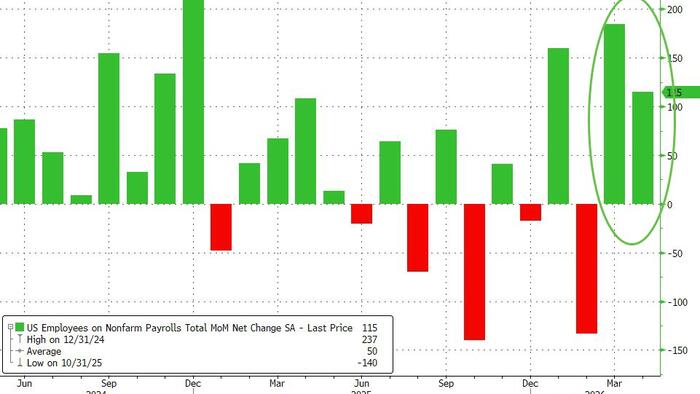
In his preview of today's NFP report, Goldman's Delta One head wrote that "NFP almost feels like a sideshow at this point. You can argue weak labor data gives a Warsh led Fed enough cover to cut, but with oil and input inflation still elevated there’s also an argument that a weakening labor market alongside a constrained Fed is actually the more difficult combination for risk assets." With that in mind, moments ago the BLS reported that in April the US added a red hot 115K, above the median consensus of 65K (and near the upper end of the forecast range which peaked at 133K), down from an upward revised (for once) 185K (originally 178K).This was the first back to back gain in jobs in a year.
The change in February jobs was revised down by 23,000, from -133,000 to -156,000, and the change for March was revised up by 7,000, from +178,000 to +185,000. With these revisions, employment in February and March combined is 16,000 lower than previously reported
A look below the surface reveals a less impressive picture: while payrolls rose to a new record high, actual employment has dropped to the lowest since January 2025...
... as the monthly change in payrolls has disconnected dramatically from actual jobs, which dropped by 226K in April and are now down 4 months in a row!
The unemployment rate was unchanged at 4.3%, in line with expectations, which is odd since allmajor ethnic groups saw their unemployment rate increase...
... while the Labor Force Participation Rate dipped to 61.8% from 61.9%. The employment-population ratio, at 59.1 percent, changed little in April. These measures edged down over the year after accounting for annual population control adjustments.
Wage growth came in cooler than expected, rising 0.2% MoM, below the 0.3% expected, and translating into a 3.6% annual increase, also below the 3.8% expected.
Some more details from the April report:
Looking at the composition of the report, employment edged up by 115,000 in April, after showing little net change over the prior 12 months. In April, job gains occurred in health care, transportation and warehousing, and retail trade. Federal government employment continued to decline.
Source: ZeroHedge News
