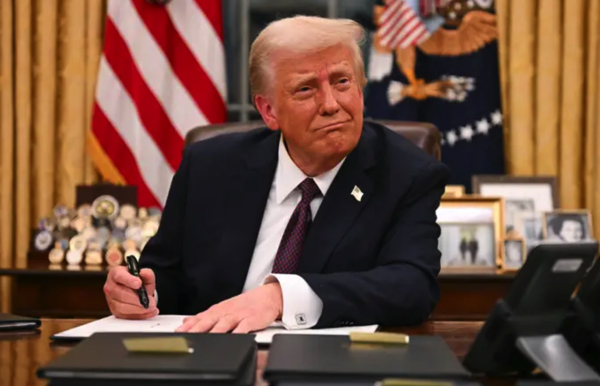
President Donald Trump has announced plans to issue an executive order mandating strict voter ID requirements nationwide for the 2026 midterms, vowing to bypass Congress if necessary. Trump accused Democrats of enabling election fraud by opposing voter verification measures, framing the move as essential to secure elections. The announcement comes amid escalating partisan battles over election integrity, with Republicans positioning voter ID as a cornerstone issue for the upcoming cycle.
The Republican-led House narrowly approved the SAVE America Act, which requires photo ID for voter registration and ballots, along with stricter mail-in voting rules. The legislation aims to prevent fraud but faces near-certain defeat in the Senate due to Democratic opposition and the lack of filibuster-proof support, needing 60 votes to advance. While Sen. Susan Collins (R-ME) became the 50th Republican to endorse the bill, she opposes abolishing the filibuster, and Sen. John Fetterman (D-PA) supports voter ID but not the broader measure.
Senate Minority Leader Chuck Schumer (D-NY) dismissed the bill as "dead on arrival," calling it "a fringe piece of legislation… masquerading as election security when it’s really about laying the groundwork to meddle in the midterm elections." Democrats have decried the measure as voter suppression, arguing it would disenfranchise millions, particularly minorities, low-income voters, and women whose married names differ from birth certificates.
The Brennan Center for Justice estimates that 21 million Americans lack immediate access to passports or birth certificates, disproportionately affecting younger and nonwhite voters. Rep. April McClain Delaney (D-MD) claimed the bill would "impact millions of people," though fact-checkers note provisions allow alternate documentation. Progressive groups, including the ACLU and League of Women Voters, have mobilized against it, labeling the measure racially discriminatory.
Despite the partisan divide, voter ID enjoys broad public support. A Pew Research poll from August 4-10, 2023, found 83% of Americans—including 95% of Republicans and 71% of Democrats—favor photo ID requirements, making it one of the least contentious election policies. Supporters argue it is common sense to prevent fraud.
Legal experts contend Trump lacks unilateral authority to impose voter ID rules, citing past court rulings that blocked similar executive actions, including his previous order on citizenship verification. Courts have affirmed that Congress and states regulate elections. Sen. Lisa Murkowski (R-AK), the sole GOP dissenter on the bill, criticized it for "federalizing elections."
Trump framed the issue as a winning strategy for Republicans, declaring: "Republicans must put this at the top of every speech—It is a CAN'T MISS FOR RE-ELECTION IN THE MIDTERMS, AND BEYOND!" Democrats warn of executive overreach and potential midterm interference, while the SAVE Act's Senate defeat has prompted Trump's executive order threat.
The battle over voter ID is escalating as a central flashpoint ahead of the 2026 election cycle, with Trump's planned order likely to face immediate legal challenges.
