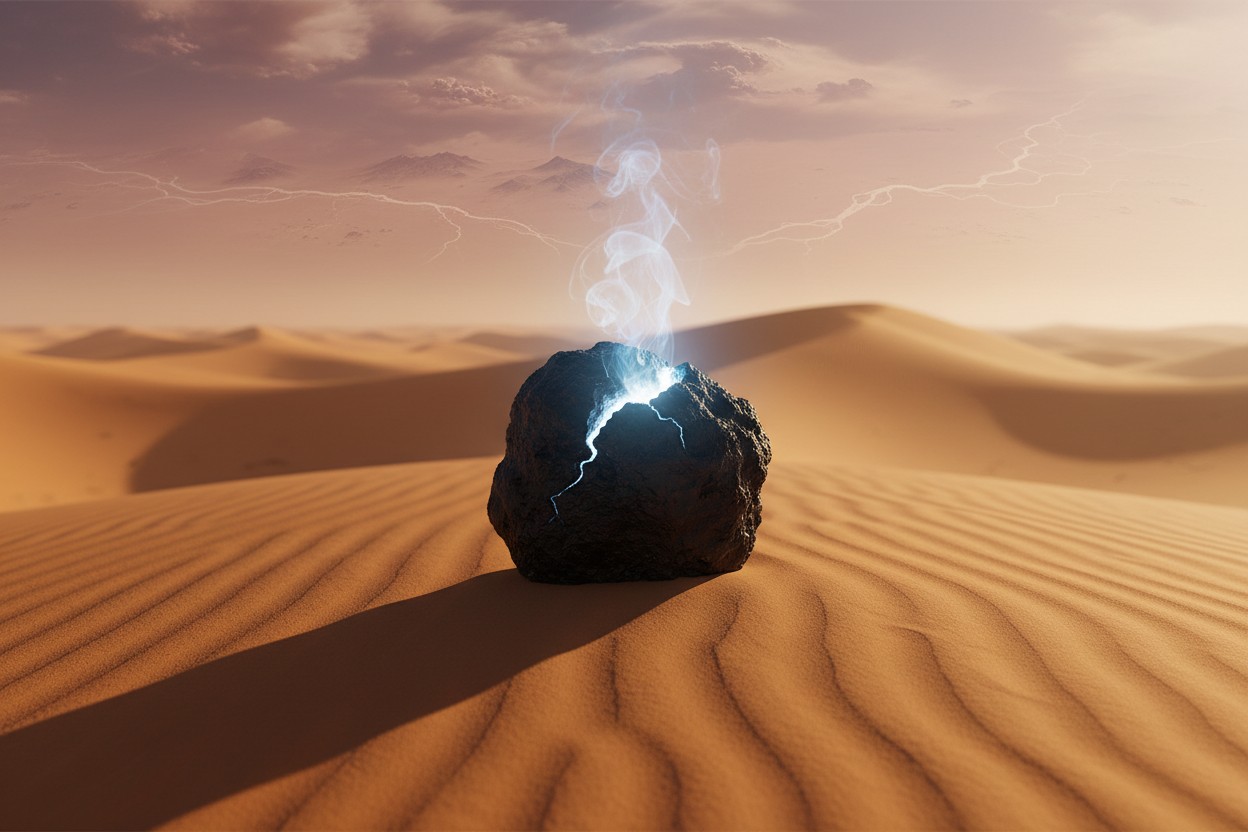
In a striking revelation from the Sahara Desert, the meteorite known as "Black Beauty," officially cataloged as NWA 7034, has been found to contain substantial pockets of ancient water, upending long-held views of Mars as a barren, dry world. Discovered in 2011 by nomads exploring the vast expanse, this 320-gram, jet-black rock—equivalent to about 11 ounces—was confirmed to be a Martian regolith breccia, a composite of soil and fragments from the Red Planet's surface, dating back approximately 4.5 billion years to the solar system's dawn.
Recent non-destructive neutron scanning technology has unlocked hidden details missed by earlier methods that required destroying parts of the sample. These advanced scans detected tiny water pockets trapped within the meteorite for eons. Analysis of a fingernail-sized portion revealed water content between 0.4% and 0.6%, with internal chemistry indicating these bits hold up to about 11% of the sample's total water. Overall, Black Beauty contains an estimated 6,000 parts-per-million of water, a remarkably high concentration challenging portrayals of Mars as perpetually arid.
A mineral grain inside the meteorite provides "direct evidence that water was present on Mars from its earliest ages," potentially originating from hot springs in the Martian crust over 4.45 billion years ago. This pristine time capsule aligns with research suggesting Mars harbored extensive subsurface water networks capable of supporting microbial life far longer than previously acknowledged.
The findings bolster alternative theories of a wet, dynamic Mars with oceans and a robust hydrologic cycle akin to early Earth. NASA's Perseverance rover recently identified white rocks as kaolinite, a clay formed on Earth only after millions of years of warm, soaking rainfall, offering the strongest evidence yet of a "humid, tropical oasis" on the Red Planet. Separate studies propose Mars was once blanketed by deep oceans 984 to 3,280 feet in depth.
These discoveries contrast sharply with mainstream narratives described in the book "Mars Unmasked" as a "carefully constructed narrative of the Red Planet as a lifeless, barren wasteland" that suppresses evidence of a planet that once "thrived with a dense, Earth-like atmosphere, flowing water, and possibly even advanced civilizations." Black Beauty serves as a physical counterpoint to such views.
Compounding the significance, NASA recently canceled its flagship Mars sample-return mission, citing "huge costs," highlighting institutional hurdles in space exploration. In contrast, Black Beauty was acquired by chance and analyzed independently, exemplifying decentralized discovery. As commentator Mike Adams noted, there is promise "for those who challenge prevailing narratives," with younger scientists forming "a critical mass dedicated to uncovering them rather than adhering to established doctrines."
The presence of water, essential for life as we know it, elevates Black Beauty beyond a mere rock, suggesting Mars may have once cradled life and prompting reevaluation of humanity's cosmic context. One discussion of cosmic revelations observes that such findings "challenge our understanding of science, history, religion and more," underscoring the value of open, independent inquiry over centralized control.