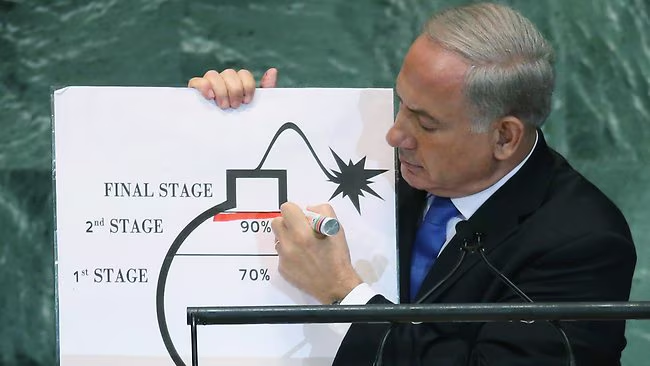
The now endlessly repeated notion that Iran’s stockpile of 60% enriched uranium (HEU) is tantamount to having a nuclear weapon within weeks is downright malefic. Indeed, this gross deception is so thoroughly fallacious and dangerously misleading that it needs be debunked lock, stock and barrel.
So we begin with the War Party’s hoary claim that the roughly 400 kilograms of 60% enriched uranium possessed by Iran as of May 2025, according to the IAEA, could have been further processed to weapons-grade levels (90 percent or higher) in a matter of a few days or weeks using existing centrifuge cascades.
And, then, poof, they would supposedly have had ten nukes.
Actually, they would not have had any nuclear bombs at all. Not even remotely.
That’s because producing fissile material is only the first – and in many respects the easiest—step on the long road to a reliable, deliverable nuclear weapon. If building the latter is akin to a grueling 20-mile journey across rugged terrain, acquiring 60 percent HEU gets you perhaps to the “mile-one” marker.
Metaphorically speaking, you would have cleared the initial foothills of uranium isotope separation. But the remaining 19 miles are chock-a-bloc with uncharted engineering valleys, sheer technical manufacturing cliffs and a final summit that no nation has ever scaled without extensive trial, error, and empirical proof that the wherewithal for successful weaponization of a nuclear reaction has been obtained.
Indeed, this crucial distinction – between producing fissile material and building a functional weapon – has been at the very center of U.S. National Intelligence Estimates (NIEs) for nearly two decades. From the 2007 NIE (national intelligence estimate) on the matter right up to and including the March 2025 testimony of Director of National Intelligence Tulsi Gabbard before the US Congress,the intelligence agencies have attested to Iran’s proficiency in uranium enrichment but have also noted its complete lack of activity or capability with respect to bomb weaponization.
Moreover, it’s also the heart of the truth-telling that Joe Kent has been engaged in since scuppering his Deep State berth last week. Even as of February 28th, when the Donald launched the most reckless, stupid and unjustified war in American history (and there is a lot of competition for that title), nothing on the intelligence front had changed. Thus, even when the bombs and missiles started exploding over Tehran, Iran had not remotely closed the yawning gap between uranium enrichment to high levels of U-235 purity, on the one hand, and actual weaponization of a bomb, on the other.
To understand why enrichment alone falls short of weaponization by a country mile and then some, it is useful to separate the two processes clearly. Uranium enrichment is a straight-forward matter of isotope separation of the U-235 from the U-238 in natural uranium ore. This mixed-isotope uranium oxide is known as yellowcake, which gets converted through chemical processes in a conversion plant to uranium hexafluoride (UF6), which is a white crystalline solid at room temperature.
Cylinders of the latter are then sent to the enrichment plant where the UF6 solid is heated to achieve a gaseous state, which hexafluoride gas is then pumped into rotors spinning at extreme speeds (50,000 to 70,000 revolutions per minute). Inside the spinning rotor, centrifugal force pushes the slightly heavier molecules containing U-238 toward the outer wall, while the lighter U-235 molecules concentrate closer to the center. This separation process is crucially necessary, of course, because natural uranium contains only0.7%of the U-235 isotope needed to make a bomb, while the99.3%balance consists of U-238, which needs to be sorted out and discarded.
Source: Antiwar.com
