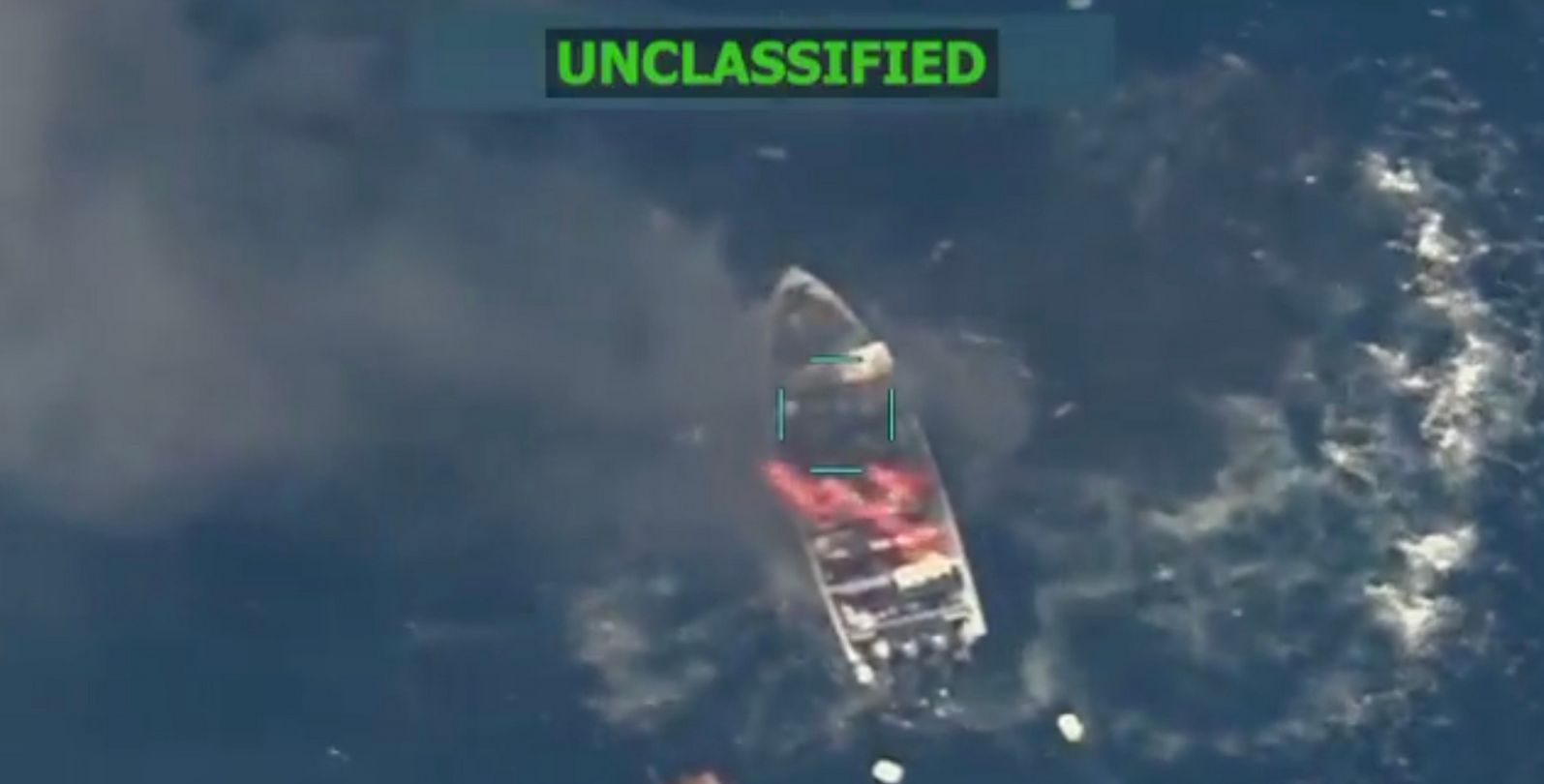
A US military strike on May 4 killed two mariners in an alleged “narco boat” campaign which now has a cumulative death toll of at least 188. The pace of extrajudicial executions is ramping up,accordingtoThe Guardian. But why?
The serial murders could be, as the Trump administration claims, a genuine counter-narcotics operation. Or Mr. Trump and company may be conducting a demonstration exercise of executive power. Alternatively, the “kinetic strikes” may reflect more domestic concerns or perhaps foreign policy issues. Another possibility is that the administration is intentionally cultivating an image of unpredictability associated with “madman theory” of deterrence. We interrogate those explanations.
When small boats were first being blown out of the water off the coast of Venezuela last September, stopping the epidemic of fentanyl deaths waspresentedas a national-security emergency.
This claim was despitefailureof the US Drug Enforcement Administration’s reports from 2017 through 2025 to list Venezuela as a fentanyl producer or trafficker. This was backed by comprehensivestudiesfrom the United Nations. Almost all the fentanylentersthe US from land routes according to the US State Department.
The White House initiallywarnedthat these small outboard motorboats would actually make the 1,370-mile oceanic journey to attack the homeland. Consequently, overwhelming military force was necessitated to deter them. The largest armada ever was deployed in the Caribbean: an aircraft carrier, a nuclear submarine, a number of battleships, stealth bombers, etc.
Later, the War Departmentsignaledthat the naval deployment would be “enduring” regardless of the drug interdiction mission, suggesting that was not thepurposeof “bringing a howitzer to a knife fight” in the first place. Strikes, some two-thirds of them to date, wereextendedto the eastern Pacific.
The US subsequently invaded Venezuela on January 3, kidnapping its president and first lady. On May 1, Trumpthreatenedthat the US Navy may “take on Cuba.” This is without drug interdiction as the central pretense.
The administration did not initially articulate a detailed legal doctrine after the first lethal strike in September. The broad rubric of the president’s responsibility to defend the homeland was proffered as if the US was being attacked rather than the other way around. In this initial stage, the rhetoric echoed the “war on drugs” with only a vague legal rationale.
Earlypollingby the Harris organization surprisingly showed initial public support for the strikes. Democratic Party discomfort centered mainly on procedural issues regarding secrecy and constitutionalwar powersauthority within a largerbipartisan consensusover expanding national-security tools and legitimizing militarized counternarcotics policy.
Soon, the Trump administration’s discourse transitioned to “narco-terrorism.” SOUTHCOMstatementsbegan referring to traffickers as” “Designated Terrorist Organizations” and “unlawful combatants.” This legal maneuver was needed because simple criminal behavior such as drug trafficking cannot legally justify extralegal executions. Increasingly the administration cited cartel violence as something comparable to warfare in order to move beyond criminal law.
Source: Antiwar.com
