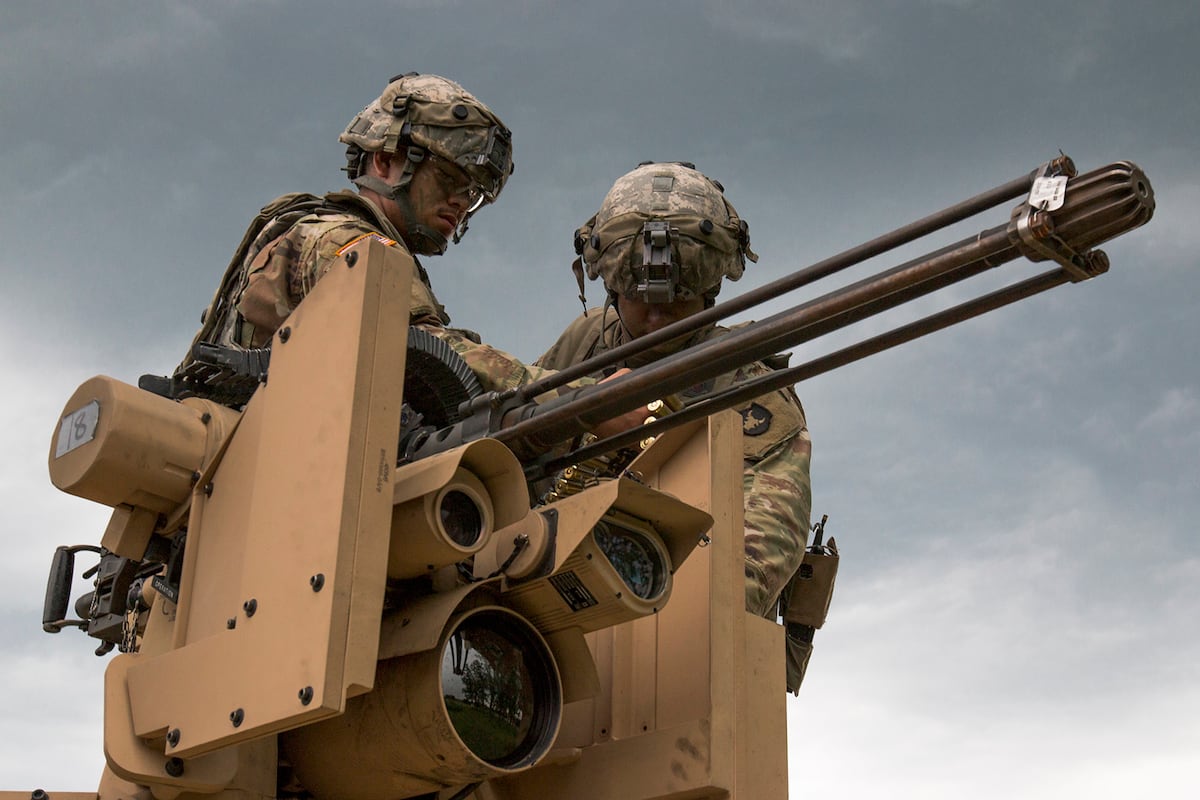
The Department of Defense is looking forAI-enhancedtarget recognition to help troops, vehicles and ships destroydrones.
The C-UAS Close-In Kinetic Defeat Enhancement project focuses on aidedtarget recognition, or AiTR. This uses concepts such as AI, machine learning and computer vision to create a system that candetect threats— and distinguish them from non-threats such as birds — faster than a human operator can.
The first phase of the project is aimed at remote weapons stations, and specifically the ubiquitous Common Remotely Operated Weapon Station, or CROWS, turrets fitted to a variety of military vehicles.
“The primary objective is to accelerate the engagement timeline, initially focusing on Unmanned Aircraft Systems (UAS), with a secondary focus on other threats like vehicular and man-sized targets,” explained the Defense Innovation Unitsolicitation. The deadline is May 15.
Prototypes must “demonstrably improve” the ability of current remote weapons stations to detect, track and engage Groups 1 and 2 — targets with a weight of 55 pounds and under.
Detection should be at ranges greater than 600 meters, and engagement at a minimum of 100 meters. The system should be effective against drones moving at speeds of at least 30 meters per second, or 67 miles per hour, per the solicitation.
The second phase of the project seeks to boost C-UAS capabilities on “both moving and stationary platforms, including ground and maritime environments,” the solicitation said.
Specifications include the ability to hit a Group 1 drone — under 20 pounds — moving at 7 meters per second, or 16 miles per hour, at a range of 50 to 200 meters. Weapons should be able to engage targets while depressed to minus 10 degrees or elevated directly overhead to 90 degrees, the document stated.
This requires contractors to provide a prototype that can “be fired in land and maritime environments,” the solicitation says, “rather than just a laboratory setting at time of pitch.”
Most noteworthy, meanwhile, is the third phase of the project: adding aided target recognition to small arms carried by dismounted troops.
Source: Drudge Report
