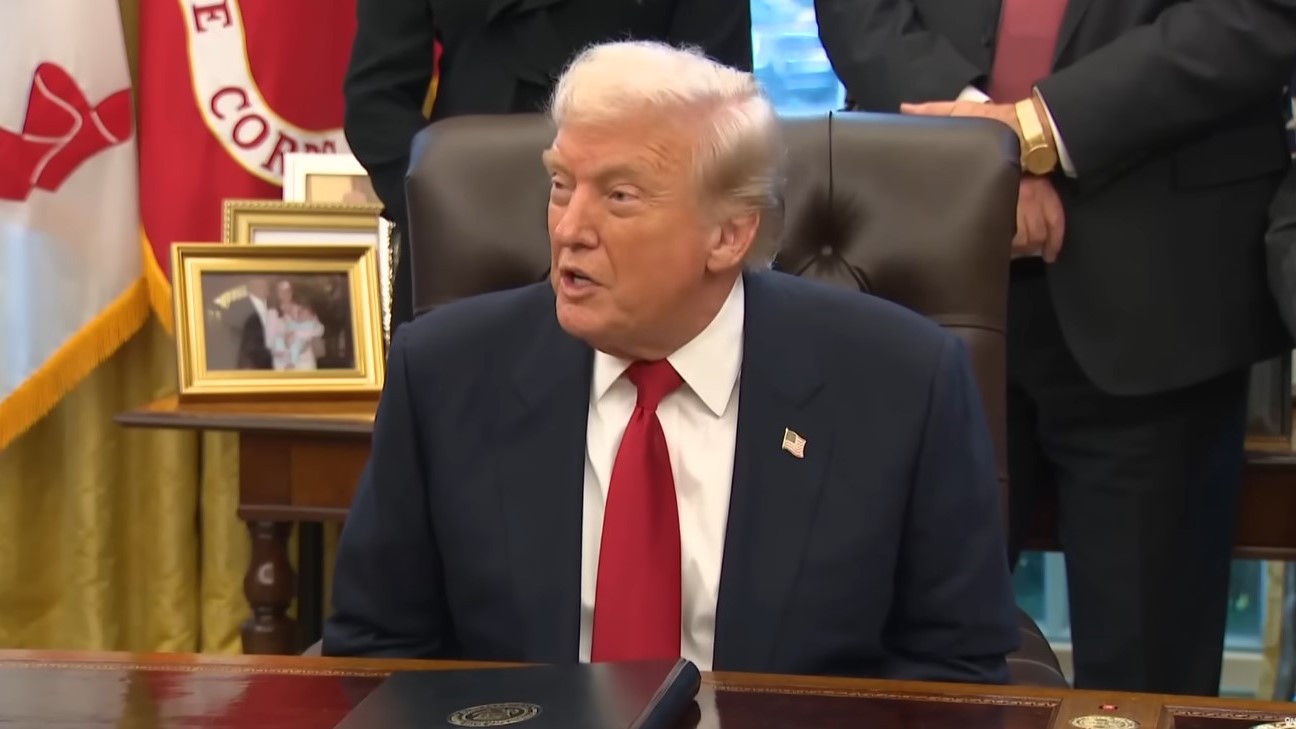
PresidentDonald Trump's pledge to issue $2,000 (£1,500) checks has ignited confusion and anger as no clear plan for how the funds will be financed or distributed has emerged. According to areport, millions of Americans are left questioning the reality of the promised payments, as government officials, analysts, and lawmakers struggle to reconcile the bold claim with legal, fiscal, and bureaucratic hurdles.
The anticipated payments—pitched as a 'tariff dividend' funded by revenue from import taxes—have become a tangled mix of political rhetoric and economic uncertainty. Instead of clarity, citizens find themselves sifting through mixed timelines, contradictory statements, and an absence of formal legislation. Whilst the administration and Trump have repeatedly reaffirmed their commitment to delivering $2,000 (£1,500) checks, experts say that without Congressional approval and a clear distribution blueprint, the promised funds may remain theoretical rather than tangible financial support.
Trump has claimed that the government's increased revenue from tariffs would finance $2,000 (£1,500) checks distributed to most Americans, excluding high-income households. He described this as a way to return 'a dividend of at least $2,000 a person', though specific criteria remain vague.
Anarticlerevealed that, in interviews, the president suggested the checks could arrive 'toward the end of the year' or mid-2026, but media outlets note that thetimelines have varied significantlyand lack concrete backing.
Even the administration's own economic officials acknowledge that without legislative approval, the plan lacks authority. Treasury Secretary Scott Bessent has hinted that legal authority and Congressional involvement might be required, contradicting earlier claims that Trump could proceed unilaterally.
Reporter: What about the $2,000 checks you promised?Trump: I'm looking at it very seriously.Reporter: But you can promise some Americans will get those checks?Trump: Oh yeah, sure. I can do that. I haven't made the commitment yet, but I may make the commitment.pic.twitter.com/DqQmvZ4KUW
At the heart of the controversy is whether tariff revenue alone can fund the promised $2,000 checks. Independent analysts estimate that paying a $2,000 (£1,500) dividend to qualifying Americans could cost between $200 billion (£146 billion) and more than $450 billion (£328 billion), far exceeding the roughly $195 billion (£142 billion) collected in tariffs in 2025.
Economists warn that relying on tariffs could widen the federal deficit, especially as recent tariff policies have already contributed to inflationary pressures. Some experts suggest such stimulus payments could inadvertently stoke further price rises rather than provide sustainable economic support.
The lack of a detailed funding mechanism also opens the proposal up to legal and constitutional challenge. The USSupreme Courtis considering cases that could affect the legality of Trump's tariff policies, meaning future revenue streams might be reduced or rolled back entirely.
Even if funding hurdles are overcome, significant questions remain about who would qualify. Proposals have centred on excluding 'high-income' earners, with media reports citing potential income thresholds around $100,000 (£73,000), but nothing has been formally confirmed.
Source: International Business Times UK
