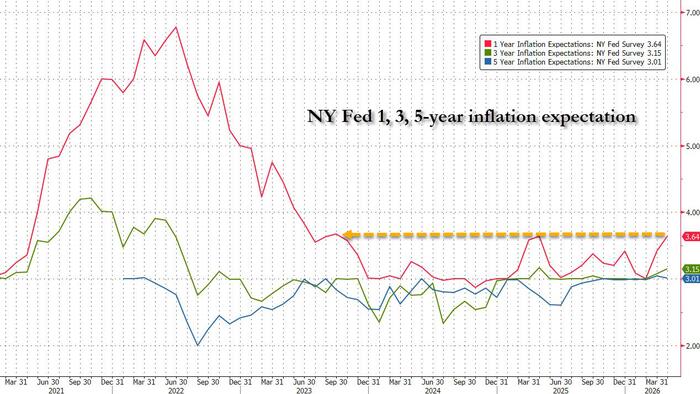
Ahead of tomorrow's jobs report which is expected to show a substantial slowdown from last month's 178K surge, moments ago we got another reminder that the stagflationary iceberg remains front and center ahead of the US, after the NY Fed's latest monthly survey of consumer expectations reported that Inflation expectations at the one-year horizon rose again to 3.64% in April from the previous month’s 3.42%, the highest since September 2023. Inflation expectations were unchanged at 3.15% for the three-year-ahead horizon and also unchanged at 3.01% at the five-year-ahead horizon in April.
The jump in year-ahead expectations took place even though 1 yeargas inflation expectations tumbled sharply in April to 5.11% from 9.42% in April,which had been the highest reading since March 2022.
Other commodity price change expectations also rose, but to a more limited degree: food prices are now expected to rise 5.2%, down from 6%; medical costs to rise 9.6%, also a bit lower than the 9.7% in March; the price of a college education to rise 8.8% (down from 9%); and rent prices should drop from 7.1% to 6.0%.
Turning to the labor market, sentiment has continued to deteriorate fast with respondents saying that the mean probability the US unemployment rate will be higher next year rose another 0.4% (after the 3.6% jump a month ago) to 43.9%; highest reading since April 2025
On the other end, medianone-year-ahead earnings growth expectations rose by 0.3% to 2.7% in March,tied for the highest since April 2025.
More bad news:the mean perceived probability of losing one’s job in the next 12 months increased again, this time by 0.2% to 14.6%,tied with the series’ 12-month trailing average of 14.6%. The mean probability of leaving one’s job voluntarily, or the expected quit rate, in the next 12 months declined by 0.1% to 18.2%.
A silver lining: the mean perceived probability of finding a job if one’s current job was increased modestly by 0.1% to 46.0%, while remaining below its 12-month trailing average of 47.5%. The increase was broad-based across age, education, and income groups.
Perceptions about households’ current financial situations also deteriorated compared to a year ago, with a larger share of households reporting a worse financial situation and a smaller share reporting a better financial situation. Year-ahead expectations about households’ financial situations also worsened,with the share of households expecting a worse financial situation at its highest level since April 2025,and a smaller share of households expecting a better financial situation in one year from now.
Perceptions of credit access compared to a year ago also deteriorated, with a higher share of households reporting it is harder to get credit and a smaller share of households reporting it is easier to get credit. Expectations for future credit availability deteriorated, with the net share of respondents expecting it will be harder to obtain credit in the year ahead increasing.
There was a glimmer of good news when it comes to household debt: the average perceived probability of missing a minimum debt payment over the next three months decreased by 0.9% to 11.4% the lowest reading in more than two years and below the 12-month trailing average of 13.2%.
Source: ZeroHedge News
