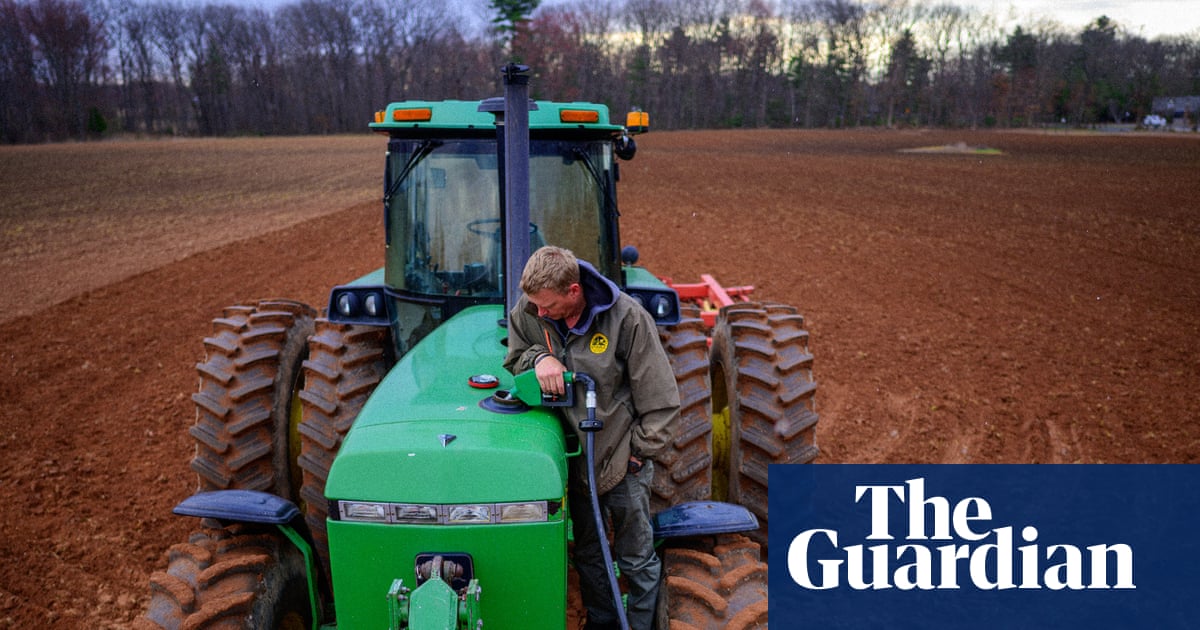
US war with Iran drives diesel fuel prices up during spring planting season, ‘hitting us at the wrong time’, farmers say
It has been a tough few years for American farmers.
Squeezedlast year by tariffs, they lost an estimated$34.6bnwhen former trade partners stopped buying. Now, the war with Iran has not only depleted crucial fertilizer stores but has also driven diesel fuel up torecord prices. Like the trucking industry, agriculture relies heavily on diesel to run machinery, as diesel-powered engines aremore fuel efficientthan gasoline-powered ones.
Worst of all, the price increase is taking place during the spring planting season.
“These rising costs are hitting us at the wrong time here in the north country in New York,” said Blake Gendebien, who owns a 1,200-acre dairy farm with 500 cows in Lisbon, New York. “I use 20,000 gallons of fuel to get my crops in the ground and harvested.”
Last April, he paid about $2.65 a gallon for off-road diesel. Off-road diesel is for vehicles used off public roads and is therefore exempt from federal and state excise taxes. Depending on the state, it can be anywhere $0.20 to $0.80 cheaper a gallon than on-road diesel.
This year, it’s pushing $5 a gallon. According to themost recent statistics, 86% of farmers in America run small family farms, defined as having a gross income of $350,000 per year or less. And the majority of those farms have high-risk profit margins of 10% or less. So rising diesel costs pose a serious threat to their ability to stay inbusiness.
“It’s a massive cost for farmers that are already barely, barely getting by,” Gendebien said.
When Sam Frost recently purchased diesel for the family farm in the Fountain Creek Valley south of Colorado Springs, he didn’t look hard at the price. “I’m still gonna go buy fuel regardless,” he said.
A fourth-generation farmer, Frost is CEO of Frost Livestock Company and focuses on its hay production, which makes about $200,000 in gross income. His brother, Will, is in charge of their organic meat and vegetable production, which they sell locally through CSA boxes and farmers markets. That part of the operation grosses about $100,000 a year
Source: Drudge Report
