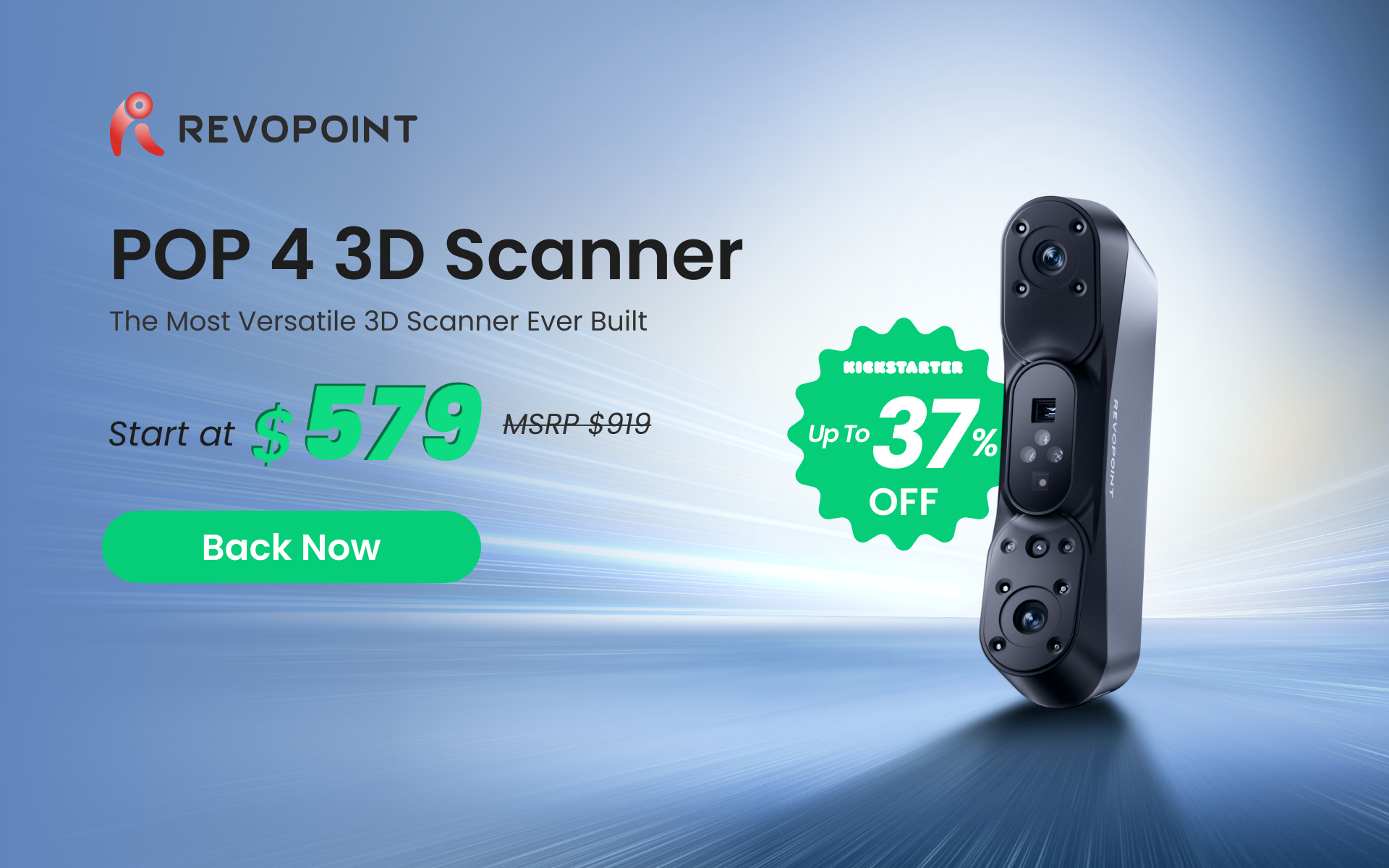
Home-The New All Rounder Revopoint POP 4 3D Scanner Now on Kickstarter: Technical Specifications and Pricing
A product designer has a discontinued component on her desk, something a client needs replicated exactly. The geometry is all there in the physical part. What’s missing is a reliable way to turn it into a file, because the scanners she’s tried before either wash out on the polished metal finish or lose tracking on the featureless curved surfaces.
That frustration sits at the center of whatRevopointis addressing with thePOP 4 3D scanner, which is launching on Kickstarter today. The pitch is straightforward: one scanner that works on shiny metal, dark surfaces, and everything in between.
Precision Scanning for Complex, Shiny Surfaces
The reason affordable handheld scanners have struggled with that kind of part is largely a light-source problem. Infrared structured light, which most consumer-grade scanners use, reflects off shiny metal in ways that confuse the sensor and goes largely invisible on dark surfaces. Blue laser handles those materials better. But blue laser has its own limitations on textured organic surfaces, on hair, on skin.
ThePOP 4solves both. It does this through five scanning modes. Two use near-infrared structured light: one for detailed capture of general objects, one optimized for speed. A third is powered by coordinated dual projectors for fast, high-quality surface capture.
The remaining two are blue laser: a 30-crossed-line mode for high-reflectivity and dark materials, and a single-line mode for narrow grooves and deep holes. Users switch based on what’s in front of them, not because the scanner forces the choice.
ThePOP 4 3D scannerachieves a fused point distance of 0.05 mm, with an industrial-grade volumetric accuracy down to 0.03 mm plus 0.05 mm/m specifically in the laser modes, and a frame rate of 105 fps in multi-line laser mode. Working distance runs from 200 to 800 mm.
Worth noting separately is the outdoor capability. ThePOP 4is rated for up to 100,000 lux, roughly direct sunlight. Most structured light scanners are effectively indoor instruments because ambient light competes with the projected pattern. That ceiling opens up archaeological sites, and on-site industrial work that previously required considerably more expensive equipment.
On the software side, two additions move the needle beyond incremental. Real-time AI object segmentation lets you define your target before scanning, so the scanner captures the object and ignores the surroundings. Anyone who has spent twenty minutes deleting a table from a scan knows exactly what this is worth.
Source: 3D Printing Industry
