A widening gap is emerging in global birth rates.
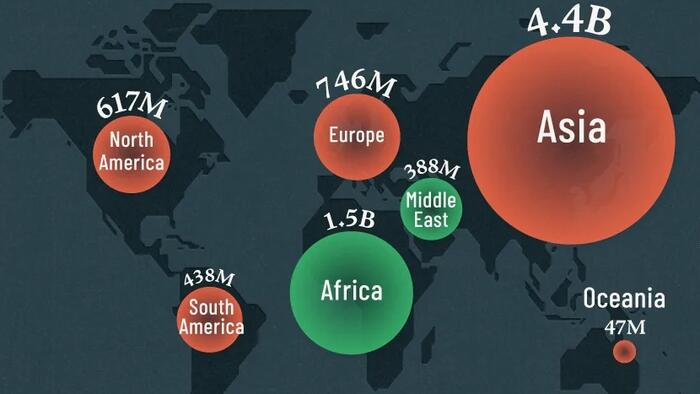
This chart,via Visual Capitalist's Niccolo Conte,shows population-weighted total fertility rates (TFR) across major world regions, based on data from theUN World Population Prospects 2024 Revision, and how they compare to the 2.1 replacement level.
While Africa remains far above this threshold, most of the world, including Asia, Europe, and the Americas, has already fallen below it.
This split highlights where future population growth is likely to be concentrated.
Africa’s fertility rate of 4.0 children per woman is the highest of any region. It is nearly double the global average of 2.2 and close to three times Europe’s rate of 1.4.
With a rapidly growing population base, Africa is expected to drive a significant share of global population growth in the coming decades.
Higher fertility rates are often linked to younger populations, lower urbanization, and differences in access to education and healthcare.
Many parts of the world now have fertility rates below the replacement level of 2.1. Asia,North America, and South America each sit at 1.7, while Europe trails at 1.4.
These levels point to aging populations, slower natural population growth, and potential workforce pressures over time. In many countries, immigration and family-support policies are becoming more important parts of the demographic outlook.
Asia accounts for 54% of the global population, meaning its relatively low fertility rate has an outsized influence on the global average.
Source: ZeroHedge News
