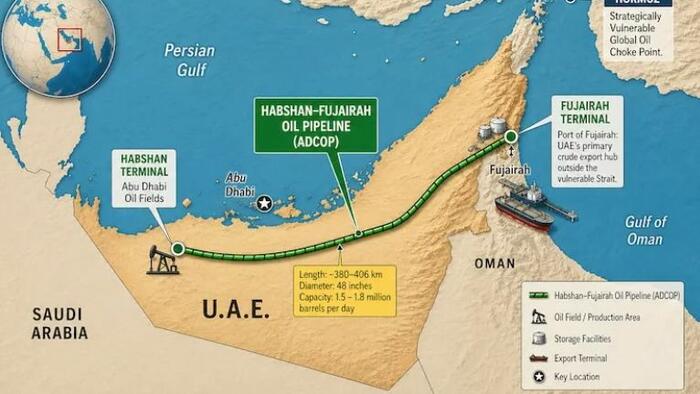
Long after the Iran war is just a bookmark in the history books, one distinct consequence will persist: much of the world, at least the part that does not fall under the Chinese sphere of influence, will do everything it can to avoid the Strait of Hormuz and failing that, have a Plan B. Just like when the Biden admin weaponized the US Dollar in 2022 by booting Russia from SWIFT after the Ukraine war, and in the process started the biggest gold and bitcoin rally in history as the rest of the world parked its savings in non-USD assets, so the world's most important oil choke point willnever againbe viewed again in the same way after Iran launched dozens of rockets at the ships transiting it.
This shift in perception is what James Thorne, chief market strategist of WellingtonAltus, called "Iran’s Historic Mistake"; he explains it as follows:
By weaponizing the Strait of Hormuz, Iran committed a strategic blunder of historic proportions. Tehran meant to punish America.Instead, it exposed every power built on imported energy, vulnerable sea lanes, and the delusion that globalization repealed geography.China is exposed. Europe is exposed. Britain is exposed. Iran has created a world where hard resource power decides outcomes.
Iran’s mistake is that once Hormuz becomes structurally unreliable, the world builds around it. That means bypass corridors, revived pipeline politics, and urgent planning for routes linking Aqaba to Mediterranean outlets near Gaza and the long-stalled Basra-to-Aqaba pipeline. The old energy order is cracking.The UAE’s OPEC exit signals cartel discipline giving way to national advantage under pressure.
The full note can befound here, and we didn't have long to wait to see the world it predicted begin to emerge.
Earlier today,Nikkei Asia reportedthat Japan agreed to buy anadditional 20 million barrels of crude oil from the United Arab Emirates as Tokyo continues pursuing alternative supply channels amid the effective blockade of the Strait of Hormuz.Japan used 2.36 million barrels of crude oil per day in 2025, the economy ministry reports. Based on this average, the additional 20 million barrels from the UAE could cover eight to nine days' worth of demand, so much more is coming.
The deal was finalized Tuesday after Ryosei Akazawa, Japan's minister of economy, trade and industry, met with the Emirati industry minister in Abu Dhabi. Akazawa told reporters after the meeting that he had requested increased oil supplies for Japan.
Roughly 40% of Japan's crude oil imports comes from the UAE. The Middle Eastern country, which left the Organization of the Petroleum Exporting Countries on Friday, intends to gradually increase oil production at its own discretion, which could lead to more cooperation with Japan.
Japan willpick up the Emirati oil at the port of Fujairah on the UAE's eastern coast,which lies on the Gulf of Oman,allowing for crude exports without going through the Strait of Hormuz.
The war in the Middle East -- a region on which Japan has relied for more than 90% of its oil supply -- has spurred Tokyo to approach other oil producers. It reached a deal last month to procure 1 million barrels of crude from Mexico.
Source: ZeroHedge News