Freddie Ponton21st Century Wire
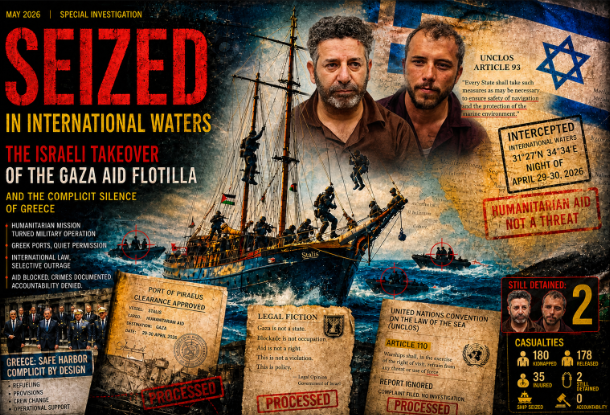
On the night of April 29 to 30, Israeli forces intercepted theGlobal Sumud flotillain international waters west of Crete, seizing a civilian aid convoy hundreds of miles from Gaza and funnelling 176 activists into a tightly managed transfer operation on Greek soil, where 31 wounded required first aid.
But the episode did not end in Crete. While most passengers were offloaded into Greek custody and dispersal, two organizers,Saif Abukeshek,a Spanish-Swedish activist of Palestinian origin andThiago Ávila,a Brazilian activist, were abducted and forcibly transferred to Israel against their will, brought before the Ashkelon Magistrates’ Court, and held in Shikma Prison in Ashkelon, where lawyers say their detention was extended and abuse allegations emerged.
IMAGE:Global Sumud Flotilla boats docked in a Greek port on May 28, 2026 (Source: Baris Seckin/Anadolu via Getty Images)
What began as a challenge to the siege of Gaza quickly became something larger—a test of whether Israel can project force deep into the Mediterranean under the cover of blockade law, and whether Greece can stand inside its own search-and-rescue (SAR) zone, refuse the burdens of protection, process the wounded onshore, and then watch as two captives vanish into the Israeli prison system. Greece’s inaction in its SAR area of responsibility has therefore raised serious questions about whether Athens merely stood aside or deliberately narrowed its obligations while Israel turned a violent high-seas seizure into an administrative handover
VIDEO:The Israeli Navy’s kidnapping of international activists and interception of the “Freedom Flotilla” during a humanitarian mission toGaza(Source: Euromed Human Rights Monitor)
.From the High Seas to Crete: How Israel’s Seizure of the Global Sumud Flotilla Became a Greek Accountability Crisis
To understand what happened off Crete, it is not enough to ask how Israel justified the raid. The deeper question is how a violent capture at sea was sanitized through legal euphemism and then recast ashore as administration.
Israel wants this episode buried under the antiseptic language of “interdiction,” as if commandos storming civilian boats in international waters were carrying out a routine act of maritime administration rather than the violent seizure of unarmed activists. But that language is not merely misleading. It is designed to sanitize brutality, to erase the image of armed men descending on civilian vessels and replace it with procedure, paperwork, and the fiction that brutal violence becomes lawful once a state recites the right maritime formula.
Israel’s legal defence rests on five contested pillars. Remove any one of them, and the whole structure gives way: the legality of the blockade, its proportionality, the right to stop humanitarian vessels despite civilian need, the claim that occupation does not preclude blockade, and the idea that blockade law overrides the ordinary protections of the high seas.
Source: 21st Century Wire
