How does economic growth emerge? Let us turn to Ludwig von Mises, one of the defining economists of the 20th century – and paraphrase his idea: growth arises where private capital is guided in a free market by an undistorted price system. Prices signal scarcity and direct scarce resources to where they generate real value. When this system is distorted by ideological intervention, capital is misallocated – potential growth simply evaporates.
That is the theory. And there is no doubt that the reality of emerging economies has repeatedly confirmed the teachings of the Austrian School. Take Argentina, for example: the economic policy shift under President Javier Milei is leading to a rollback of the state and new private investment impulses. That is how it should be: the state as a rule-setting referee, not a player in the economy.
This thesis meets maximum resistance in German editorial offices. There prevails a staunchly statist spirit, a vulgar Hegelianism that regularly loses itself in the labyrinth of economic causality. As a reminder: Milei is the libertarian whom Chancellor Friedrich Merz and German media denounced as a far-right eccentric, accusing him of trampling on his own people. As said: ideologically blinded, intellectually shallow.
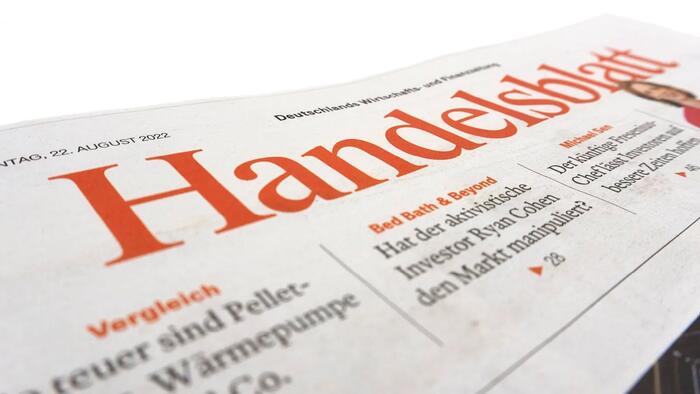
On Thursday,Handelsblattpresented its readers with the result of the marriage between green-statist ideology and editorial missionary zeal.In its morning briefing, the author made clear how she interprets the world: at the top, the all-knowing state; far below, the misguided, dependent individual. The piece appeared under the title “When Father State must save German growth” and stands as a case study of the spirit dominating German media. The individual counts for nothing, the state for everything. A hint of Orwell runs through these lines. They are meant to remind us that our economic fate now lies in the hands of an all-knowing federal government. Listening closely, one can still hear the fading odes of the press to former vice chancellor and manager of green chaos Robert Habeck.
Many people find it helpful to embed their existence into the prevailing ideology, thereby relieving themselves of existential responsibility. When this happens on a mass scale, a state within the state emerges – what we call the welfare state. Yet this attitude carries a problem: in journalism it obscures the search for the causes of the current crisis. Editorial work blurs the overregulation of our economy, the destruction of nuclear energy, and clientelist climate policy – together forming the broad delta of deindustrialization.
We are facing a media-historical phenomenon.Magazines such asmanager magazin, Handelsblatt, WirtschaftsWoche,and even once-bourgeois papers likeFAZnow only vaguely suggest through their names that they were once committed to economic analysis. Condensing tone, imagery, and reporting style, one can hardly escape the impression of a media phalanx of the Green Deal.
The shift in perspective has succeeded. Economic rationality has been replaced by an iron belief in the net-zero cult. For the socialists in editorial offices, a fortunate development – since it is tied to the expansion of a vast state apparatus, conveniently justifying long-term funding of their own activities within the framework of so-called democracy promotion. The state orders – the media deliver: all from a single mold, always in the tone of climate apocalypse.
Manager Magazinconfirmed this week the suspicion that even business-oriented outlets operate as a media arm of the green extraction economy. Economics Minister Katherina Reiche, after her cautious criticism of the green subsidy cult, is already depicted on the cover as an oil-soaked fossil-era lobbyist. The rest: a cheer for the energy transition.
The media climax of kneeling before Father State came last year with the presentation of the so-called Draghi Plan. Former Italian prime minister and ECB president Mario Draghi outlined a program intended to lift the eurozone out of stagnation through massive state investment. The plan envisioned around €800 billion annually. Over at least five years, roughly five percent of European GDP would be politically directed. Draghi describes nothing less than a future EU in which economic dynamism is increasingly eroded by state control.
Those who followed media coverage of Draghi’s megalomania rarely encountered dissent. After decades of successful indoctrination – beginning in schools and continuing through universities and media transformed into socialist re-education matrices – this is hardly surprising. Brussels has now largely integrated the plan into the new seven-year budget. Between 2028 and 2034, around €2 trillion will pass through the hands of the Brussels bureaucracy – a remarkable joint success of political elites and their compliant media narrators.
Source: ZeroHedge News
